


Dynamic Mechanical Analysis Laboratory Guide: Uses, Results, and Benefits
Material performance issues rarely start in production, but that is often where they are discovered. A packaging film that looked stable in early testing may warp during temperature cycling, or a capsule coating that passed initial quality checks may become brittle during low-temperature transit. These failures are expensive and disruptive, and they are often avoidable.


What’s needed is dynamic mechanical analysis (DMA), a materials characterization method that measures how a material responds to oscillating stress or strain across changing temperature, time, or frequency. The global material testing market is slated to grow from $908.5 million in 2026 to $1.07 billion by 2030, highlighting the demand for testing that enhances material predictability and performance. When connected to a materials informatics platform, DMA data supports better formulation decisions and more efficient R&D workflows.
Here's a detailed guide to dynamic mechanical analysis and its uses, results, and benefits in the laboratory.
What is dynamic mechanical analysis (DMA)?
Dynamic Mechanical Analysis (DMA) is a laboratory technique used to characterize the viscoelastic properties of materials. The process applies a small, oscillating force to a sample and measures its mechanical response.
The method is especially useful for materials that behave partly like elastic solids and partly like viscous fluids. These include polymers, elastomers, composites, gels, adhesives, films, coatings, and packaging materials. Instead of measuring only one static property, DMA shows how a material stores and dissipates energy under changing conditions, making it useful for evaluating the mechanical properties of solids.
In practice, DMA helps materials scientists, QA/QC engineers, and R&D teams evaluate stiffness, damping behavior, transition temperatures, and mechanical stability. These measurements are useful for comparing formulations, validating performance, investigating failures, and supporting product development decisions.
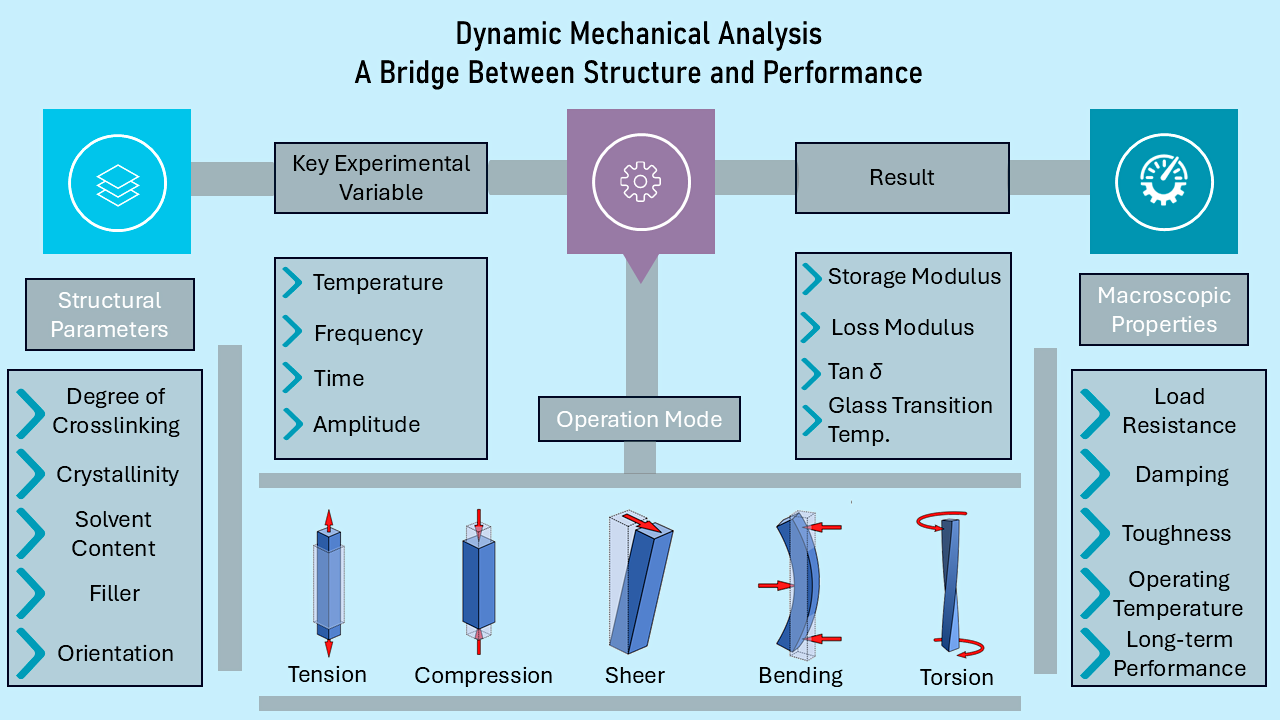
How Dynamic Mechanical Analysis Works
A DMA test follows a controlled sequence and involves using a dynamic mechanical analyzer to measure how a material responds when it is exposed to controlled, repeated mechanical loading.
1. Prepare the sample
The sample is cut or formed to the dimensions required for the selected DMA method. Films, fibers, gels, foams, adhesives, and rigid solids may require different geometries, dimensions, or conditioning steps.
2. Select the test mode and fixture
A test mode is selected that defines how the sample is deformed. The proper fixture for the sample is selected to keep it in position inside the DMA analyzer when the selected deformation is applied.
3. Load the sample into the DMA analyzer
The prepared sample is secured in the fixture according to the test method. Proper alignment is important because slippage or uneven loading can distort results.
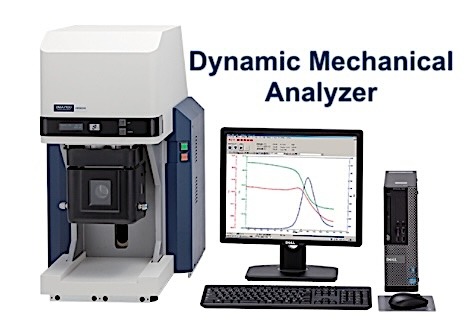
4. Apply oscillating stress or strain
The DMA analyzer applies a small, controlled, repeating mechanical input. Depending on the method and instrument settings, the test may be stress-controlled or strain-controlled.
5. Measure the material's response
The analyzer records how the sample responds to the applied input. Elastic behavior responds almost immediately to the applied input, while viscous behavior responds with a delay. DMA uses this timing difference to evaluate viscoelastic behavior.
6. Run the selected test program
The test may be run across a temperature range, at different frequencies, or under different strain amplitudes. These programs can reveal transitions, rate-dependent behavior, and the linear viscoelastic region.
7. Calculate DMA outputs
The phase difference between the applied input and the sample response is used to calculate key outputs that describe how the material stores and dissipates energy. These measurements show how the material stores energy, dissipates energy, and changes under test conditions.
4 Key Components That Control DMA Test Accuracy
DMA results are only as reliable as the decisions made before and during the test. The following four factors have the greatest influence on data quality:
1. Sample Preparation
Accurate results start with properly prepared samples. Common sample forms include rectangular bars, thin films, discs, and cylinders. Surface finish should be smooth, and dimensions must be precise to ensure even stress distribution. Pre-conditioning methods like exposing the sample to specific humidity or temperature can help simulate real-world environments and reduce variability.
2. Test Modes
The test mode defines how the sample is deformed, and selecting the right one for the material is critical:
- Tension: Ideal for films, fibers, and tapes. Simulates stretching forces.
- Compression: Used for foams and gels to assess behavior under crushing or pressing.
- Bending: Suited for rigid samples like composite bars or laminates.
- Shear: Used for adhesives or layered structures to test resistance to sliding forces.

3. Test Variables
The controlled variables determine what the test can detect and how relevant the results are to real-world conditions:
- Temperature Sweep: Evaluates material behavior across a defined temperature range to identify transitions, such as the glass transition temperature (Tg), and assess thermal stability.
- Frequency Sweep: Measures how stiffness and damping shift under slow to fast loading conditions.
- Strain Amplitude Sweep: Determines the linear viscoelastic range and identifies when material behavior becomes nonlinear.
4. Test Setup and Control
High-quality DMA results depend on a precise test configuration. Improper setup can distort the mechanical response, invalidate transitions like Tg, or produce data that is unusable in modeling and compliance workflows.
Key elements include:
- Fixture alignment: Ensure the right fixture is used for the material and test mode, with proper centering, no slippage, and uniform grip pressure. Even minor misalignment can skew modulus measurements.
- Instrument calibration: Maintain regular calibration for force, temperature, and displacement sensors using traceable standards. Include system checks before each test to detect sensor drift or load cell issues.
- Environmental control: Set appropriate temperature ramp rates, allow for thermal stabilization, and use controlled atmospheres (e.g., nitrogen) for oxidation-sensitive materials. If moisture affects the material, lab humidity should also be monitored.
- Sample handling: Prepare samples to consistent dimensions, with smooth surface finishes and flat ends. Apply pre-conditioning when needed to replicate storage or operating conditions accurately.
- Documentation and repeatability: Log all test parameters in a consistent format. Use standardized test scripts and templates for multi-batch comparison or regulatory traceability.
Reliable configuration ensures that DMA results can be used with confidence. Whether you're comparing batches or preparing validated data for use in a compliant AI or digital system, maintaining a consistent test setup makes those results actionable across the R&D process.
What Dynamic Mechanical Analysis Measures
Dynamic mechanical analysis produces several outputs that help explain how a material behaves under changing mechanical and thermal conditions:
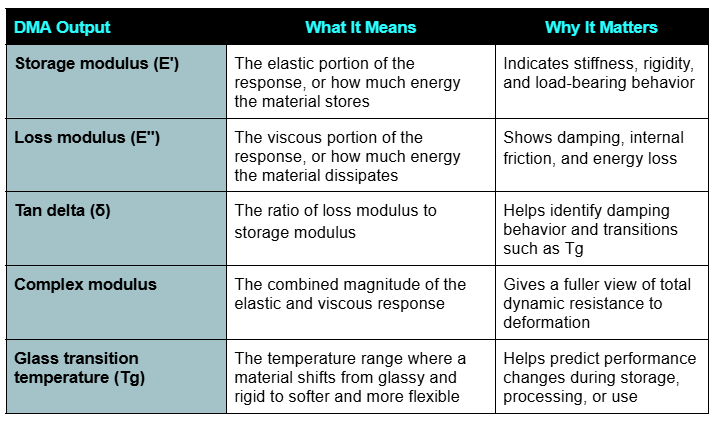
These values are usually plotted as curves against temperature, frequency, time, or strain.
How to Interpret Results from Dynamic Mechanical Analysis
Interpreting those curves helps teams understand not only whether a material passes a test, but how and why its behavior changes. Here are the common curve patterns and what they may suggest:
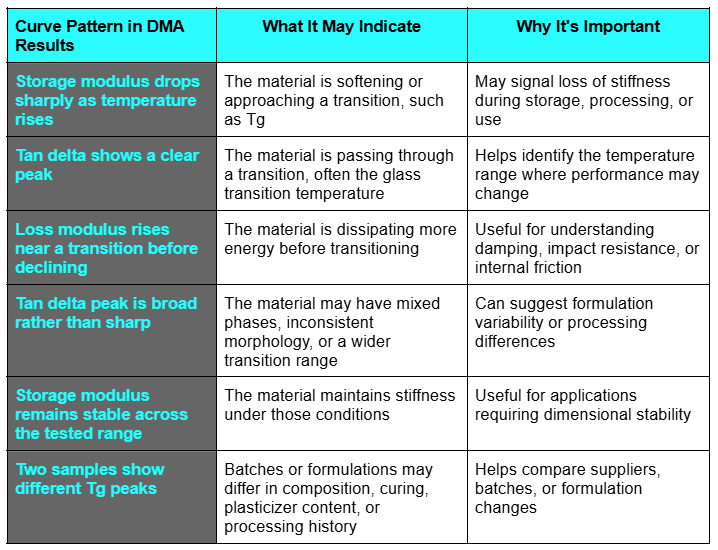
Here's an example of how this works in the lab: Imagine a pharmaceutical company is testing two polymer capsule coatings under cold-chain conditions.
- Batch 1 shows a sharp change in storage modulus and a pronounced tan delta peak within the tested low-temperature range, suggesting a transition that could affect brittleness or mechanical integrity.
- Batch 2 remains stable across the same range.
With this insight, the better-performing batch can be advanced while the riskier option is investigated or rejected.

Why Dynamic Mechanical Analysis Matters in R&D
Dynamic mechanical analysis is essential for effective R&D because it helps teams make better decisions before materials reach production. It’s critical during formulation and product development, when teams are still comparing options and refining material choices. DMA can reveal differences in mechanical behavior that may not appear in static testing, giving researchers more confidence in which materials should move forward.
For R&D teams, the value of DMA is not just the test result itself. It is the ability to turn mechanical behavior into usable evidence for development decisions. When those results are connected in a platform like MaterialsZone with related formulation, process, and quality data, teams can build a stronger knowledge base for future materials development.
Benefits of Dynamic Mechanical Analysis
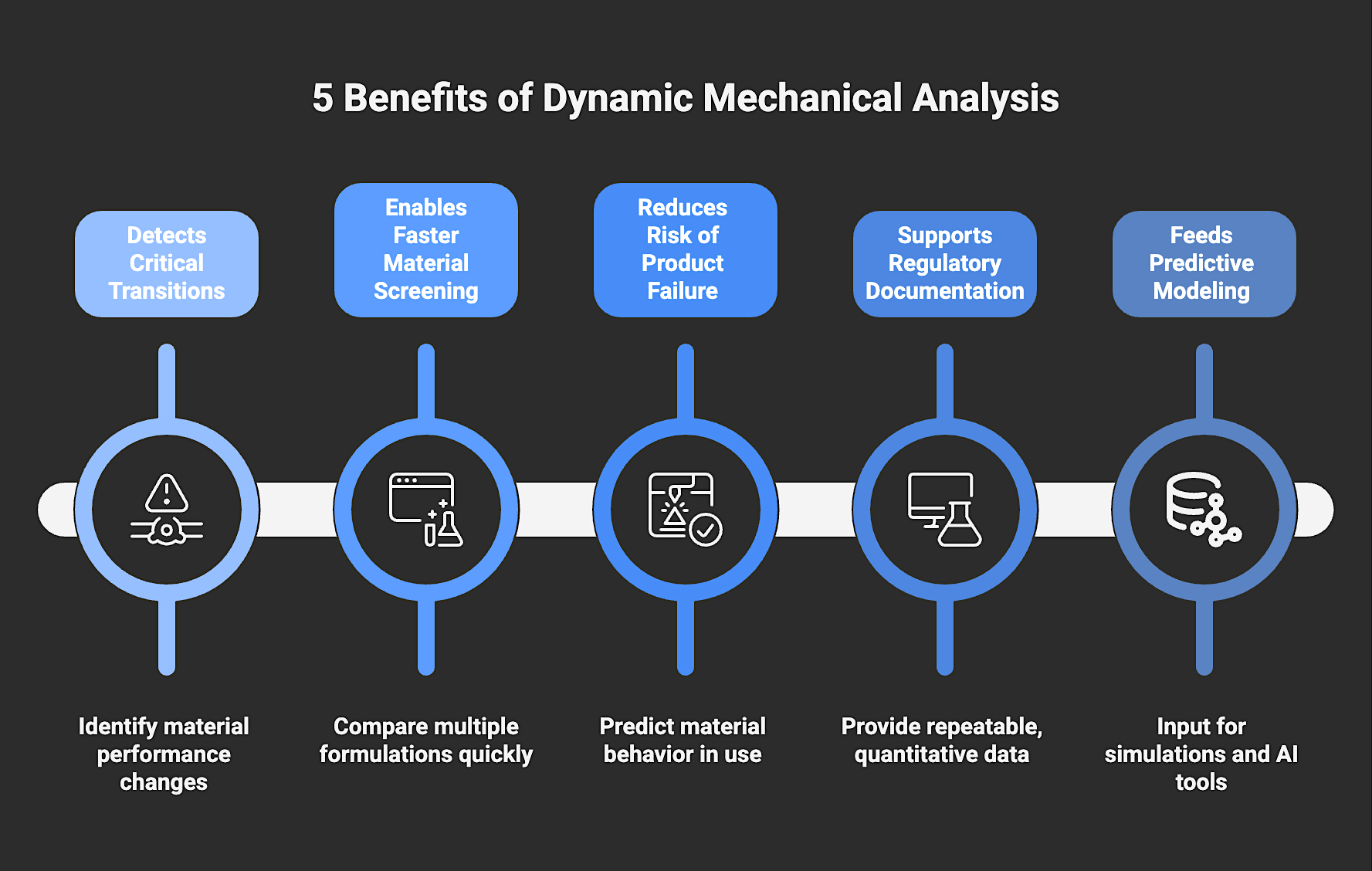
1. Detects Critical Transitions
DMA can identify transitions that static mechanical tests may miss, which is important in applications such as pharmaceutical packaging, cold-chain materials, coatings, films, and elastomers. A material that performs well at one temperature may soften or become brittle at another. DMA helps teams identify those transition points before they create performance problems.
2. Enables Faster Material Screening
R&D teams often need to compare multiple formulations, suppliers, or processing conditions. DMA helps screen those options by showing how each material behaves across relevant conditions. This data supports faster formulation decisions and can reduce the risk of delays during new product introduction.
3. Reduces Risk of Product Failure
Material failure often happens when the use environment is more demanding than the test environment. DMA helps reduce that risk by showing how materials respond to temperature, stress, frequency, and time so that teams can identify potential product or compliance risks before scale-up or release.
4. Supports Regulatory Documentation
DMA produces repeatable, quantitative data that can support quality investigations and audit readiness. It's critical for regulated or quality-sensitive industries where teams need to document why a material was selected and how its performance was verified. Standardized DMA methods make results easier to trust and compare. In a connected system, teams can turn those results into reusable knowledge for future R&D decisions.
5. Feeds Predictive Modeling
DMA data can be used as an input for simulations, predictive models, and AI-driven formulation tools. Because the method generates structured mechanical property data, it is well-suited for materials informatics workflows that support prediction, formulation decisions, and cross-project knowledge building.
Common Applications of Dynamic Mechanical Analysis
Here are some of the most common use cases for dynamic mechanical analysis and how it enhances those processes:
- Adhesives and Sealants – Measures viscoelastic response under shear or other controlled deformation modes.
- Composite Materials – Evaluates changes in stiffness and damping behavior under controlled temperature or frequency conditions.
- Failure Analysis – Helps determine whether a material shows a change in mechanical behavior near a transition temperature or under the tested conditions.
- Food and Beverage Packaging – Evaluates the temperature-dependent mechanical behavior of polymer films used in packaging applications.
- Pharmaceutical Packaging – Assesses mechanical behavior in coatings, films, or polymer packaging materials under defined test conditions.
- Polymer Formulation – Compares candidate formulations using measured properties such as tan delta, storage modulus, loss modulus, and Tg.
- QA/QC and Batch Comparison – Compares the DMA response of a tested batch against a reference sample or approved specification.
Dynamic Mechanical Analysis vs. DSC, TGA, and Rheology
Dynamic mechanical analysis is often used alongside other characterization methods that each provide a different view of material behavior:

DMA is most useful when the question is mechanical: How stiff is the material? How much energy does it dissipate? When does it transition from rigid to flexible? How does it behave under repeated loading? DSC and TGA are valuable for thermal characterization, while Rheology is helpful for flow and deformation behavior.
There is some overlap between DMA and Rheology, especially for oscillatory shear measurements. In practice, DMA is often used for solid or semi-solid mechanical characterization, while Rheology is commonly used for liquids, gels, melts, and flow-related behavior.
Together, these methods help labs build a more complete material profile.
Limitations and Common Sources of Error in Dynamic Mechanical Analysis
Even with a well-configured test, results can be difficult to compare or interpret if certain variables aren't controlled consistently. Common sources of error that make results difficult to compare include:
- Fixture or geometry mismatch, leading to invalid modulus values
- Sample slippage that distorts the measured response
- Inconsistent temperature ramp rates that shift apparent transition points
- Uncontrolled moisture or environmental exposure that alters material behavior
- Testing outside the linear viscoelastic region
- Comparing results from different instruments without harmonized methods
- Interpreting Tg from one curve without considering the full material context
DMA does not answer every material question on its own. It should be combined with complementary methods that are suited to the material, product requirements, or other factors being investigated.
Integrating DMA Into a Connected Materials Strategy
Dynamic mechanical analysis offers critical mechanical insight, but its value increases when it is integrated with the rest of the materials characterization workflow. In many labs, DMA data sits in instrument software, spreadsheets, PDFs, or isolated project folders. Fragmented data slows formulation decisions and increases the risk of errors. It also makes it difficult to compare results across projects or over time, creating barriers to effective data governance.
A connected materials strategy enables teams to centralize mechanical testing data alongside formulation data, processing parameters, supplier information, quality results, and other characterization outputs.
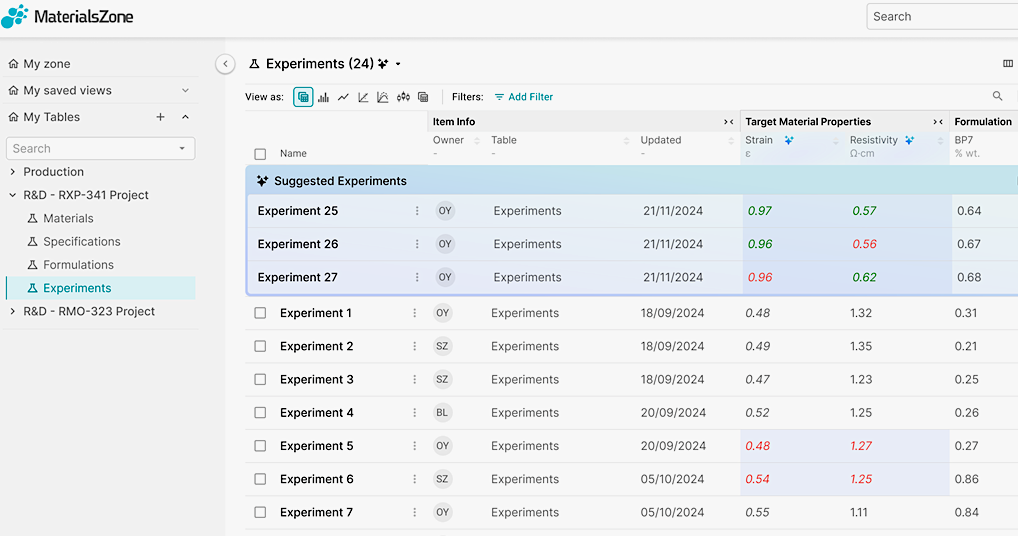
MaterialsZone helps labs bring this data into a unified materials informatics environment that allows teams to:
- Capture and standardize DMA and related test results
- Visualize mechanical trends across materials, batches, and projects
- Compare formulations and supplier data in context
- Correlate mechanical behavior with process variables
- Use AI-assisted tools to support prediction and formulation decisions
- Generate consistent, audit-ready documentation
Centralizing mechanical testing data and connecting it to digital workflows allows teams to move faster while maintaining data integrity and reducing routine overhead. In high-pressure R&D environments, this approach helps labs keep pace without compromising quality. Integrated DMA data can be applied in new contexts, such as compliance efforts or to guide product design changes as materials evolve.
Transform DMA Results Into R&D Action
Dynamic mechanical analysis gives labs a clearer view of how materials behave under real-world stress, strain, temperature, and time. For materials-based industries, the real value comes from using that data consistently. When results are centralized and connected to formulation, process, supplier, and quality data, DMA becomes part of a smarter R&D decision system.
MaterialsZone's AI-guided R&D platform makes that possible by helping teams operationalize DMA data across the full materials development workflow. With capabilities like the Materials Knowledge Center, Visual Analyzer, and Predictive Co-Pilot, teams can turn mechanical testing results into better decisions, shared documentation, and getting innovative products to market faster.
Book a MaterialsZone demo to discover how your laboratory can get more value from every dynamic mechanical analysis data point.

.png)
.png)
.png)
