The ISO 14001 Audit Checklist (with XLS download)
Environmental performance credentials, such as ISO 14001:2015 certification, are now treated as baseline evidence of control in regulated industries, even when certification itself is not legally required. Sectors with tight regulatory oversight or supply-chain scrutiny face tough questions about their environmental intent and day-to-day practice, including whether operational controls are consistently applied within an Environmental Management System (EMS).

The latest research shows that over 1.1 million companies worldwide are certified to the ISO 14001:2015 EMS standard. ISO 14001 audit checklists support certification readiness by providing the repeatable, evidence-driven audit structure needed to turn documented procedures into observable practices. Effective audit outcomes require clear traceability between activities and evidence, but many organizations struggle to achieve this level of connectivity.
It’s especially easy for traceability to become fragmented in R&D-driven environments where materials decisions and processes change rapidly, or when data is siloed across teams and systems. AI-driven materials informatics platforms and audit checklists bridge that gap by linking materials data and process context directly to evidence. Let’s break down what you need to know about ISO 14001 audits and how to use an ISO 14001 audit checklist to support effective audit preparation.
What is ISO 14001:2015?
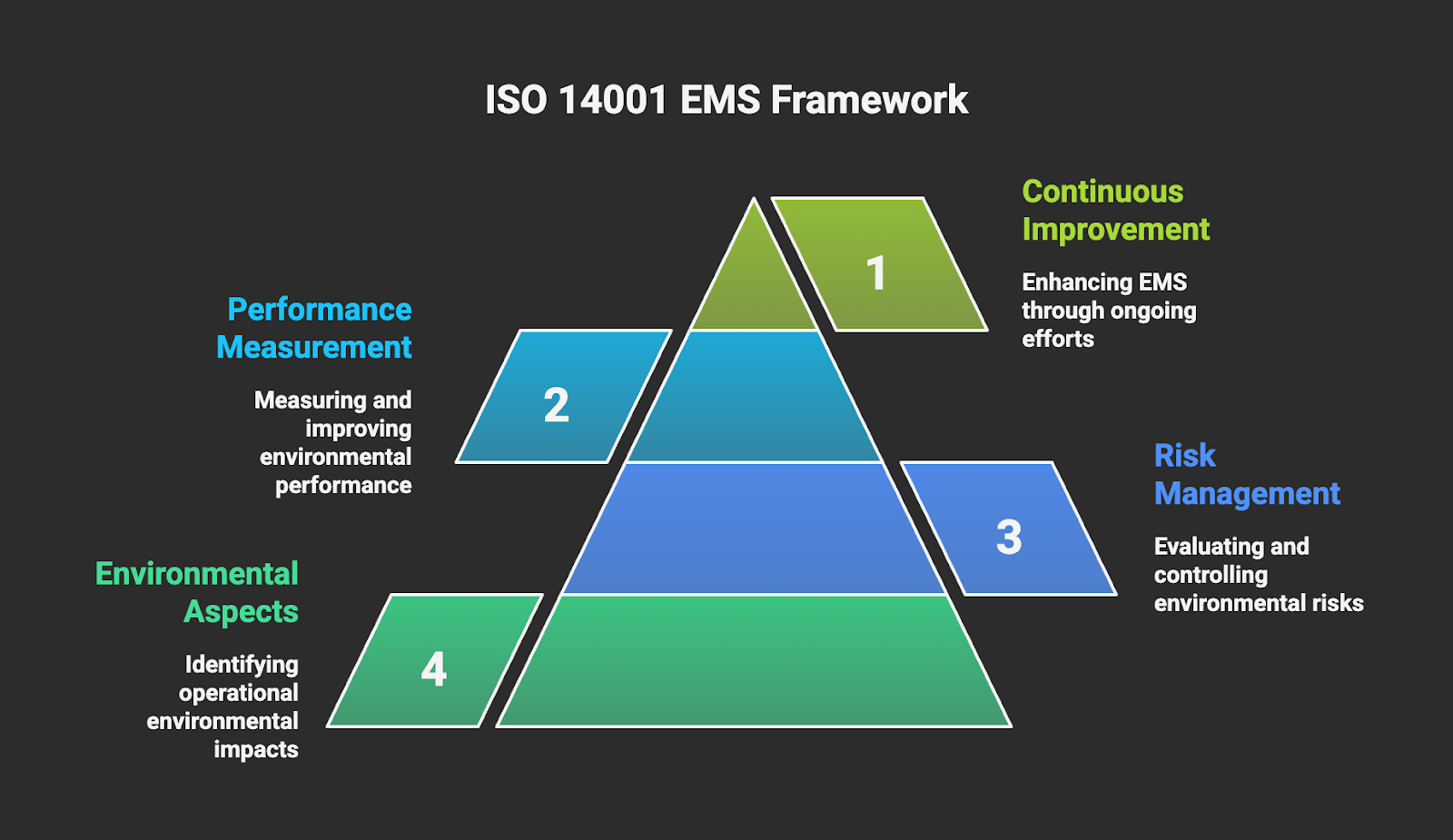
ISO 14001 is the international standard defining the requirements for an EMS. ISO 14001:2015, the current version, is not a legal requirement. Instead, it’s a structured framework outlining how your organization establishes and operates an Environmental Management System (EMS) to identify, manage, monitor, and improve environmental impacts.
By following this framework, you can align environmental management with your overall business strategy, emphasizing activities such as risk-based thinking and continuous improvement.
If you’re operating in a complex, high-change environment, ISO 14001 gives you a repeatable system guiding you through:
- Identifying environmental aspects and impacts associated with operations.
- Evaluating and controlling environmental risk.
- Measuring performance and driving continual improvement through a formal management system.
Although it is designed to be applicable to organizations of any size, sector, or maturity level, ISO 14001 is especially relevant for materials-intensive and regulated industries such as pharmaceuticals, chemicals, food and beverage, and advanced materials. In these industries, environmental risk often crosses multiple stages, from research to process development.
All decisions made during development can have downstream environmental consequences that ISO 14001 helps bring to light. The common factor between these industries is that they are audit-driven, which is why they turn to frameworks like ISO 14001 to demonstrate systematic environmental risk control, separate from direct regulatory compliance.
Understanding ISO 14001 Certification
To obtain ISO 14001 certification, an organization must undergo an audit conducted by an accredited third-party certification body. The certification process typically includes two stages:
- The first stage focuses on reviewing EMS documentation and assessing whether the system is designed and ready for evaluation against ISO 14001 requirements.
- The second stage is an on-site audit that evaluates whether environmental controls and processes are effectively implemented and operating as intended across the organization.
Achieving ISO 14001 certification confirms that your Environmental Management System conforms to the standard’s requirements. Organizations in materials-intensive and regulated industries often pursue certification to manage environmental risk, meet governance expectations from investors, and demonstrate environmental control to customers and supply-chain partners.
While ISO 14001 certification is technically voluntary, it is frequently treated as a commercial or contractual requirement. In R&D-driven environments, certification is often expected by customers, partners, or global supply chains as evidence that environmental risks introduced through materials, processes, and operational change are being systematically controlled.
The ISO 14001 Audit: What You Need to Know
An ISO 14001 audit is a systematic evaluation of whether your Environmental Management System (EMS) conforms to ISO 14001 requirements and is effectively implemented and maintained. Within an EMS, an ISO 14001 audit is vital for confirming that the system is operating as designed and for generating actionable findings that support continual improvement.
The audit can also uncover gaps and weaknesses between procedures and practices, which often crop up in R&D-driven environments. For example, if you introduce environmental risk through new materials, the ISO 14001 audit verifies whether these changes are being assessed and controlled within the EMS.
Auditors will look at documentation, such as policies and records, along with operational evidence demonstrating what is actually happening on the lab floor. The audit’s goal isn’t just to tick off the existence of evidence; it’s to verify that environmental controls are applied consistently and risks are understood.
ISO 14001 Audit Frequency
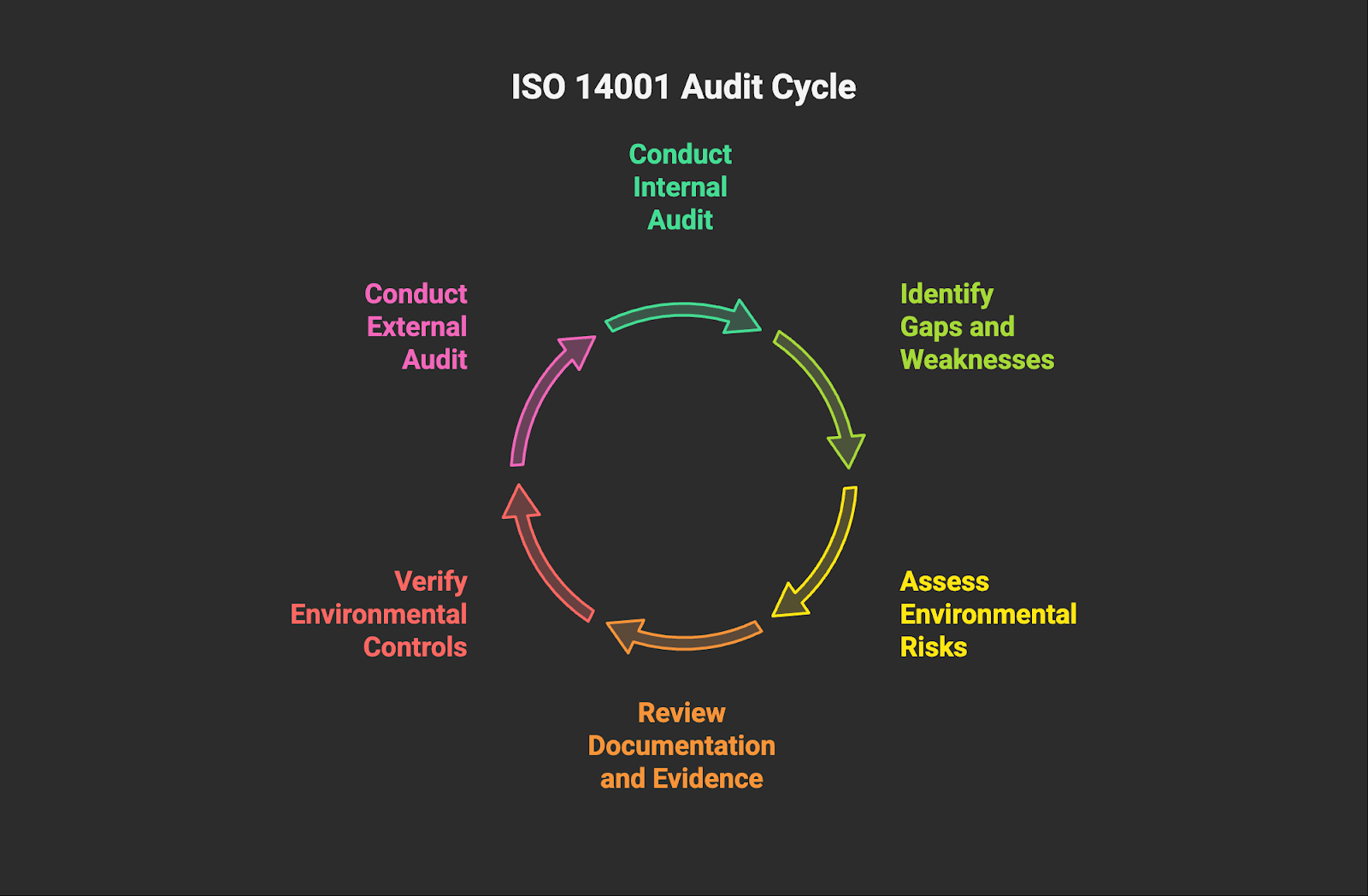
Within your EMS, you’ll be expected to conduct internal audits at scheduled intervals to verify that it is properly implemented and maintained. Many organizations choose to follow an annual internal audit cycle. However, higher-risk operations or rapidly changing environments may require more frequent audits of specific areas.
For certified organizations, external ISO 14001 audits conducted by the certification body typically follow a three-year certification cycle, including annual surveillance audits and a full recertification audit.
In practice, the effectiveness of ISO 14001 audits depends less on how often they occur and more on how systematically they are executed. After all, poorly timed audits can miss critical internal changes. Well-planned audits should be aligned with development milestones, allowing you to identify risks early before they escalate into compliance issues.
What is an ISO 14001 audit checklist?
An ISO 14001 audit checklist is an audit tool used to systematically evaluate whether your Environmental Management System (EMS) conforms to ISO 14001 requirements. It allows you to easily map each real-world operation to ISO 14001 requirements.
A comprehensive and repeatable audit approach to audit preparation is essential, which is why organizations rely on audit checklists. You’ll gain visibility into results to compare them across departments and conduct audits consistently, especially if your organization has multiple manufacturing sites or labs.
Using the clause-based structure of an ISO 14001 checklist makes it easier to identify systemic issues versus site-specific gaps. With this knowledge, you can clearly communicate findings to management, enabling faster and more targeted corrective actions.
Although ISO 14001 audit checklists are widely used by those responsible for EMS conformity, including internal auditors, EMS leaders, compliance teams, and consultants, they’re particularly valuable for auditors who are less involved in day-to-day laboratory management or development activities.
A well-designed checklist should be tailored to your organization’s:
- Scope
- EMS goals
- Relevant environmental aspects and impacts
- Complexity of materials, processes, and change activities
For example, an organization with extensive formulation development may need more comprehensive audit coverage around waste characterization and change management. No matter your requirements, an ISO 14001 audit checklist provides the structure necessary for consistency and understanding real environmental risk.
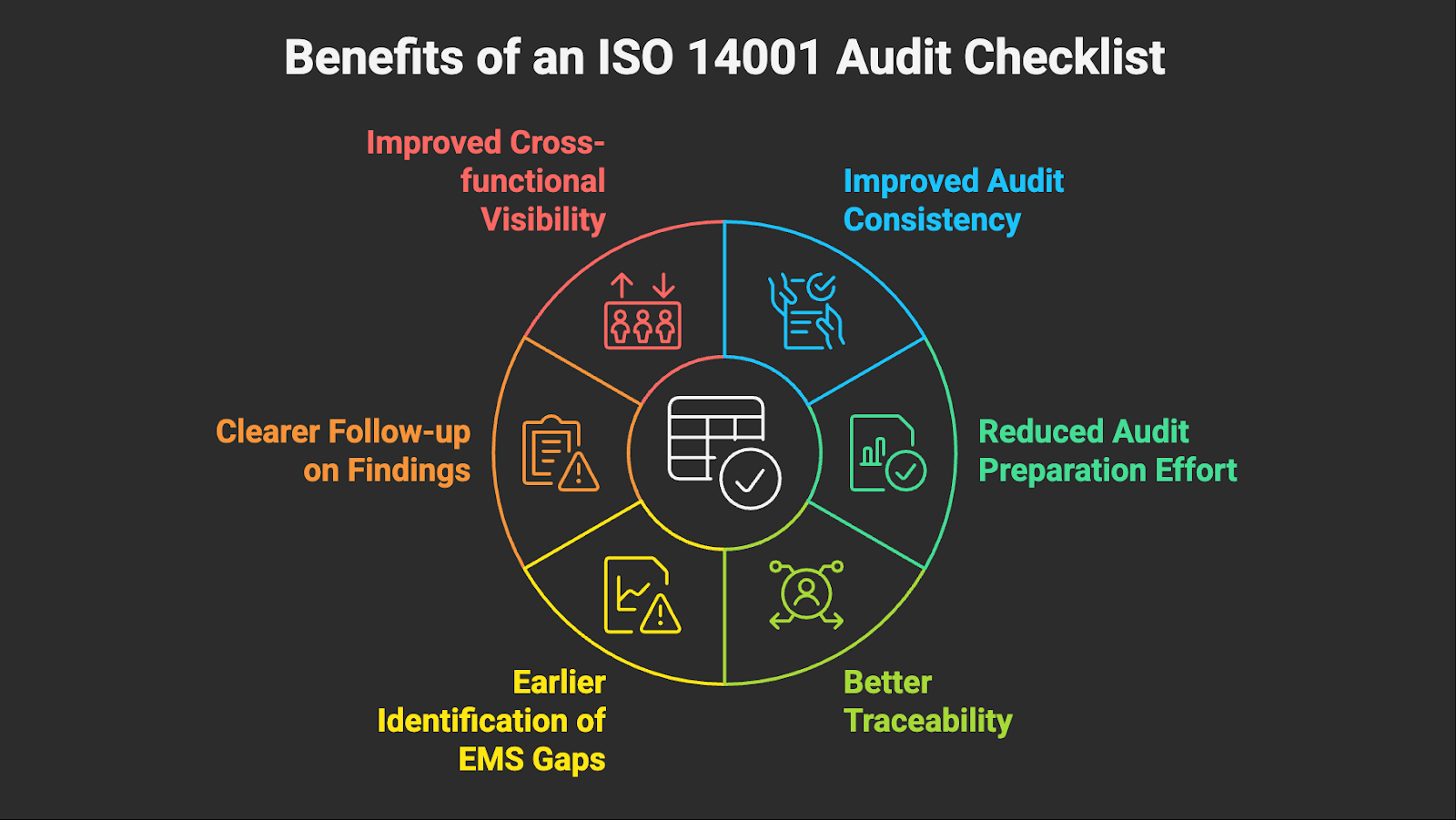
6 Key Benefits of an ISO 14001 Audit Checklist
An ISO 14001 audit checklist provides many benefits, including:
- Improved audit consistency: Audits are conducted in a consistent way across auditors, sites, and audit cycles.
- Reduced audit preparation effort: Audit preparation is more predictable and requires less manual interpretation of ISO 14001.
- Better traceability: ISO 14001 requirements, operational controls, and audit evidence are clearly connected.
- Earlier identification of EMS gaps: Issues and gaps are identified during internal audits, giving teams time to address them before external audits.
- Clearer follow-up on findings: Corrective actions are directly linked to ISO 14001 requirements and audit findings.
- Improved cross-functional visibility: Audit results are easier for environmental and safety teams, as well as operations and R&D, to understand and act on.
What’s covered in an ISO 14001 audit checklist?
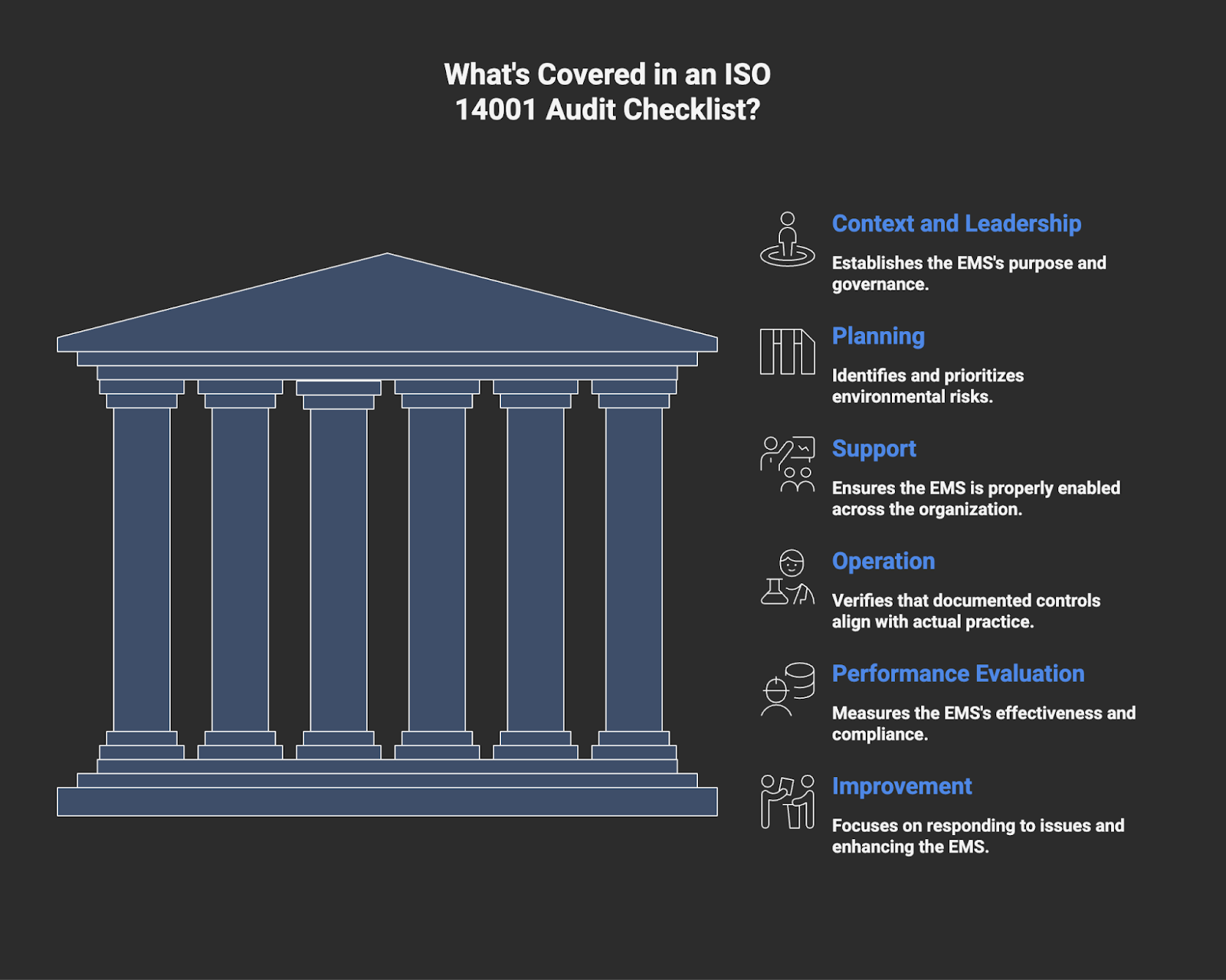
Here are the key areas of ISO 14001 covered in an ISO 14001 audit checklist:
Context and Leadership (Clauses 4-5)
This section establishes why the EMS exists and how it is governed. For R&D operations teams, this part often reveals disconnects between high-level policy and fast-moving development activities.
What the checklist includes:
- Understanding internal and external issues relevant to the EMS and environmental performance, such as regulatory pressure and operational complexity.
- Identification of interested parties, including regulators, customers, suppliers, and local stakeholders, as part of broader environmental and vendor risk assessment.
- Definition of EMS scope, ensuring boundaries align with materials and processes.
- Documented Environmental Policy, confirming it includes commitments to compliance and continual improvement.
- Top management commitment, including evidence of leadership accountability and appropriate resource allocation.
Planning (Clause 6)
Planning is where you formally identify and prioritize environmental risk. Factors such as new formulations and process changes can quickly introduce environmental impacts, so auditors look for evidence that planning processes capture these changes effectively. Planning may include the use of quantitative data, such as emissions estimates or product carbon footprint analysis, to evaluate the significance of environmental aspects.
What the checklist includes:
- Identifies environmental aspects and impacts, and determines which are significant using defined criteria (e.g., waste streams, emissions, water use, or hazardous materials).
- Tracks compliance obligations, including applicable laws and customer requirements.
- Sets environmental objectives and targets, and defines actions to achieve them using measurable criteria.
Support (Clause 7)
Clause 7 focuses on whether the EMS is properly enabled across your organization. Weak document control or inconsistent training records are common audit findings, which is why centralized access to controlled documentation is essential.
What the checklist includes:
- Resources, competence, and awareness, ensuring personnel understand environmental impacts relevant to their roles.
- Communication processes, both internal and external, are related to environmental performance and obligations.
- Control of documented information, including records and version control.
Operation (Clause 8)
In environments such as labs and production, pay close attention to whether documented controls align with actual practice. Clause 8 is often where differences between R&D activity and formal procedures start to show.
What the checklist includes:
- Operational controls for significant environmental aspects, such as waste handling, emissions management, or material storage.
- Change management, ensuring environmental risks are assessed and controlled when processes or materials change.
- Emergency preparedness and response, such as incident records.
Performance Evaluation (Clause 9)
Clause 9 verifies whether the EMS is delivering measurable results. At this stage, auditors are looking for clear traceability between objectives, performance data, audit findings, and management decisions, often across multiple data pipelines.
What the checklist includes:
- Monitoring and measurement of environmental performance and compliance.
- Internal audit program, including planning, execution, and follow-up.
- Management review confirms that leadership evaluates EMS effectiveness using defined inputs, including audit results and performance data, and identifies improvement opportunities.
Improvement (Clause 10)
The final section focuses on how you respond to issues and improve over time. Organizations that perform well in Clause 10 can demonstrate that audit results are used to support decision-making and that corrective action processes are effective for maintaining EMS integrity.
What the checklist includes:
- Nonconformity and corrective action processes, including root cause analysis and actions taken to prevent recurrence.
- Continual improvement mechanisms, demonstrating that audit findings and performance data lead to meaningful change.
How to Use the ISO 14001 Audit Checklist
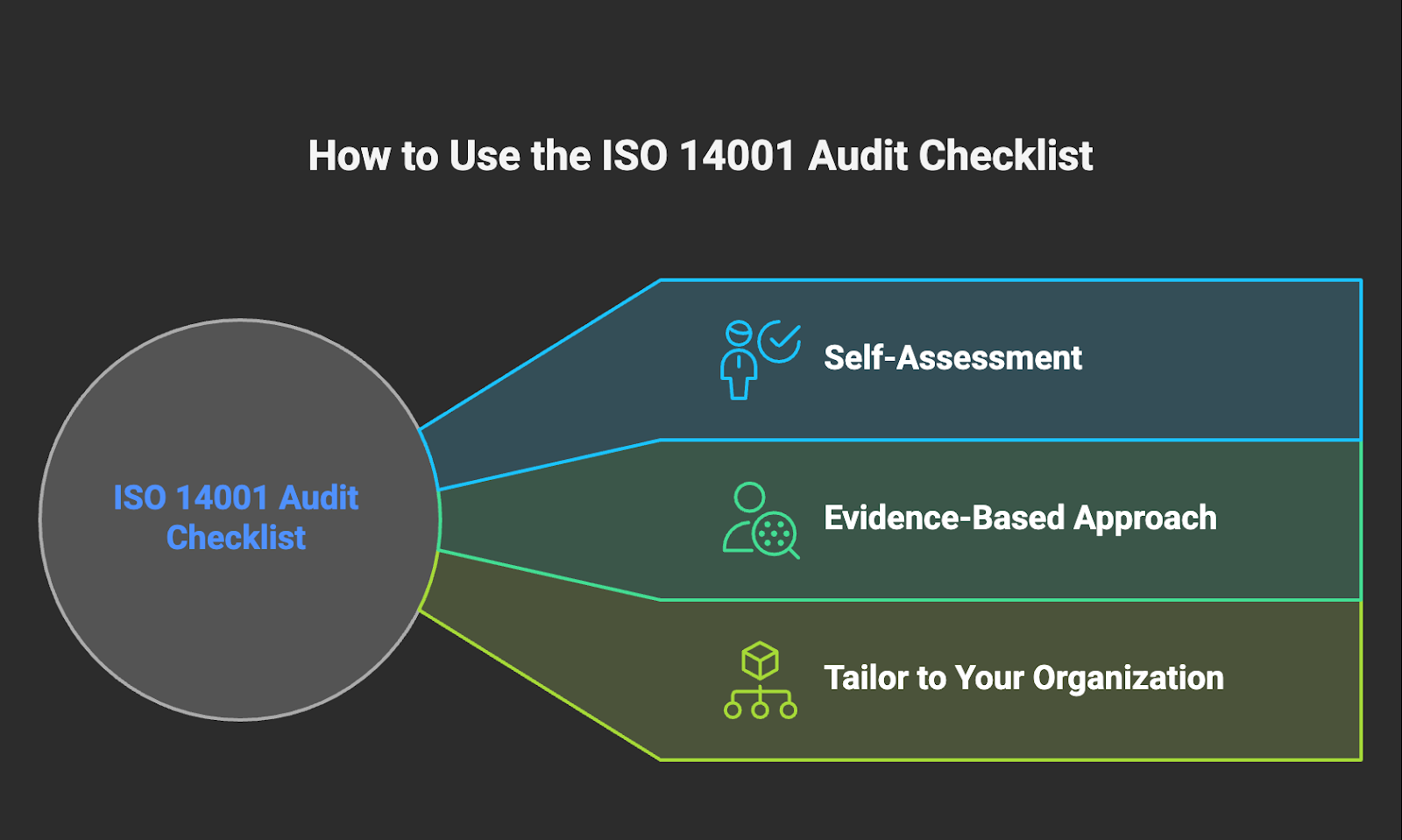
An ISO 14001 audit checklist provides complete, auditable coverage of the EMS. It’s most effective when used as a practical tool during internal audits and audit preparation. Here’s how to get the most from it:
Self-Assessment
Start by using the checklist to conduct internal audits against your existing EMS. Work through each clause and evaluate whether the required controls are defined, implemented, and maintained. If you’re prepping for certification, consider regular checklist-based internal audits for a clear picture of EMS readiness.
Evidence-Based Approach
ISO 14001 audits are driven by objective evidence. As you work through the checklist, look for:
- Documented information, e.g., logs
- Operational evidence, e.g., observed lab practices
- Performance data, e.g., monitoring and measurement
The ISO 14001 audit checklist prompts auditors to record the evidence they reviewed and where it was found, supporting traceability and defensible audit conclusions.
Tailor to Your Organization
While the downloadable checklist is already aligned to ISO 14001 clauses, you can customize it to reflect your organization’s scope, size, and environmental risk profile. For example, you could add specific environmental aspects or compliance obligations and adjust focus areas based on materials or development stages. Tailoring means R&D-driven organizations can capture risks introduced dynamically.
Making ISO 14001 Audits Work for You
In today’s materials-intensive and regulated markets, an ISO 14001 audit checklist is an essential requirement for demonstrating environmental control and operational maturity. Clear, traceable evidence of EMS effectiveness equips you with the capability to confront tight sustainability expectations and turn them into operational control. However, audit tools are only part of the equation.
In environments where materials decisions and process changes cause environmental risks, it’s more important than ever to maintain auditable data. MaterialsZone’s platform centralizes materials and process data centralizes materials and process data, helping make everyday R&D activity and ISO 14001 audit evidence traceable and accessible across teams. This continuity is critical when preparing for internal or external audits and supports broader environmental governance and compliance initiatives.
To prepare for your next internal audit or getting ready for external certification, download the ISO 14001 Audit Checklist to begin aligning your EMS to close gaps with confidence.
Try a MaterialsZone demo to discover how its AI-driven materials informatics platform helps you keep audit evidence traceable and accessible across teams.

.png)