


REACH and RoHS Compliance: The Essential Guide
Your company is developing a commercial product that contains multiple chemicals and materials for sale in the European Union. One day, your procurement manager receives an email from a supplier explaining that a critical raw material is being discontinued. Everything seems manageable, as the replacement they offer “should be equivalent.” The R&D team swaps out the materials to keep the project moving. Two weeks later, QA flags an issue during pre-launch checks. The updated formulation now contains a restricted substance above a legal threshold, meaning your team cannot immediately demonstrate what is in the product.

Around one in five products on the market fails to meet key chemical safety standards, underscoring how visibility gaps and compliance blind spots still exist in complex, multi-tier supply chains. Fortunately, compliance with REACH and RoHS reduces the likelihood of this scenario happening to your organization. These regulatory frameworks help determine whether substances and materials can legally enter the EU market.
As the EU continues to tighten its chemical safety and sustainability expectations, compliance is increasingly becoming a baseline requirement for doing business. Sustained REACH and RoHS compliance come down to maintaining accurate, connected data about the chemicals and materials across the product lifecycle. Here’s what you need to know.
REACH Compliance: What is it, and how does it work?
REACH is a core chemical regulation in the European Union that governs how chemical substances are manufactured, imported, used, and sold on the EU market. If you want to sell into the EU market, you’re expected to demonstrate that substances are being used safely, with evidence to support that claim.
REACH is overseen by the European Chemicals Agency (ECHA), whose goal is to protect the environment and human health from the risks posed by chemicals. Unlike many regulations that focus mainly on finished products, REACH is substance-based and requires companies to assess and manage chemical hazards.
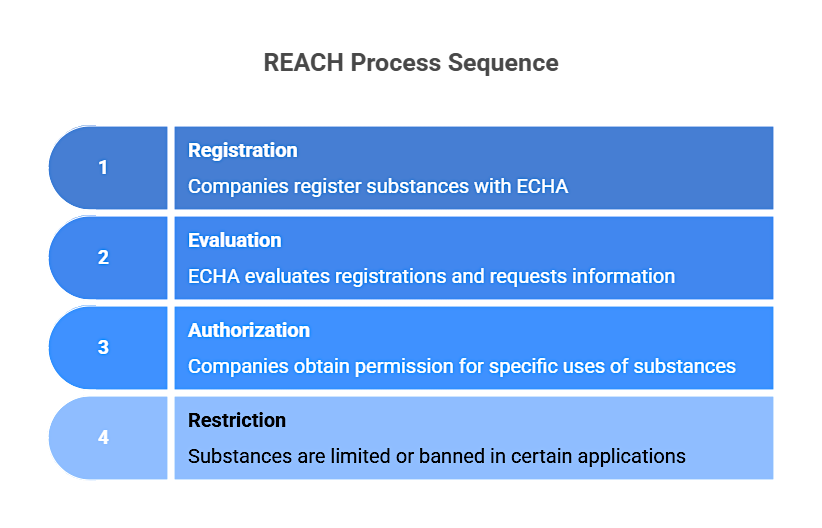
REACH has four key elements:
- Registration: Requires companies to register substances with ECHA when they manufacture or import them into the EU above certain volume thresholds.
- Evaluation: Allows ECHA and national authorities to evaluate registrations and request more information where needed.
- Authorization: Restricts the use of certain Substances of Very High Concern (SVHCs) unless companies obtain permission for specific uses.
- Restriction: Limits or bans substances in certain applications where the risk is considered unacceptable.
What substances and use cases does REACH cover?
REACH has a very broad scope, applying to:
- Substances on their own, e.g., industrial chemicals.
- Substances in mixtures, e.g., coatings and inks.
- Substances in articles, e.g., packaging and medical devices.
REACH compliance often becomes a shared responsibility across R&D, product development, procurement, quality, and regulatory functions. It is especially relevant in the advanced materials, chemicals, electronics, and regulated manufacturing sectors, where formulations evolve frequently and supply chains are complex.
Core REACH Requirements
- You may need to register the substance under REACH if you manufacture or import it into the EU at volumes of 1 tonne or more per year. The required compliance data increases with higher tonnage bands.
- EU manufacturers and importers are legally responsible for registration. Non-EU manufacturers can appoint an Only Representative (OR) to fulfill these obligations on their behalf.
- When you’re registered, you’ll need to submit detailed technical documentation to ECHA. Higher tonnage substances require more extensive testing and exposure assessments. Registrants must also communicate safe use information through Safety Data Sheets (SDS) and exposure scenarios, so downstream users understand and apply appropriate risk management measures.
- SVHCs are added to the REACH Candidate List when they meet criteria such as carcinogenicity, mutagenicity, reproductive toxicity, persistence, bioaccumulation, or endocrine disruption. Under EU REACH Article 7(2), you must notify ECHA if an SVHC is present in an article above 0.1% weight-by-weight and the total quantity of that SVHC in those articles exceeds 1 tonne per year per importer.
Who needs to comply with REACH?
The primary legal responsibility under REACH typically falls on substance manufacturers and importers within the EU. It is also relevant for Only Representatives (ORs) appointed by non-EU manufacturers to fulfill REACH registration obligations.
Downstream users, such as companies that use substances in industrial or professional activities, also have responsibilities to ensure any use is covered by a registration and complies with risk management measures.
However, this is where REACH compliance becomes operationally challenging. Achieving it relies on continuously understanding what substances are present, where they appear in your materials, and how they’re being used as products and formulations change over time. If you’re selling into the EU or supplying to companies that are, REACH should be part of everyday decision-making, from R&D formulation choices to supplier selection.
RoHS Compliance: What is it, and how does it work?
The Restriction of Hazardous Substances (RoHS) framework is a materials-related regulation in the EU that restricts the use of certain hazardous chemicals in electrical and electronic equipment (EEE).
RoHS aims to protect human health and the environment by limiting materials that can pose health risks during a product’s manufacture, use, recycling, and disposal. It applies to most EEE placed on the EU market, and compliance can be achieved through technical documentation and conformity assessment processes.
What product categories does RoHS cover?
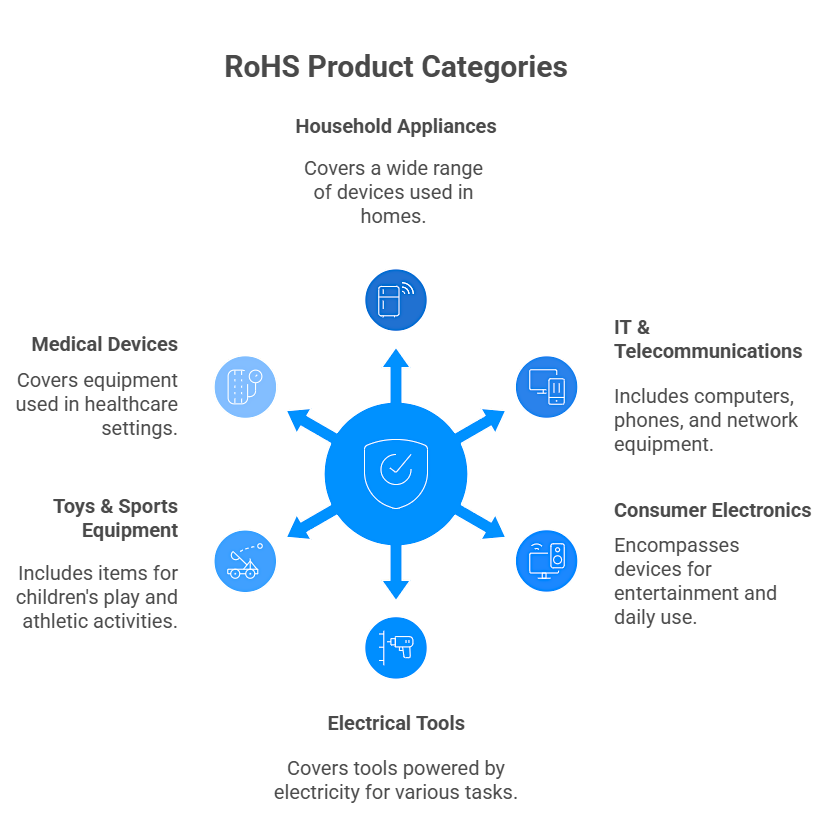
Under Annex I of the RoHS directive, the regulated categories include:
- Large and small household appliances
- IT and telecommunications equipment
- Consumer electronics and lighting equipment
- Electrical tools
- Toys and sports equipment
- Medical devices
In short, if an electrical product falls within these categories and is being placed on the EU market, RoHS will apply. This narrower scope means RoHS isn’t a universal chemical regulation like REACH. Instead, it is tied to the context of EEE and related materials.
Restricted Substances Under RoHS Compliance
The core restricted substances under RoHS currently include:
- Lead (Pb)
- Mercury (Hg)
- Cadmium (Cd)
- Hexavalent chromium (Cr⁶⁺)
- Polybrominated biphenyls (PBB)
- Bis(2-ethylhexyl) phthalate (DEHP)
- Polybrominated diphenyl ethers (PBDE)
- Butyl benzyl phthalate (BBP)
- Dibutyl phthalate (DBP)
- Diisobutyl phthalate (DIBP)
For most restricted substances, the maximum concentration value is 0.1% by weight in each homogeneous material. RoHS includes application-specific exemptions if substituting the chemical is technically or scientifically impractical.
Who needs to comply with RoHS?
Responsibility for RoHS compliance flows to the economic operators who place EEE on the EU market, including manufacturers, importers, and distributors. Additionally, compliance responsibilities cascade down the supply chain. For example, manufacturers typically rely on supplier data to verify that their products meet RoHS limits, and changes in materials or designs can trigger updates to compliance documentation.
RoHS includes temporary and specific exemptions that allow certain substances to be used in defined applications where there is no suitable alternative. Exemptions typically have an expiration date to encourage ongoing material substitution and design innovation over time.
Key Differences Between REACH and RoHS Compliance
Data Requirements for REACH and RoHS Compliance
If REACH and RoHS compliance feels difficult in practice, it’s rarely because teams don’t understand the regulations. It’s because they don’t have the correct data, or their data is scattered across spreadsheets and disconnected systems.
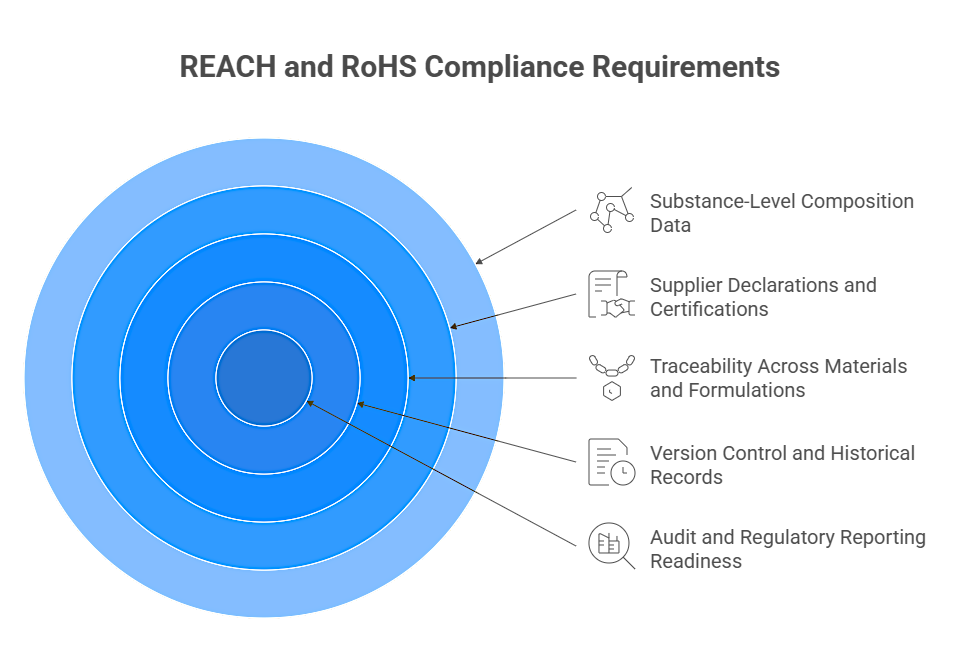
Both frameworks ultimately depend on being able to prove which chemical substances are in your materials and products, and showing how you know that information is accurate. The key data requirements for compliance with both standards are:
Substance-level Composition Data
For REACH, teams often need substance-level visibility to support restrictions and safe use communication. For RoHS, a high-level formulation declaration is usually not sufficient. In this case, you’ll need to prove compliance against maximum concentration limits in homogeneous materials.
Supplier Declarations and Certifications
Compliance requires current, documented supplier declarations and certifications for all materials and components incorporated into the product.
Traceability Across Materials and Formulations
Compliance requires end-to-end traceability across formulations, products, supplier variants, and production sites to demonstrate substance presence and regulatory status.
Version Control and Historical Records
It’s crucial to prove what was true at a specific point in time. The ability to demonstrate historical material composition and compliance status is vital when teams need to respond to regulatory inspections, internal audits, and even investigations following non-conformance.
Audit and Regulatory Reporting Readiness
Compliance requires structured, audit-ready documentation that can be produced on demand. Many teams also align compliance documentation and traceability practices with broader environmental management frameworks like ISO 14001.
5 Best Practices for Ongoing REACH and RoHS Compliance
REACH and RoHS are distinct regulations with different scopes and requirements. However, robust compliance programs with both standards rely on a shared set of best practices that improve visibility and make compliance easier to maintain over time.
1. Integrate Compliance Early in R&D
If restricted substances are only identified when a product is near launch, your team could be forced into expensive last-minute fixes. Instead, compliance should be embedded across the product development life cycle, starting with formulation design and screening, materials selection, supplier onboarding, and early prototype development. Early compliance integration is particularly critical in fast-moving R&D environments, where materials evolve rapidly, and teams must make confident decisions without slowing innovation.
2. Maintain Continuously Updated Materials Data
Many compliance programs rely on a spreadsheet of substances or a one-time RoHS certificate. The problem is that those snapshots go stale quickly. Best-in-class compliance depends on maintaining living materials data, including traceability across product variants and versions, plus up-to-date supplier declarations. Both REACH and RoHS obligations are triggered by real-world change, so the only way to manage change confidently is to keep the underlying materials data current.
3. Monitor Regulatory Updates Systemically
REACH compliance can shift rapidly as the SVHC Candidate List grows or new authorisation requirements are introduced. RoHS changes less frequently, but exemptions expire, and restricted substance lists can expand.
The key best practice here is repeatable monitoring. That means assigning clear ownership for regulatory watch activities and reviewing updates on a defined cadence. You can also connect updates directly to impacted materials and products and document decisions and actions taken. Without this structure, updates are easy to miss and teams often only find out they’re exposed when a customer asks for proof, or when an audit begins.
4. Align Compliance Workflows Across Teams
One of the most common failure points in REACH and RoHS compliance is organizational. Compliance affects teams from R&D to procurement, and it becomes inconsistent when everyone works in silos.
For example, a material substitution might be approved in procurement without being flagged for RoHS. Or, a supplier might update their declaration, but no one links it to the correct product variant. The best practice is to align workflows so compliance becomes a shared system with clear handoffs and visibility across functions.
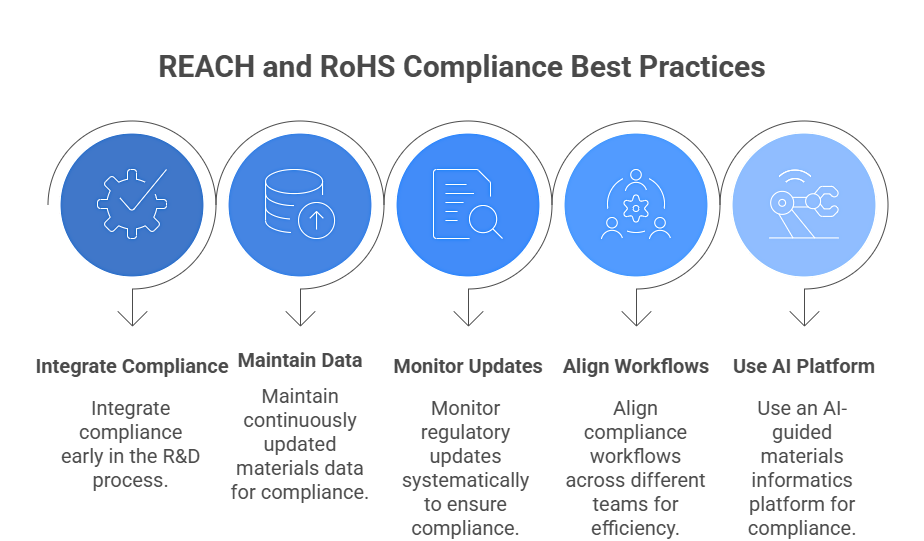
5. Use an AI-Guided Materials Informatics Platform
For organizations managing complex materials portfolios, MaterialsZone’s platform becomes a strategic advantage by supporting ongoing REACH and RoHS compliance through:
Centralized Materials and Compliance Data
Teams can store and manage materials and compliance information in a structured system, building a reliable single source of truth. Integration with existing R&D and quality systems ensures data consolidation without requiring workflow replacement. Secure cloud architecture aligned with SOC 2 Type II standards protects sensitive R&D and compliance data through controlled access and encryption.
Automatically Maps Substances to Regulations
With REACH and RoHS, the challenge is knowing which substances matter under which regulation, and under which conditions. A materials informatics and discovery platform can help you connect composition data to regulatory requirements, making it easier to identify risks earlier and more consistently.
Impact Analysis for Changes
When a supplier changes a raw material or when the R&D team adjusts a formulation, you may notice that REACH and RoHS compliance shifts. The platform provides faster impact analysis by showing what formulations and downstream materials are affected by changes, enabling your team to respond proactively. Early visibility into compliance risks reduces the likelihood of launch delays caused by reformulation.
Cross-Functional Collaboration
Compliance is the responsibility of every department, from R&D to QA, regulatory, and procurement. The platform connects stakeholders through shared workflows and visibility, making it easier to coordinate decisions and maintain audit-ready records.
Build a Scalable Foundation for REACH and RoHS Compliance
The REACH and RoHS frameworks present significant compliance challenges. REACH brings substance-level obligations and frequent updates, while RoHS requires deep composition visibility and strict concentration limits at the homogeneous material level. Organizations that are able to overcome these hurdles can make better formulation decisions and minimize audit risk.
MaterialsZone’s AI-guided materials informatics platform helps teams build a scalable foundation for REACH and RoHS compliance without slowing down innovation. It helps teams embed REACH and RoHS compliance into everyday R&D and sourcing decisions, while providing clear compliance status and risk visibility across materials, formulations, and product portfolios.
Book a MaterialsZone demo today to accelerate REACH and RoHS compliant product development with AI-guided R&D.

.png)

-min.jpeg)
