What Is AI Materials Discovery, and How Is It Being Used?
AI materials discovery uses artificial intelligence, machine learning, and materials data to help R&D teams discover, design, predict, and optimize materials with desired properties. It can support innovation in property prediction, formulation optimization, inverse design, next-best-experiment recommendations, and AI-guided product development.

What is AI materials discovery?
Materials R&D is becoming more complex, and development timelines are tighter than before. Teams now have to optimize for performance, cost, sustainability, compliance, and manufacturability at the same time, while working with more variables than ever. In this environment, trial-and-error experimentation to test every possible formulation or process parameter is often too slow, expensive, and resource-intensive.
AI materials discovery helps address these challenges by using data to guide better decisions before lab resources are committed. Instead of replacing materials scientists, AI helps them to narrow the search space, prioritize stronger candidates, and make better use of the experimental data they already have. With the global AI in materials discovery market projected to exceed $5.5 billion by 2034, the question for R&D leaders is how to connect the right data and workflows so AI can produce useful, validated recommendations.
What is AI materials discovery, and why is it important?
AI materials discovery is the use of artificial intelligence, machine learning, automation, and materials data to discover, design, predict, and optimize materials with target properties. The goal is to help teams make better R&D decisions before they commit time and resources to lab testing.
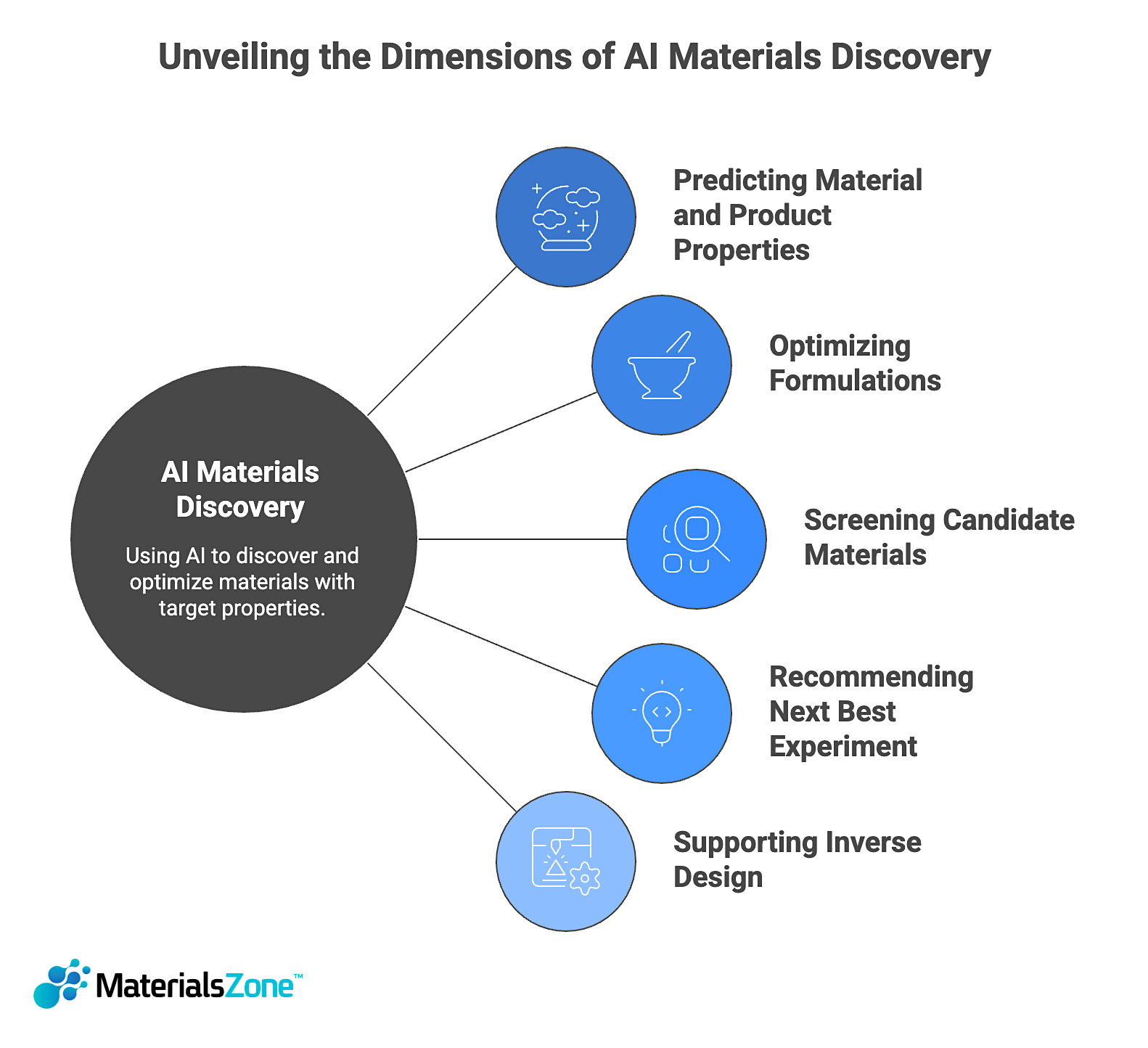
In practice, AI materials discovery can include:
- Predicting material and product properties
- Optimizing formulations
- Screening candidate materials
- Recommending the next best experiment
- Supporting inverse design
These workflows can combine experimental data, simulation results, literature data, material descriptors, active learning, and historical R&D knowledge.
AI materials discovery is most relevant to R&D, formulation, materials science, QA/QC, production, and innovation teams working with complex materials data. For example, leveraging AI materials discovery can help a FMCG R&D team screen more sustainable cosmetics formulations for texture, stability, ingredient restrictions, and sensory performance, while prioritizing candidates that can move through development faster.
How does AI materials discovery work?
AI materials discovery changes the traditional R&D workflow by using data to narrow the search space before testing. Rather than relying on broad trial-and-error batches, AI helps you predict which material candidates are most likely to meet the target before lab resources are committed.
Scientists and data teams still play a central role:
- R&D, materials, and formulation experts define the goal and validate results, while models help identify patterns and recommend candidates.
- Lab testing remains essential because AI recommendations still need physical validation and expert review. They must also be checked for manufacturability, safety, and real-world performance.
A typical AI materials discovery workflow includes five steps:
1. Define the Material Goal
The process starts with a target outcome. For example, a team might seek higher strength, improved shelf life, lower cost, better conductivity, a reduced carbon footprint, or compliance with a new requirement. The clearer the target, the easier it is for AI models to identify useful relationships between inputs and outcomes.
2. Use Relevant Materials Data
AI models rely on data from sources such as previous experiments, formulations, raw material records, test results, processing conditions, and production records. The data context and quality matter, as a dataset is more useful when it includes formulation details and both successful and unsuccessful results.
3. Connect Inputs With Outcomes
AI models look for relationships between material inputs and performance outcomes, such as how ingredient ratios, processing conditions, or raw material properties affect durability, viscosity, stability, conductivity, cost, or emissions. These patterns help teams understand which variables are most likely to matter.
4. Generate Candidate Recommendations
Once the model has learned from existing data, it can suggest new materials or process settings that are more likely to meet the target. Researchers can focus lab resources on the most promising candidates instead of testing every possible combination manually.
5. Validate and Refine in the Lab
Lab validation and expert review remain essential. Testing shows whether a predicted candidate can meet the target under real processing, safety, and manufacturability constraints. Once new experimental results are available, they can be fed back into the model, creating a learning loop where each experiment improves future recommendations.
5 Key Benefits of AI Materials Discovery
AI materials discovery offers many benefits, including:
1. Fewer Experiments
AI can help teams reduce low-value experiments by identifying candidates that are more likely to meet project targets. AI does not remove experimentation, but it can make each experiment more purposeful.
2. Faster Development Cycles
By narrowing the search space earlier, R&D teams can spend less time testing low-probability options and move toward viable candidates faster, especially when working under tight commercial or sustainability deadlines.
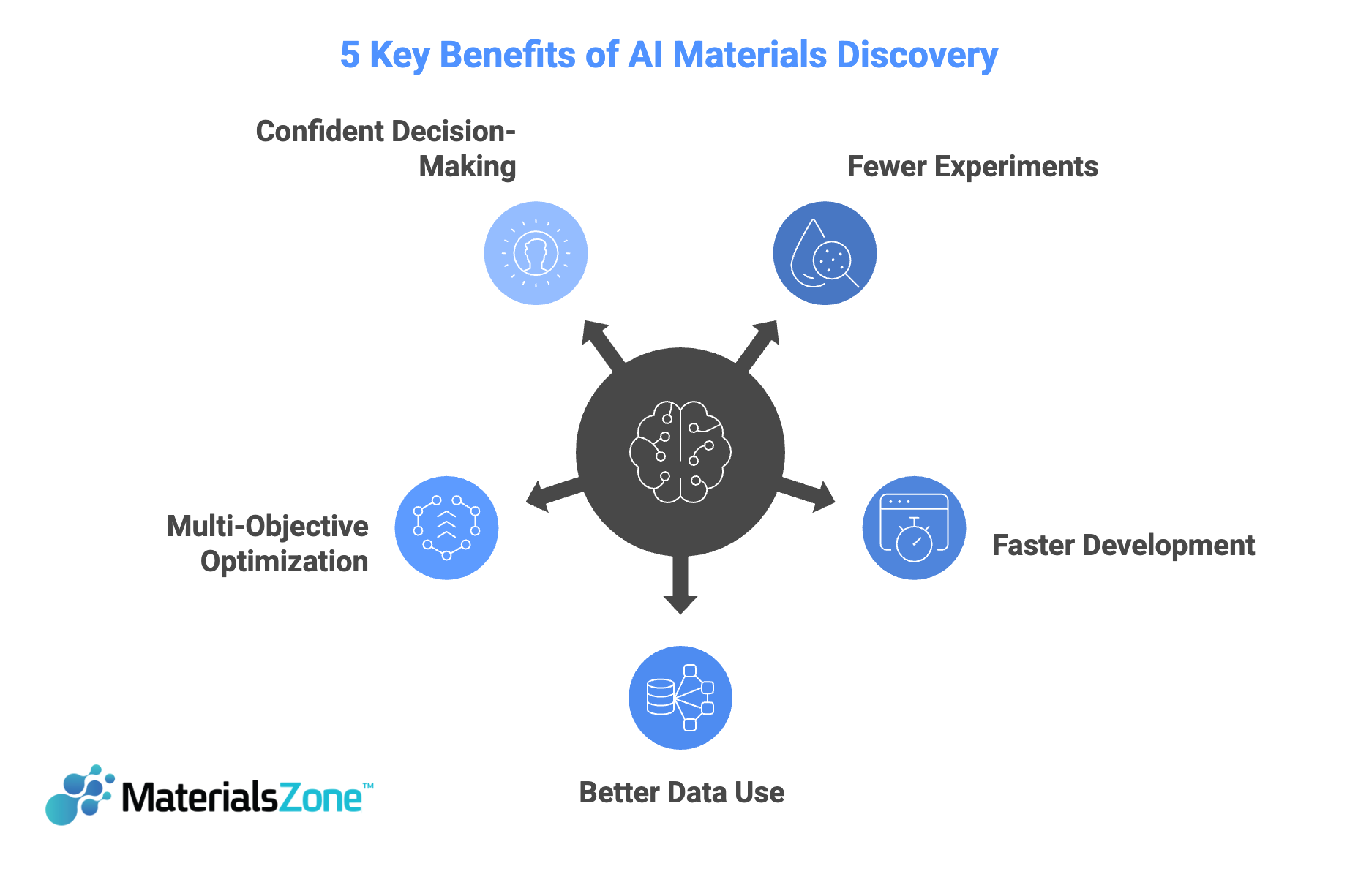
3. Better Use of Historical R&D Data
Many organizations already have valuable R&D data, but it is often scattered across spreadsheets, lab notebooks, LIMS (Laboratory Information Management System), ELNs (Electronic Lab Notebooks), instruments, and local team systems. AI materials discovery encourages teams to turn that historical data into a reusable knowledge base.
4. Multi-Objective Optimization
Teams often need to balance several targets at once, such as performance, cost, compliance, sustainability, and manufacturability. AI can help teams compare these trade-offs more systematically and identify candidates that meet more than one requirement.
5. More Confident Decision-Making
When predictions, experimental results, and historical data are connected, teams can make decisions based on stronger evidence. R&D leaders can prioritize resources, justify next steps, and reduce reliance on fragmented knowledge or repeated trial-and-error.
10 Ways AI Materials Discovery Is Being Used
AI materials discovery can support many parts of the materials R&D workflow. This table shows how these capabilities apply across ten common materials discovery areas.
AI Materials Discovery Use Cases in Detail
Let’s take a deeper dive into selected use cases from the table and explore how AI materials discovery can support specific materials R&D workflows.
Predicting Material and Product Properties (#1)
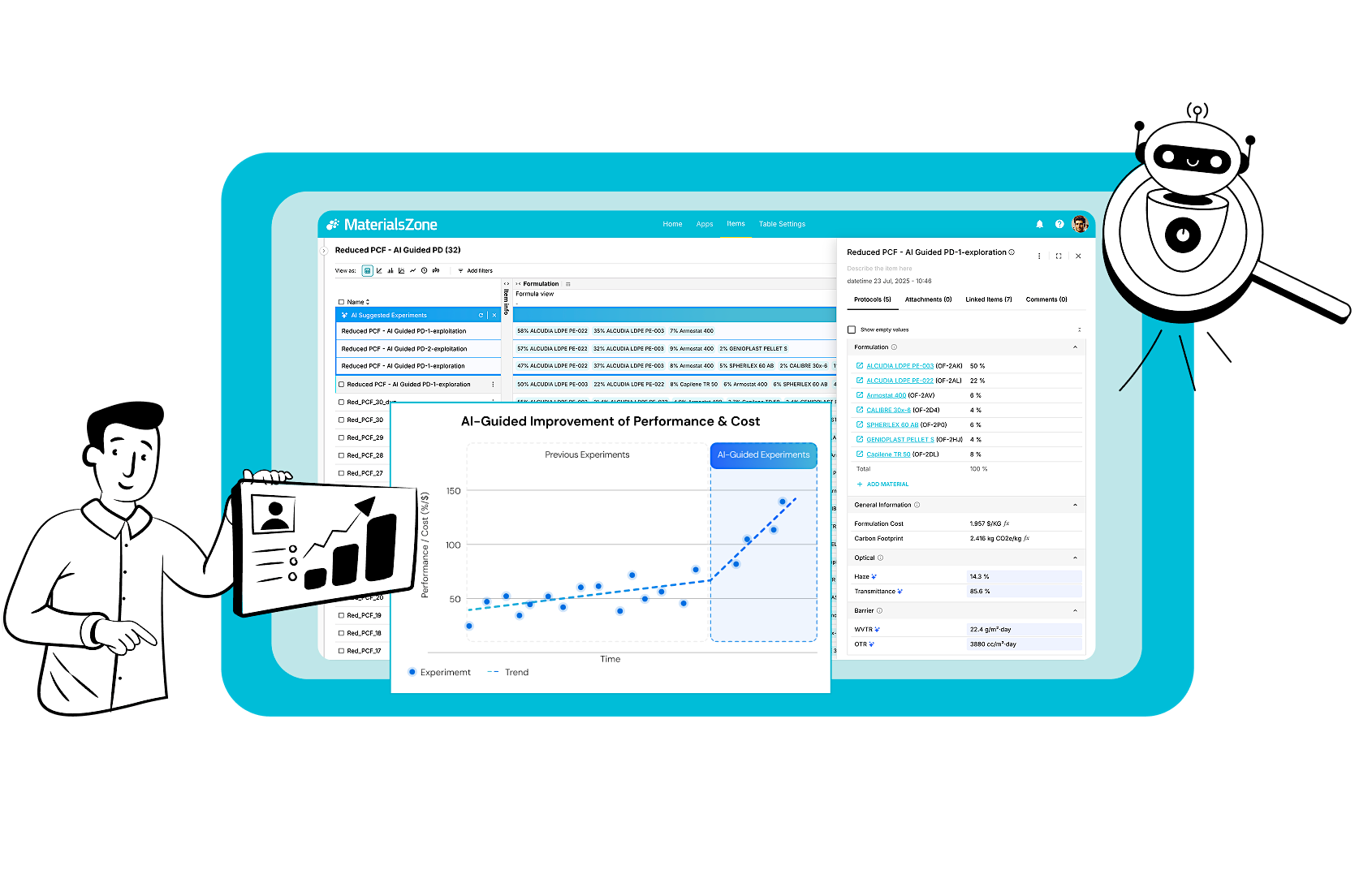
Property prediction is one of the most practical uses of AI materials discovery. Instead of waiting until every candidate has been fully synthesized or characterized, you can use predictive models to estimate how a material or product is likely to perform. For example, you may use predictive models to estimate properties such as stability and thermal behavior.
MaterialsZone’s Predictive Co-Pilot supports this use case by using experimental data to predict key material and product properties, helping teams screen candidates before full testing and focus lab work on the options most likely to meet target requirements.
Designing Battery and Energy Materials (#3)
Battery and energy materials are strong use cases for AI materials discovery because electrolytes, electrodes, and related materials depend on many interacting factors. AI and active learning can support this work by screening possible chemistries and learning from each round of experimental results.
Recent research has shown that deep active learning and knowledge transfer can support rapid electrolyte discovery for lithium metal batteries. Active learning is also being used to accelerate electrolyte solvent screening for anode-free lithium metal batteries.
The AI materials discovery approach does not remove the need for battery testing. Instead, it helps you use testing more strategically by focusing on candidates with stronger predicted potential.
Automating Lab Experimentation (#5)
AI materials discovery is also moving toward more automated and closed-loop R&D workflows. AI-powered lab automation solutions can help design experiments, and the results can be fed back into the model to guide the next round of testing.
This use case is especially relevant when experiments are repetitive and spread across a large design space. For example, MIT researchers developed an autonomous platform for polymer blend discovery that uses an algorithm to select candidate blends, sends them to a robotic system for mixing and testing, and uses the results to guide the next experiments. The platform was reported to generate and test up to 700 polymer blends per day.
For many R&D teams, a realistic near-term value is using AI-guided workflows to reduce manual bottlenecks, capture better data, and improve the quality of each experimental cycle.
Making Materials Knowledge Easier to Access (#10)
AI materials discovery depends on usable materials knowledge. Many organizations already have years of valuable experimental data, but that knowledge is often fragmented. As a result, it becomes difficult for researchers to answer basic but important questions, such as:
- Has this formulation been tested before?
- Which process conditions caused the best result?
- Did a similar raw material fail in another project?
AI-enabled search, visualization, and analysis can make this knowledge easier to access. MaterialsZone supports this through a centralized materials knowledge environment and Maven, its conversational AI interface for searching, visualizing, and analyzing internal and external data.
Together, these capabilities help teams connect data from different systems and sites, reuse past work, visualize complex relationships, and make decisions based on shared evidence.
Moving From Trial-and-Error to AI-Guided R&D
With AI materials discovery, you can move beyond slow, fragmented trial-and-error by using data, machine learning, and predictive models to identify better materials faster. However, reliable R&D impact depends on connected materials data and a validation process that links model recommendations back to lab results.
MaterialsZone helps R&D teams centralize fragmented materials data, collaborate across teams, analyze complex relationships, and apply predictive AI to materials development. By combining the Materials Knowledge Center, Collaboration Hub, Visual Analyzer, Predictive Co-Pilot, and conversational AI capabilities, the materials informatics platform gives teams a connected environment for AI-Guided R&D.
Request a MaterialsZone demo to see how your team can accelerate materials discovery and turn experimental data into better R&D decisions.


-min.jpeg)