What Are Sustainable Cosmetics?
Beauty has a hidden cost. The products people use every day can raise difficult questions about what lies behind their performance and presentation, especially when green claims are used to reassure consumers. Conventional cosmetics can have an impact in many ways, from hard-to-recycle packaging to manufacturing choices that generate more waste and emissions.

Sustainable cosmetics have emerged as a popular response to these challenges. The global sustainable beauty and skincare market is projected to reach $433.2 billion by 2034, showing that sustainability is becoming a serious commercial and innovation focus. However, sustainable cosmetics pose a real R&D and production challenge, requiring sustainability principles to shape the product from ingredient selection through packaging to end-of-life.
At the same time, regulators are paying closer attention to how cosmetics brands describe products as sustainable, with the European Commission reporting that 53% of green claims are vague or misleading, while 40% lack supporting evidence. To scale sustainable cosmetics credibly, manufacturers need enhanced traceability and centralized data across teams. Let’s explore the world of sustainable cosmetics development and what really goes into making them.
What are sustainable cosmetics?
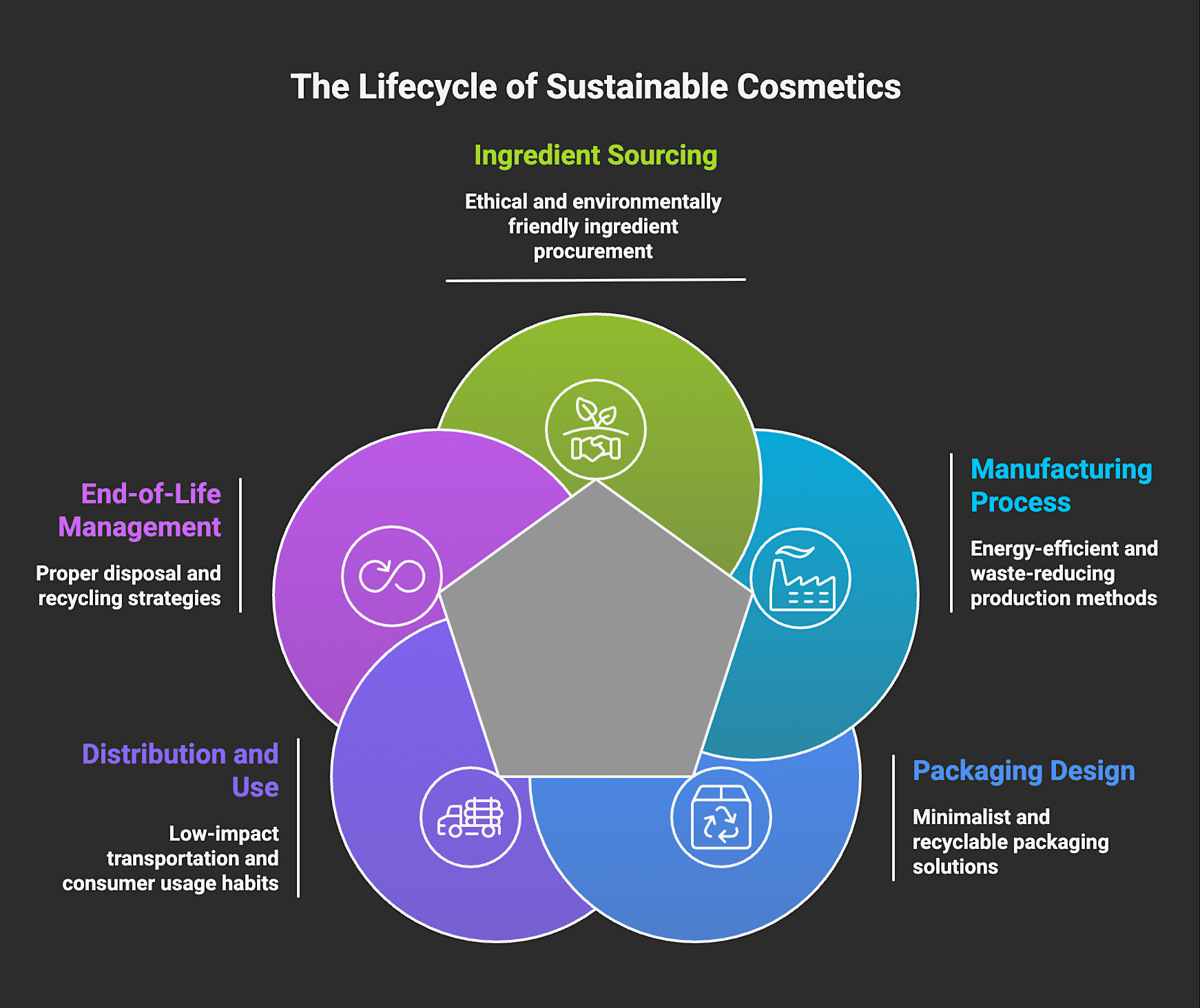
Sustainable cosmetics are beauty and personal care products designed to reduce environmental and social harm across the full product lifecycle.
Sustainable cosmetics manufacturers look beyond the formula itself and consider factors such as:
- How ingredients are sourced
- How the product is manufactured
- What packaging is used
- How it is distributed and used
- What happens at end-of-life
In other words, a cosmetic product is only truly sustainable when sustainability is built into decision-making from raw material selection through to disposal. In the cosmetics sector, this lifecycle view matters because supply chains are complex and packaging formats are often multi-material, which means that environmental impacts can be created at several stages rather than in a single obvious place.
Sustainable Cosmetics vs. Clean Beauty vs. Natural Beauty
It’s crucial to separate sustainable cosmetics from two similar-sounding labels that are often used interchangeably: clean beauty and natural beauty.
- Sustainable cosmetics focus on environmental impact, social responsibility, transparency, and long-term viability across the product lifecycle.
- Clean beauty, by contrast, is usually centered on ingredient safety and brand transparency. Products are typically positioned as free from ingredients viewed as harmful or controversial. However, that does not automatically mean the sourcing or packaging is sustainable.
- Natural beauty is narrower again, referring to products made with ingredients derived from nature. It’s worth noting that “natural” has no single legal meaning in cosmetics, and natural origin alone does not guarantee lower environmental impact or responsible sourcing. For example, a natural ingredient could still involve resource-intensive extraction.
Why are sustainable cosmetics important now?
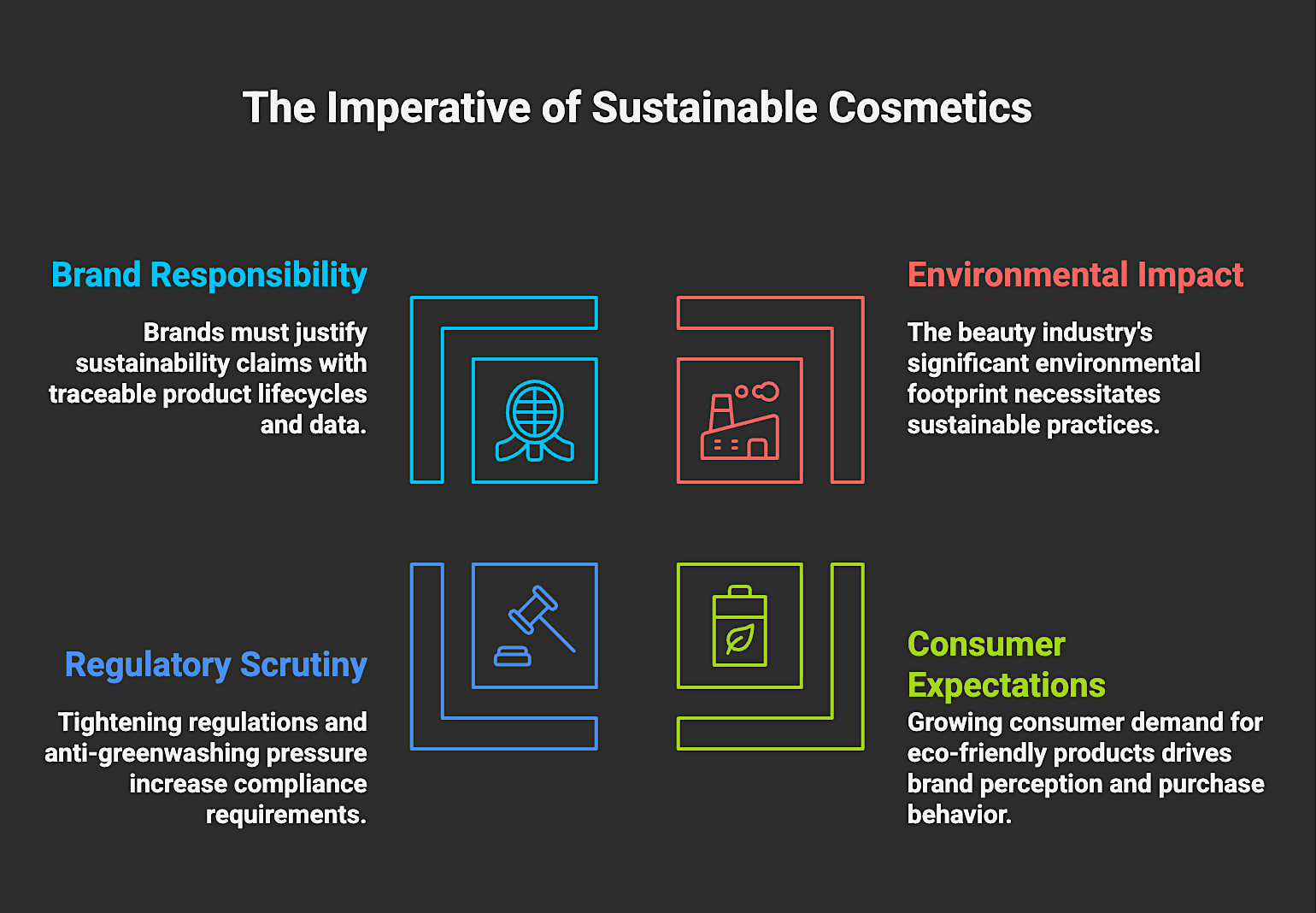
The beauty industry’s environmental footprint is too large to treat as a side issue. In a category built on high product turnover and heavy packaging use, sustainability is central to how products are brought to market.
Consumer expectations are also getting harder to ignore. 54% of consumers said they had deliberately chosen products with sustainable packaging in the previous six months, and 90% said they were more likely to buy from a brand with eco-friendly packaging.
Together, those figures suggest that sustainability is increasingly shaping both brand perception and purchase behavior. Those expectations now extend to the digital shelf, where product pages, ingredient information, packaging claims, and sourcing statements increasingly influence how cosmetics brands are evaluated.
Regulatory scrutiny is tightening under the Modernization of Cosmetics Regulation Act (MoCRA) in the United States and new packaging standards. These rules increase requirements around product safety, documentation, and compliance. Anti-greenwashing pressure is rising as regulators push for environmental claims to be more credible and evidence-based, as in the proposed EU Green Claims Directive.
For cosmetics brands, regulation raises the bar on how terms like “sustainable” and “responsibly sourced” are justified. As a result, sustainable cosmetics brands and manufacturers increasingly need a traceable product lifecycle, from formulation to packaging. Plus, manufacturers need reliable lifecycle data to support it. This requirement further reinforces why sustainable cosmetics have become an R&D and data challenge, not just a marketing one.
Challenges Brands Face When Developing Sustainable Cosmetics
Developing sustainable cosmetics is not as simple as swapping in a “greener” ingredient or choosing a different bottle. For example, a manufacturer might switch a package from virgin plastic to a material such as recycled PET. But the real sustainability outcome depends on the full materials picture, including material reduction and end-of-life recovery rates.
Therefore, manufacturers face numerous challenges:
- Cost and performance tradeoffs: Lower-impact ingredients or materials can increase costs and affect elements like texture or shelf life.
- Scale-up and manufacturing constraints: A formulation that performs well in R&D may need adjustment when moved into full-scale production.
- Supply chain complexity and traceability gaps: Manufacturers and brands often lack clear visibility into vendor risks, sourcing, and material-level data across the supply chain.
- Packaging and formulation compatibility: Sustainable packaging still needs to protect the formula and work with production processes.
- Regulatory pressure and claim validation: Sustainability claims are under greater scrutiny, so brands need evidence to support terms like “sustainable” or “responsibly sourced.” This evidence also supports brand safety.
- Fragmented data across teams: R&D, sourcing, packaging, quality, and compliance teams often work from disconnected datasets. In sustainable cosmetics, that fragmentation becomes harder to trace, including why a material was selected or to validate a sustainability claim. This is where platforms like MaterialsZone become valuable, helping teams bring materials data, process context, and compliance evidence into one place so sustainability decisions are easier to validate and act on.

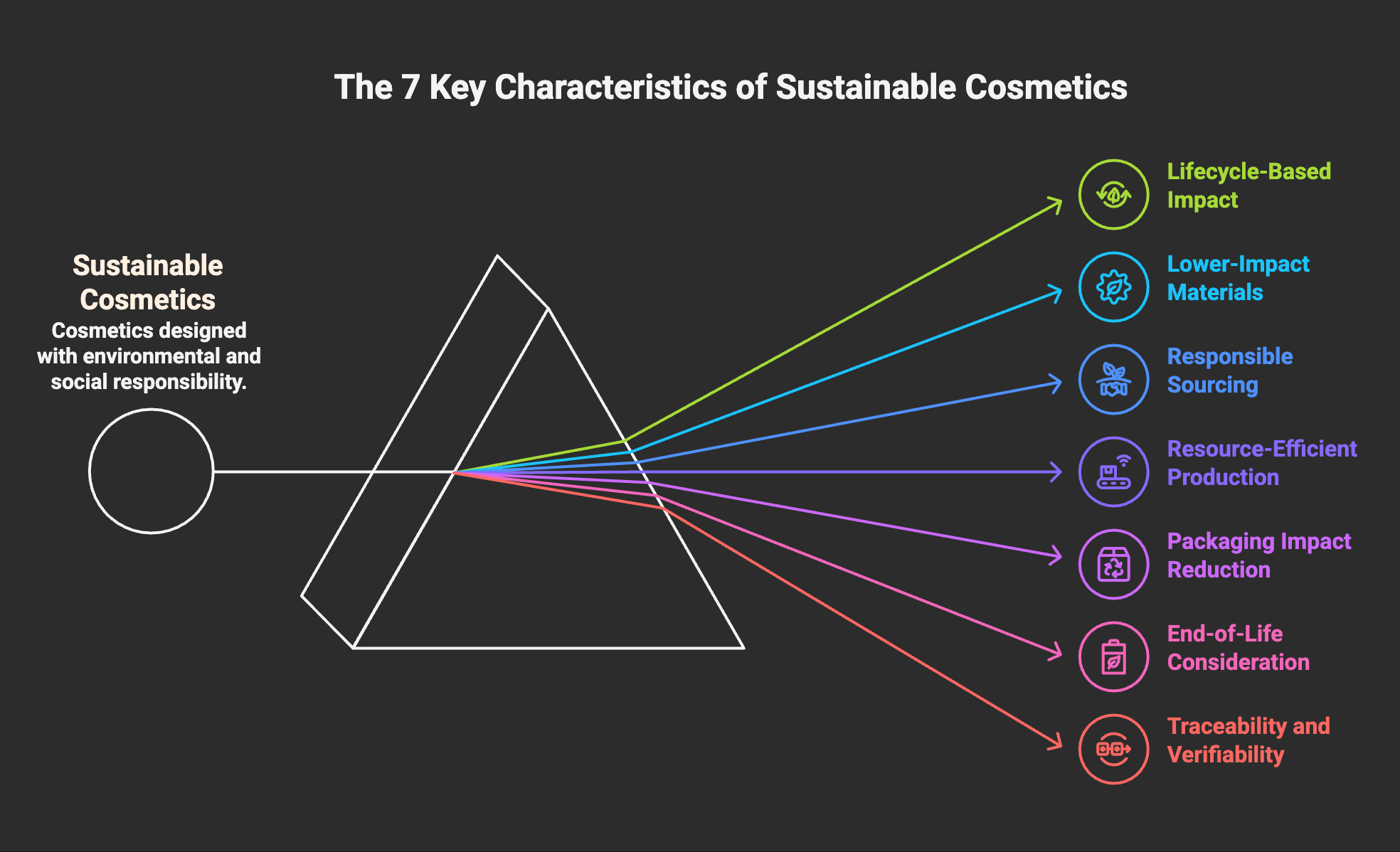
The 7 Key Characteristics of Sustainable Cosmetics
1. Lifecycle-Based Impact
Sustainable cosmetics are evaluated across many areas: sourcing, formulation, manufacturing, packaging, distribution, use, and end-of-life. There’s no single isolated attribute that makes cosmetics sustainable. That broader view matters because opportunities for environmental and social impact can be created at multiple points in the product development lifecycle.
2. Lower-Impact Materials
Sustainable cosmetics use materials selected for their lower overall impact, including factors such as biodegradability, environmental persistence, and resource use. Natural or bio-based origin alone does not make a material lower impact, especially if it is poorly sourced or difficult to process responsibly at scale.
3. Responsible Sourcing
Ingredient selection affects the entire supply chain. Sustainable cosmetics rely on sourcing practices that take factors like ethical labor, biodiversity, transparency, and controlled raw material extraction seriously. Responsible sourcing is especially crucial as beauty brands face growing scrutiny over where materials come from and how they are produced.
4. Resource-Efficient Production
Sustainability has to extend into the lab and the factory through smart manufacturing. Best practices for resource-efficient production include reducing water use, energy demand, waste generation, and hazardous inputs during formulation and manufacturing, while still maintaining product quality and reproducibility.
5. Packaging Impact Reduction
Packaging remains a major part of the cosmetics sustainability equation. Sustainable products aim to minimize material use by reducing dependence on virgin plastic. Other best practices include improving recyclability and supporting reuse or refill where possible.
6. End-of-Life Consideration
A sustainable cosmetic should also be designed with what happens after use in mind. That means thinking about recyclability, refill systems, reuse models, and whether the product or packaging could persist in the environment if disposal systems fail.
7. Traceability and Verifiability
Finally, sustainable cosmetics need to be demonstrable, not just well-intentioned. Manufacturers have a duty to trace materials, validate sourcing decisions, and connect sustainability claims to real data.
To support this, MaterialsZone’s platform creates a single source of truth for materials and product data. It makes it easier for R&D, sourcing, and compliance teams to work from the same evidence base as products move from development toward scale-up.
Supporting Sustainable Cosmetics with AI-Guided R&D
Sustainable cosmetics depend on better decisions across sourcing, formulation, manufacturing, packaging, and compliance. Most importantly, all decision-making should be backed by data that manufacturing teams can actually trust and use.
MaterialsZone’s AI-Guided materials informatics platform is built to unify data, reduce iteration cycles, and help teams work from a shared evidence base. With tools such as the Materials Knowledge Center, Collaboration Hub, Visual Analyzer, and Predictive Co-Pilot, MaterialsZone supports fast and more transparent product development. For sustainable cosmetics manufacturers, that means a stronger foundation for formulation decisions and the ability to make credible sustainability claims.
Book a demo to see how MaterialsZone supports smarter, more connected, sustainable cosmetics development.