10 Use Cases For AI in Materials Science
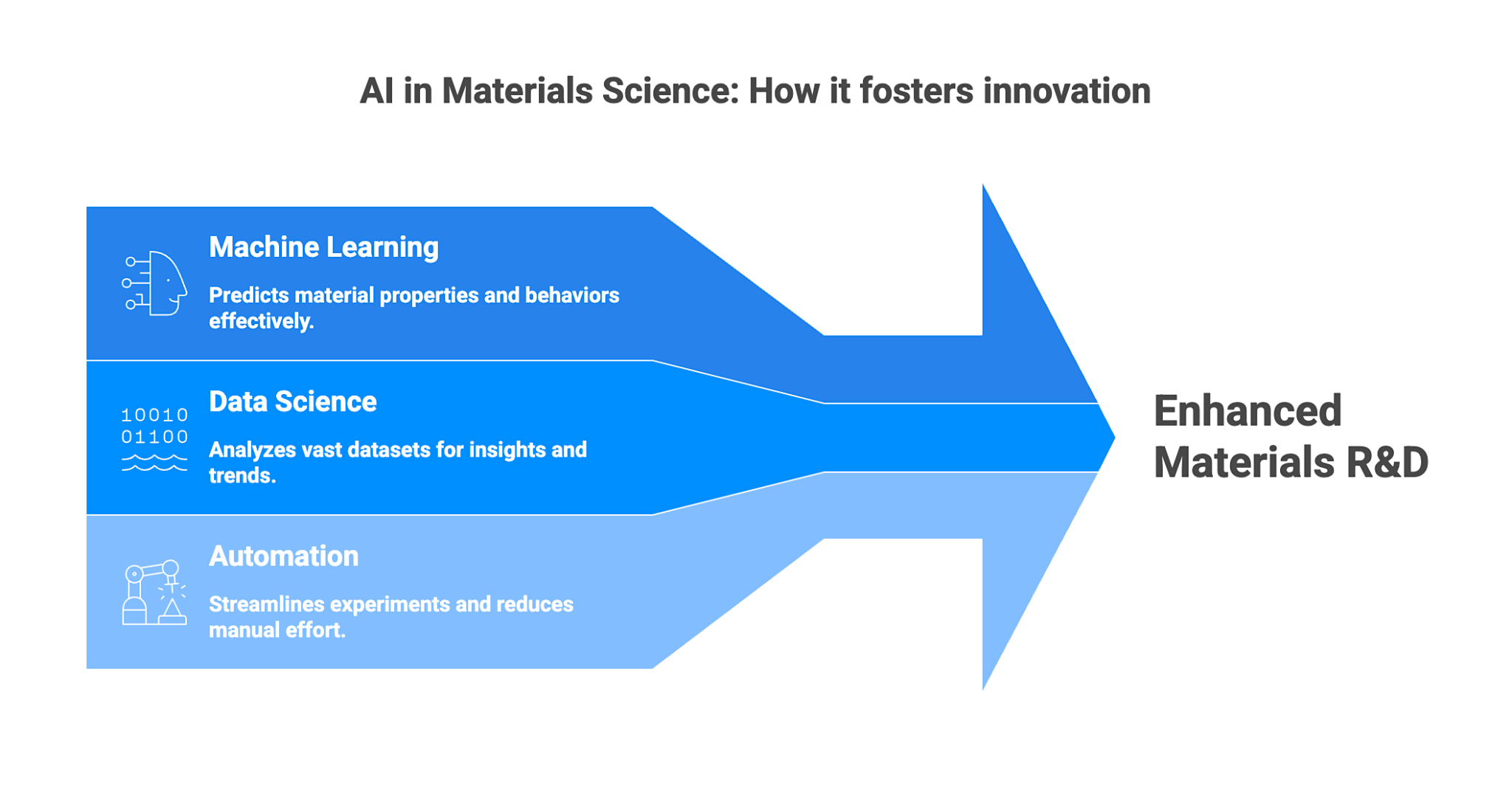
AI in materials science applies machine learning, data science, and automation to materials R&D so teams can predict outcomes, prioritize experiments, and improve decision-making across the R&D lifecycle.


Practical use cases for AI in materials science include:
- Materials informatics
- AI-accelerated materials discovery
- Predictive formulation optimization
- Property prediction
- Process modeling and simulation
- Automated literature and data mining
- Defect detection and quality control
- Autonomous and self-driving labs
- Materials selection and sourcing optimization
- Sustainability and green materials development
Materials science shapes almost everything physical, from advanced coatings and specialty chemicals to packaging and fast-moving consumer goods. Bringing better materials to market, however, has always been slow, expensive, and heavily dependent on trial-and-error experimentation. Competitive pressure and supply chain volatility are making that model harder to sustain, forcing R&D teams to do more with less.
AI is changing what's possible. Rather than replacing experimental science, AI helps you decide which experiments are most worth running. It can also screen candidate materials, estimate properties, optimize formulations, and improve as validated lab results are added back into the dataset. The market is taking notice: one analysis estimates the generative AI in materials science market will grow from $1.1 billion in 2024 to $11.7 billion by 2034.
Here are ten practical use cases showing how AI is already being applied across the materials science R&D lifecycle.
Why AI Is Changing Materials Science Now
Traditional materials R&D is slow by design. Researchers often rely on manual experimentation and incremental iteration to move from hypothesis to viable product, consuming time, budget, and lab capacity.
On top of that, many materials-based organizations generate huge volumes of valuable experimental data, but it is often fragmented. It may sit across spreadsheets, lab notebooks, LIMS, ELNs, instruments, supplier documents and disconnected team workflows. Even when the data exists, it is not always standardized or searchable.
For AI to be reliable, materials data needs context, which means:
- Consistent units
- Material composition
- Process parameters
- Test conditions
- Metadata
- Quality results
- Both successful and failed experiment outcomes
Without structured, contextualized data, AI tools can produce unreliable or incomplete recommendations. But with the right data foundation, teams can move beyond reacting to failed experiments and start estimating likely outcomes before synthesis, formulation, or production.
For R&D leaders and quality teams, the goal is to make experimental knowledge easier to reuse across projects and departments. AI-guided R&D platforms structure data and connect it with AI-driven recommendations, helping teams improve decision-making and bring better materials-based products to market faster.
10 AI in Materials Science Use Cases
Here are the most relevant use cases for artificial intelligence across the materials R&D lifecycle:
1. Materials Informatics
Materials informatics applies data science and AI to materials research, turning raw experimental data into structured, searchable, and reusable organizational knowledge.
Materials informatics helps teams avoid redundant work, preserve insights across projects, and compare results across labs, instruments, and workflows.
A connected data environment is especially valuable in advanced materials, chemicals and FMCG, where teams need to link:
- Formulations
- Raw materials
- Testing results
- Supplier information
- Regulatory constraints
- Process conditions
AI supports materials informatics by organizing inconsistent data into a usable structure. It can help classify records, standardize formats, and connect composition, process, and performance data. A unified platform like MaterialsZone makes experimental data easier to search, compare, and reuse across R&D workflows.
2. AI-Accelerated Materials Discovery
AI-accelerated materials discovery uses machine learning models to predict which new material candidates are most likely to meet target performance requirements before the next round of lab work begins.
Discovering new materials traditionally requires many rounds of testing and characterization. AI can shorten that cycle by screening candidates computationally and helping teams focus lab work on the most promising options.
In practice, AI-accelerated discovery involves training models on known material compositions, structures, properties, and processing histories. Then, it uses those models to rank untested candidates and recommend which compositions or structures should be synthesized and tested next.
Instead of treating every experiment as a fresh starting point, teams can build on historical evidence and make more informed choices earlier in the discovery process.
3. Predictive Formulation Optimization
Anyone who has worked through a formulation cycle knows how quickly the variables multiply. A small change in concentration, processing temperature or ingredient source can affect stability, viscosity, durability, or shelf life.
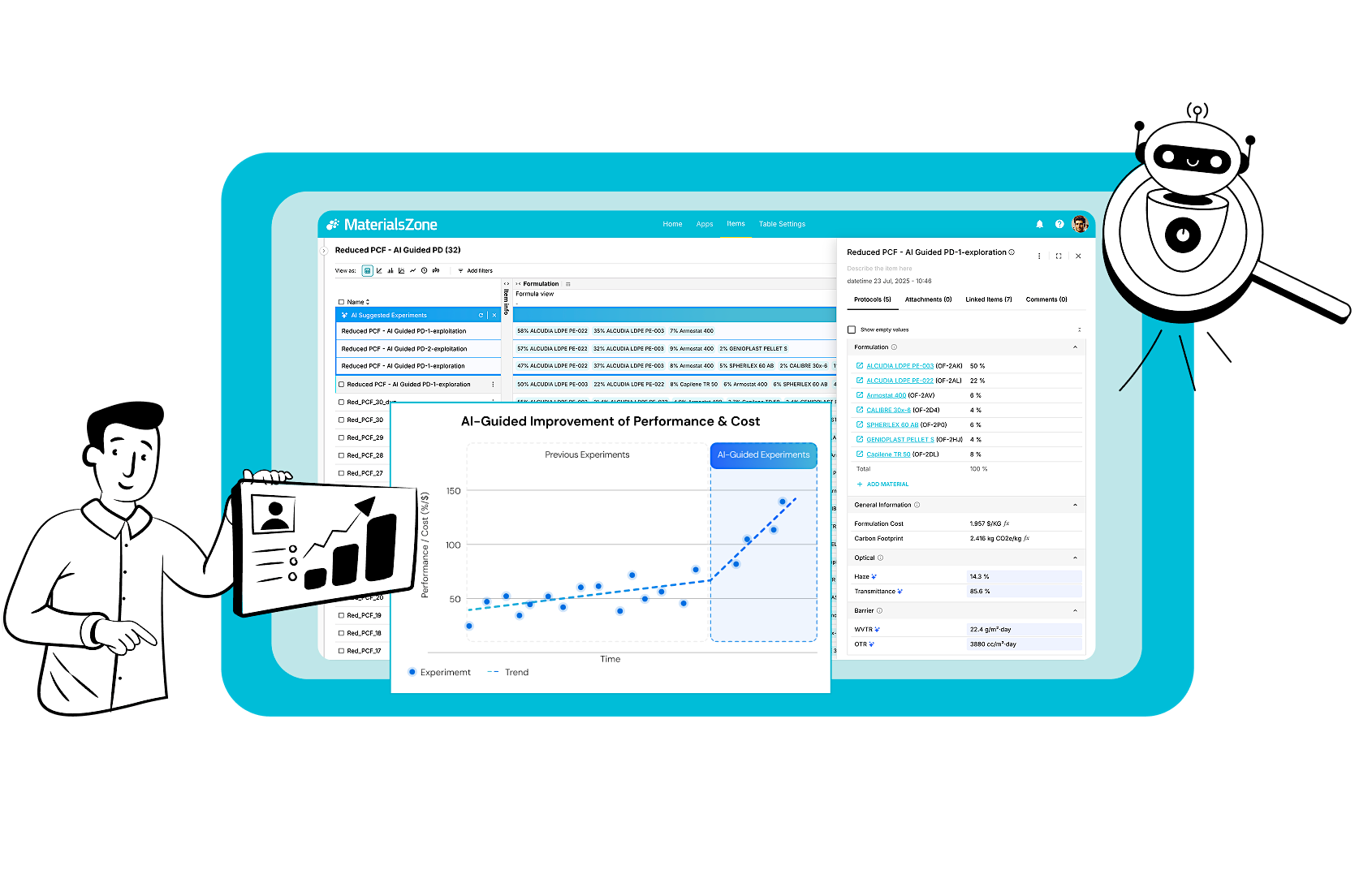
Predictive models estimate how changes in factors such as ingredients or processing conditions will affect end-product performance. Instead of adjusting one variable at a time, teams can model several performance targets simultaneously, such as stability, viscosity, durability, cost, shelf life, sustainability impact, or regulatory constraints.
Predictive formulation optimization helps replace traditional trial-and-error with more focused experimentation. In MaterialsZone’s platform, the Predictive Co-Pilot leverages existing formulation, process, and performance data to suggest promising adjustments, with recommendations improving as new lab results are added.
4. Property Prediction
Property prediction uses AI models to forecast material properties before a material is synthesized or fully characterized. These may include thermal, mechanical, chemical, electrical, optical, barrier, or stability properties.
Because physical characterization can be expensive and time-consuming, property prediction helps teams narrow the candidate pool before committing lab resources.
For example, a team developing a new polymer or composite could use property prediction to estimate which formulations are most likely to meet performance requirements. The AI model’s predictions can then be validated through targeted physical trials, with each new result improving the underlying dataset over time.
5. Automated Literature and Data Mining
Useful materials knowledge is often scattered across published research, patents, supplier datasheets, and legacy lab reports. The problem is that researchers rarely have time to extract and standardize all of that information manually.
AI-powered literature and data mining use natural language processing to extract structured information from these unstructured sources. For example, NLP models can identify material names, chemical entities, processing methods, test conditions, performance values, and reported outcomes. The extracted details can then be converted into structured, contextual data that researchers can review, validate, and reuse across AI workflows.
The value of AI here is its ability to convert scattered knowledge into reusable data points that can feed research workflows, materials databases, and predictive models. In a materials informatics environment, external knowledge can sit alongside internal experimental results and supplier data.
6. Process Modeling and Simulation
A material that performs well in the lab may behave differently under different process conditions. Process parameters, equipment conditions, temperature profiles, mixing sequences, curing times, and production environments can all affect final outcomes.
AI process modeling helps teams understand these relationships before running full physical trials. Models can learn from historical process data and identify which parameters are most likely to produce the desired result. The output may include recommended process windows or predicted outcomes under different manufacturing conditions.
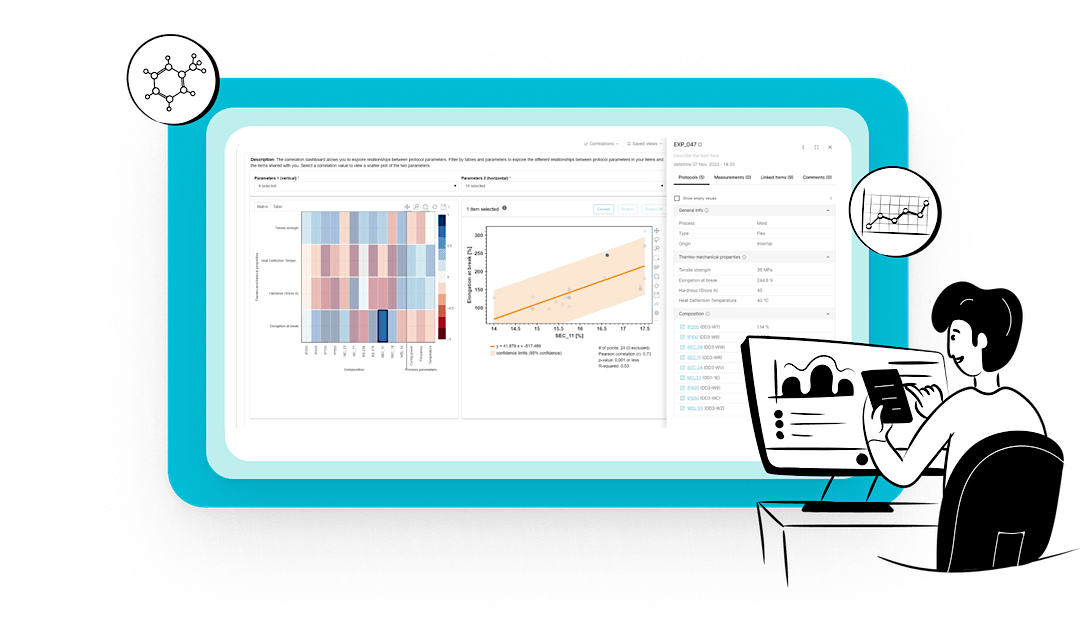
In process development, AI complements the design of experiments and process analytics. MaterialsZone’s Visual Analyzer supports cross-organizational, multi-dimensional analysis across R&D data, helping teams identify patterns, correlations and process variables that may otherwise be difficult to detect.
7. Defect Detection and Quality Control
In quality control, computer vision models can identify defects in images or production data. Examples of common defects include coating inconsistencies, cracks, voids, contamination, and microstructure anomalies.
Manual inspection can be slow and subjective. Computer vision and machine learning models can flag anomalies earlier and more consistently, reducing the risk of internal failures, rework, or customer-facing quality problems.
To do this, teams train AI models on labeled image, microscopy, spectroscopy, or sensor datasets that show both acceptable and defective materials. Once trained, the model can compare new production or inspection data against learned defect patterns and flag deviations in real time.
For R&D and production teams, connected quality data creates earlier feedback. When inspection results are linked to formulation, process and testing data, teams can investigate why a defect occurred and adjust upstream decisions before it repeats.
8. Autonomous and Self-Driving Labs
Autonomous labs combine AI, robotics and connected data systems to design, run, evaluate, and iterate experiments with minimal human intervention. Autonomous systems are especially useful for repeatable and measurable workflows.
In suitable environments, AI can propose the next experiment, robotic systems can carry it out, and a connected data infrastructure can feed the results directly back into the model.
The AI system uses each result to update its understanding of the experimental space, then selects the next experiment based on predicted performance or the likelihood of reaching a target outcome.
Fully autonomous labs are still emerging, but the underlying principle is already relevant: AI becomes more powerful when every experiment is captured, structured, and used to improve the next decision.
9. Materials Selection and Sourcing Optimization
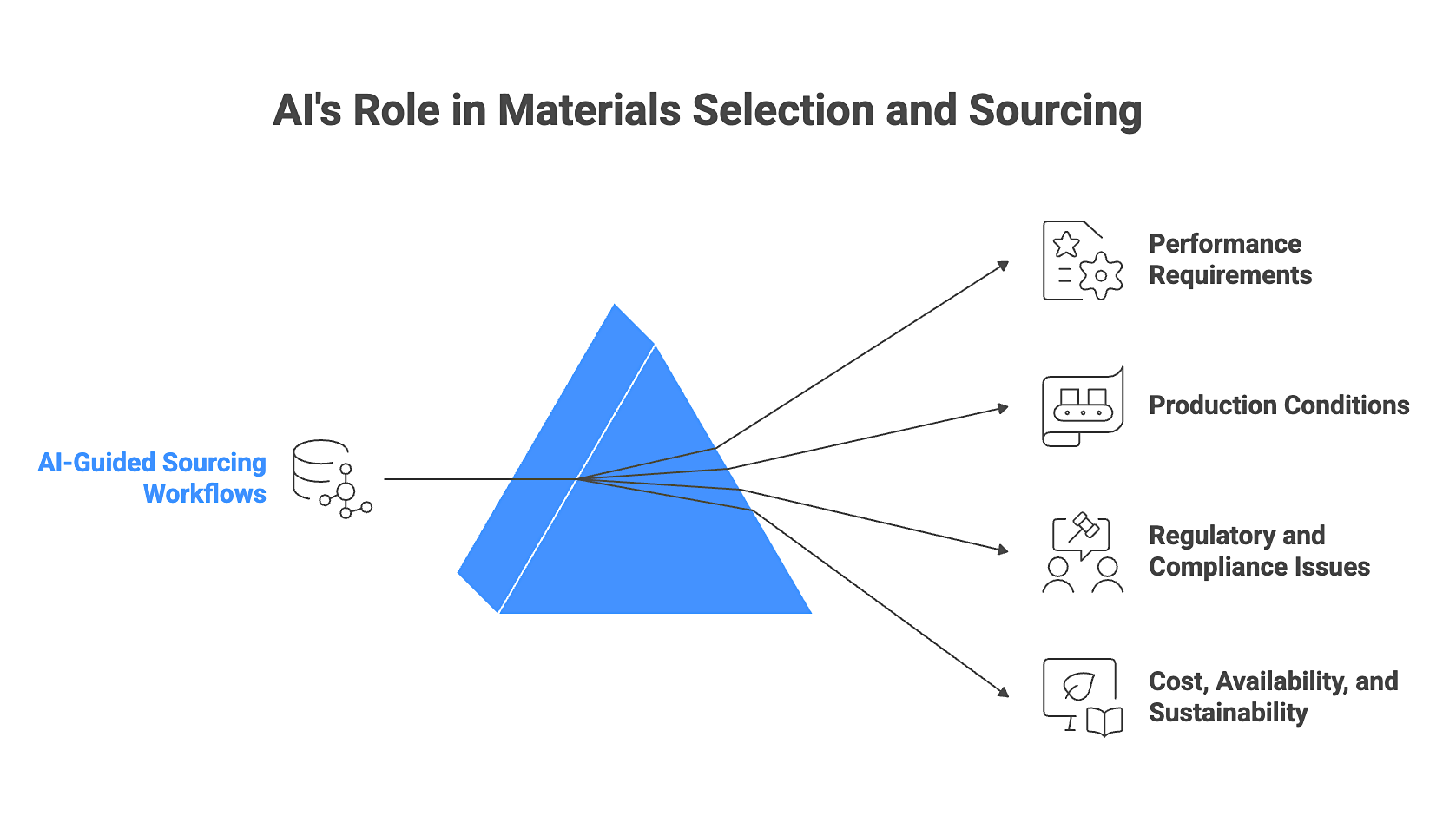
When a supplier changes a raw material or a preferred ingredient becomes unavailable, R&D teams need to know more than whether a substitute looks similar on paper. AI-guided sourcing workflows help teams evaluate whether an alternative can actually work in context:
- Will it meet the same performance requirements?
- Does it fit existing production conditions?
- Could it create regulatory or compliance issues?
- How might it affect cost, availability, or sustainability targets?
These questions are also part of a broader supplier risk assessment, where teams evaluate whether a vendor or material source could introduce operational, regulatory, quality, cost, or supply continuity risk. To answer those questions, AI can compare supplier data, historical performance results, regulatory information, pricing, availability, and sustainability metrics, then rank alternatives according to the organization’s technical and commercial priorities.
Sourcing optimization requires connected data from procurement, R&D, supplier documentation, regulatory databases, and performance testing. For example, if a supplier changes an ingredient or a material becomes harder to source, AI can help surface viable alternatives earlier and show how that change may affect compliance or production.
10. Sustainability and Green Materials Development
AI can support sustainable materials development by helping teams compare trade-offs between performance, cost, manufacturability and environmental impact.
Sustainability-focused AI works by integrating metrics such as lifecycle data and regulatory restrictions (where reliable data is available) into the same models used to evaluate technical performance.
Sustainable materials development is becoming more important as regulatory pressure and ESG commitments make sustainability a practical R&D requirement rather than a separate initiative.
The challenge is that sustainable materials decisions are rarely one-dimensional. A lower-impact material still needs to comply with regulations and make commercial sense. AI can help teams compare these competing factors more systematically, especially when sustainability metrics are integrated into the same data environment as formulation and process data.
Turning AI in Materials Science Into R&D Impact
AI in materials science is already helping R&D teams move from slower, reactive experimentation toward more informed, data-driven development. The common thread is reusable experimental knowledge: when data is structured and connected, AI can guide better decisions across the R&D lifecycle.
MaterialsZone supports AI-guided R&D through four connected capabilities:
- The Materials Knowledge Center centralizes experimental data, supplier information, formulation records, test results, and process context.
- The Collaboration Hub helps teams work from the same R&D knowledge base across projects and departments.
- The Visual Analyzer helps teams identify patterns across materials, processes, and performance data.
- The Predictive Co-Pilot uses structured R&D data to guide the next experiment and reduce trial-and-error.
Together, these capabilities enable every experiment to strengthen the next decision.
Request a MaterialsZone demo today to see how your team can accelerate materials-based product development and bring better products to market faster.

.png)