12 Best Cosmetic Formulation Software Platforms
Cosmetic formulation software helps R&D and product-development teams manage formulation data, scientific knowledge, workflows, compliance requirements, and AI-assisted decision-making, but different platforms are built for different primary jobs. This guide compares 12 platforms across four categories: enterprise materials informatics and AI-guided R&D, enterprise formulation and PLM, cosmetics-specific formulation and compliance, and AI-assisted tools for smaller teams. Use it to identify the right software category for your workflow and shortlist platforms based on data complexity, regulatory scope, integrations, AI governance, and implementation needs.
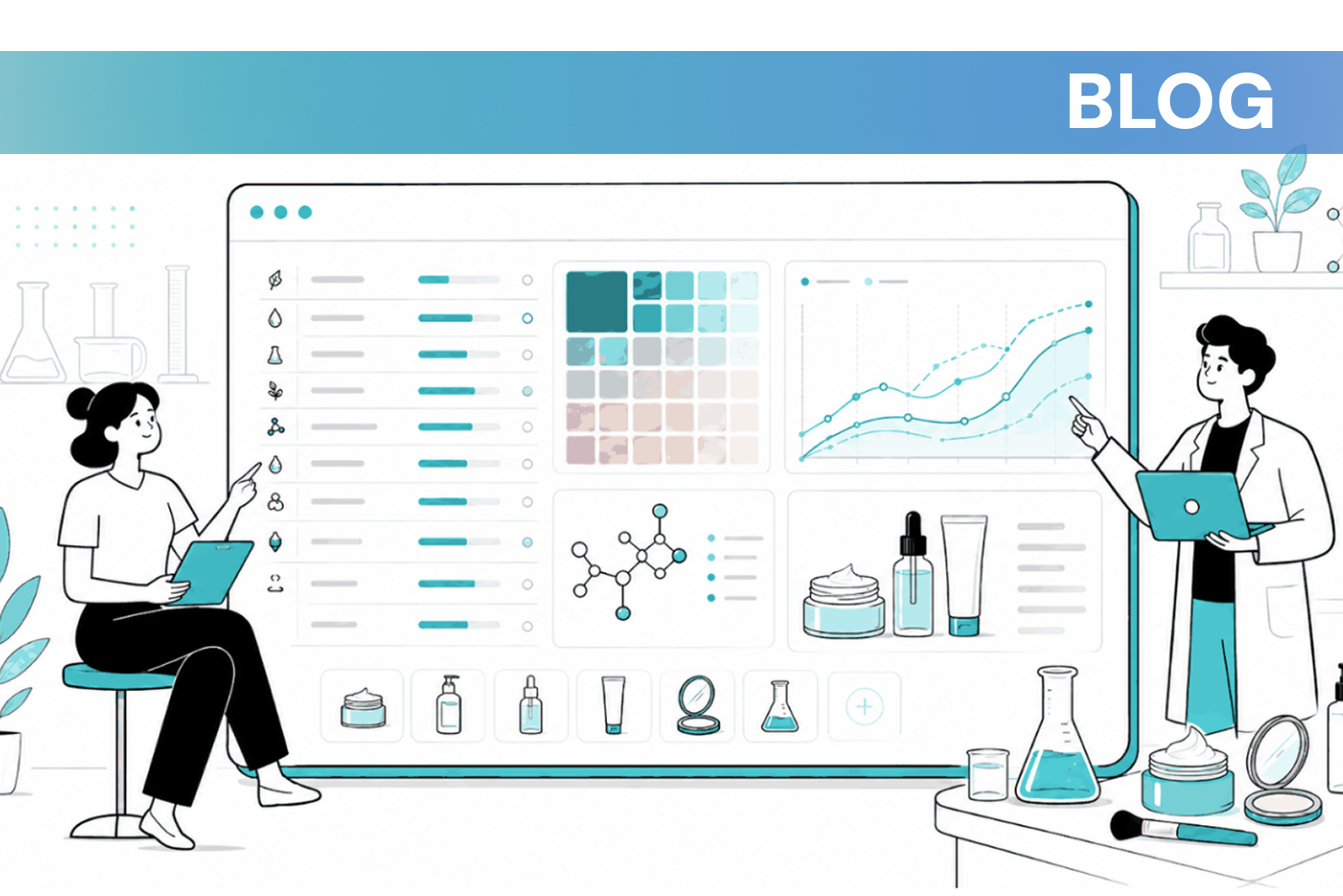

Starting with the right foundation is everything. Makeup artists get to take this universal advice literally, but for the manufacturers formulating makeup and other cosmetic products, the strongest foundations are made of accurate, accessible data.
Cosmetic formulation software platforms are effective solutions for organizing knowledge and managing efficient workflows, but cosmetic manufacturers are as unique and diverse as the goods they bring to market. How can manufacturers find a software category that aligns with their business model and choose the optimal platform?
Cosmetic formulation software is wrangling production and regulation challenges at a massive scale: as of March 2026, the FDA reported more than 1.1 million unique and active cosmetic product listings subject to regulation under the Modernization of Cosmetics Regulation Act. While multimillion-dollar industrial manufacturers and organic in-home makers may have to navigate some of the same requirements, their day-to-day processes are markedly different, and so are their criteria for software platforms.
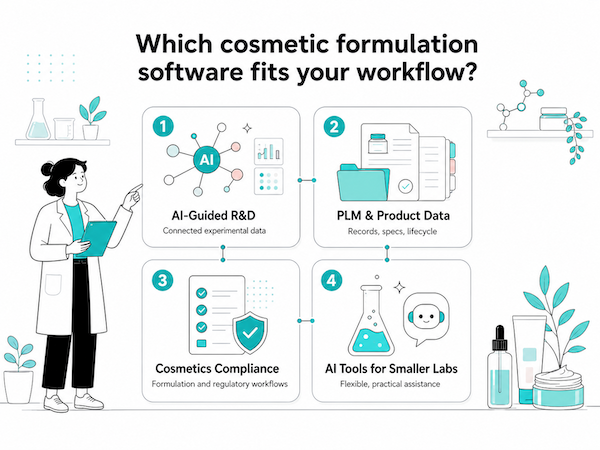
Which software category fits your workflow?
Formulation software platforms often contain a range of features, but they can be categorized based on the primary jobs they are designed to handle. The category can be difficult to define because formulation software overlaps with PLM, ELN/LIMS, compliance, and materials informatics platforms, but these systems are not interchangeable.
Because these categories overlap, the best starting point is to identify the job your team needs the software to perform most often. The platforms in this guide are therefore grouped by their primary role, helping you compare solutions with similar purposes and identify the best fit for your workflow.
The four primary jobs that define our categories are:
- Enterprise Materials Informatics and AI-Guided R&D for teams connecting experimental data and scientific knowledge to support analysis and AI-guided decisions.
- Enterprise Formulation, PLM, and Product Data Platforms for teams managing formulation records, specifications, workflows, and product lifecycles. Unlike materials informatics, PLM primarily serves as a system of record across the product lifecycle.
- Cosmetics-Specific Formulation and Compliance Platforms for teams prioritizing formulation, documentation, testing, supplier, and regulatory workflows.
- AI-Assisted Formulation Tools for Smaller Labs focused on accessible formula support, ingredient data, validation, and costing.
Enterprise Materials Informatics and AI-Guided R&D Platforms
These solutions manage connected experimental and materials data, situating it within a context that allows for multidimensional analysis, knowledge reuse, and effective AI guidance on R&D decisions. MaterialsZone is the only solution in this category because materials informatics is its primary job, whereas the rest of the platforms emphasize other core functions first.

For cosmetics manufacturers looking to connect experimental data, scientific knowledge, and AI-guided R&D decisions, MaterialsZone provides a unified materials informatics environment. Its Visual Analyzer supports multidimensional analysis of complex lab data and helps teams identify patterns across R&D processes, while the Predictive Co-Pilot models outcomes and supports AI-guided experimentation to reduce unnecessary iterations. The platform also centralizes R&D knowledge for cross-team reuse and collaboration. Teams primarily seeking PLM-style lifecycle management or dedicated regulatory compliance workflows may be better served by another software category.
Pricing is available by request.
Enterprise Formulation, PLM, and Product Data Platforms
This category best suits enterprise product development teams who are managing formulation records, specifications, workflows, and lifecycle data. In contrast with the R&D emphasis of materials informatics, PLMs serve more of a system-of-record role.

Centric PLM combines workflow, ingredient screening, product-data management, documentation, and regional assortment tools to support product development across cosmetics and other consumer-product categories. Because the platform serves industries beyond cosmetics, R&D teams should confirm that its formulation depth and scientific workflow support match their specific requirements.
Pricing is subscription-based and given by inquiry.
Consumer packaged goods including, but not limited to cosmetics are the scope of this versatile, cloud-deployed PLM.
Offering native integrations with various design and logistics applications, Aptean’s solution is built to manage cosmetic products from brief straight through to launch, promising to accelerate development without sacrificing rigorous compliance standards across multiple languages and regulatory zones.
Pricing is made available by request.

Although it isn’t designed as a cosmetics-specific solution, Labguru’s formulation data tools can deliver faster results and better tracking for R&D teams.
Relevant features include an integrated chemistry module that manages experiments as well as compliance, cloud deployment, and extensive customization options. It functions as a unified platform with Labguru’s ELN and LIMS solutions.
Pricing is given out by request only.
Cosmetics-Specific Formulation and Compliance Platforms
This category is for cosmetic manufacturing teams who have to prioritize formulation records, documentation, testing, supplier management, and regulatory workflows.
Coptis aims to reduce both the time and costs of development with their specialized PLM solution.
Informed by more than two decades of working with major cosmetic manufacturers, this integrated platform automates materials and formulation workflows, instantly producing trackable logs and minimizing repetitive work for R&D teams. On the compliance side, Coptis continuously scans international databases to generate real-time alerts and updates. Its cosmetics-specific depth may make it a stronger fit for teams prioritizing regulatory and formulation workflows than organizations primarily seeking broader experimental-data analysis.
Tiered pricing is provided upon request.
Geared toward food, beverages, and cosmetic product development, Trace One Devex PLM is a robust SaaS platform that uses collaboration tools, extensive integration options, and a detailed regulatory compliance framework to swiftly carry new products from concept to market. This platform is particularly well-situated with end-to-end quality management features, including procurement and supply chain tools. Teams that only need formulation management may want to assess whether its broader product-lifecycle and supply-chain scope adds useful value or unnecessary complexity.
Pricing is available by request.

This all-in-one platform was made specifically for cosmetics manufacturers taking on global marketing and compliance.
Whether your challenges center on regulations, toxicology, or environmental impact, EcoMundo’s industry expertise can provide accurate and detailed support for all of your required tasks and reporting. Their formulation modules offer R&D teams AI analytics and product management tools to support innovation. For teams whose primary need is experimental-data unification or advanced scientific analysis, its compliance-led focus may be less central to the buying decision.
Pricing varies by implementation and must be requested directly.
Manufacturers in search of a straightforward, cosmetics-focused PLM solution to centralize and streamline their operations will find all of the essential formulation and compliance features in this solution from Registrar Corp.
Teams with special concerns about data security will note that Cosmetri Product Manager is one of the few solutions in this market with ISO/IEC 27001:2022 certification.
Pricing on request.

Billed as an all-in-one PLM, ERP, and more, this AI-powered platform serves manufacturers of all types of regulated substances, cosmetics, food, pharmaceuticals, and supplements.
Worldover includes features tailored toward cosmetics, such as regulatory support spanning multiple major international markets. The base product boasts LIMS functionality in addition to the expected formulation management and versioning features, along with automated, single-source document authoring tools. Because it spans PLM, ERP, LIMS, and compliance functions, buyers should assess which modules they actually need and how that breadth will affect implementation.
Pricing is provided by request.

Cosmetics producers in need of a low-cost solution can find a PLM, materials finder, and AI assistant in the free-to-use CM Studio+ platform.
This solution gives you formulation tools to design or reverse-engineer new products along with compliance features such as a searchable audit database and automated rechecking against regulatory databases. Its free entry point is attractive for smaller operators, but teams should check which capabilities require paid upgrades before comparing total cost with other platforms. While the base version is free, many advanced features come at an additional cost.
AI-Assisted Formulation Tools for Smaller Teams
If “lean” and “independent” describe your cosmetics operation, this may be your category. Key features to look for include formula assistance, ingredient data, validation, cost analysis, compliance support, and flexible pricing.

Formuley is a flexible, budget-friendly cosmetic formulation solution that packs in a wide range of powerful features, like an AI formula generator, ecommerce integrations, and profit margin risk analytics.
There’s a free plan, and paid options start at $20 per month for solo formulators up to $699 or more for larger labs. Compliance is supported with a variety of documentation features and controls, some of which require “pro” or higher-level subscription plans.

Last of all is this formulation technology platform, built around core functions related to developing cosmetic and industrial chemical products, calculating product data, and providing a deep knowledge base of tutorials and technical guides.
The compliance checker covers major markets including the US, EU, China, and ASEAN. Many of FormulaAlchemy’s tools are free, but some additional features—like the AI formula generator and deformulator designed for cosmetics—are paywalled.
Pricing given upon request.
How we selected and compared these platforms
Research was conducted in August 2026 using official product information and publications, reputable independent evidence, and vetted product reviews. Active commercial products with meaningful formulation or R&D relevance, sufficient official evidence, and a distinct buyer fit were included for consideration.
Core comparison criteria included the primary job performed by each solution, its ideal user, scope of regulatory compliance frameworks, method of analytics, possible integrations, implementation and deployment, and pricing transparency.
Solutions were evaluated against shared and category-specific criteria, with direct platform comparison limited to the multi-vendor categories. Not every solution received hands-on testing.
How to choose the right cosmetic formulation software
Start your selection process by looking for the software category with the primary job that aligns most closely with your top requirements and challenges, then assess individual solutions within that category for the best fit. For example, teams focused on connected experimental knowledge and AI-guided R&D will have different requirements from teams primarily managing product specifications, regulatory documentation, or formulation records.
Important secondary criteria may include whether or not the regulatory markets you operate in are covered, the complexity of the data that the solution is capable of handling, if it offers integrations with the rest of your tech stack, how difficult it will be to implement and maintain, what options there are for implementation and deployment, concerns around AI validation and governance, and total pricing once all the features you need have been added. For AI-enabled platforms, ask how recommendations are generated, what data they rely on, how outputs can be reviewed or validated, and what controls are available for scientific and data governance.
Once you have narrowed the field to two or three platforms, compare them using the same representative use case rather than relying only on feature lists. If possible, avoid generic testing models and use your organization’s own representative workflows and data in demonstrations or pilots. This makes it easier to evaluate usability, integration requirements, data handling, and whether the platform fits the way your R&D team actually works before committing to a broader rollout.
Develop Winning Formulations with Materials Informatics
When the success of your business rides on the quality of chemically formulated products, few software solutions will matter more than the one that manages the development, maintenance, and safety of those formulas. The right solution will be one that harmonizes with your organization’s workflow, regulatory scope, data complexity, and integration requirements.
If you’re looking beyond formula recordkeeping to bigger-picture challenges, like unifying fragmented experimental knowledge for cross-team reuse, a materials informatics platform like MaterialsZone can provide multidimensional analysis and AI-guided optimization focused specifically on experimental knowledge and R&D decision-making, rather than the broader lifecycle-management role of PLM.
For cosmetics R&D teams looking to unify experimental data, improve cross-team knowledge reuse, and apply AI-guided optimization to formulation development, book a MaterialsZone demo to see how the platform fits your workflows and data.

.png)