Top 17 LIMS (Lab Information Management System) Software by Category
What is LIMS (Lab Information Management System) software? A LIMS, or Laboratory Information Management System, helps labs manage samples, workflows, tests, results, users, and compliance records in a traceable digital environment. For materials R&D and formulation teams, next-generation LIMS software is most valuable when it connects lab work to formulation context, raw material data, quality results, AI-guided analytics, and business results.

Top LIMS software includes:
- MaterialsZone
- Sapio Sciences LIMS
- QBench
- Autoscribe Matrix Gemini LIMS
- Labguru
- Labworks LIMS
- Lockbox LIMS
- Genemod
- LabWare LIMS
- LabVantage LIMS
- Thermo Scientific SampleManager LIMS
- STARLIMS
- Agilent SLIMS
- SENAITE
- Bika LIMS
- LabKey LIMS
- LabCollector LIMS
Many labs struggle when it comes to drawing clear connections between lab work and product outcomes. Your materials team might see that one formulation outperformed another, but without a clear data trail, the result is hard to trust, repeat, or use as the basis for the next product decision.
Laboratory Information Management Systems (LIMS) create traceable structures that connect lab work, results, and workflow context in one system. The value of LIMS to manufacturers is driving adoption, with the global LIMS market projected to reach $4.7 billion by 2033.
But not every LIMS is built for the same type of lab. Traditional LIMS platforms can support sample tracking, workflow control, reporting, and compliance, while materials-focused teams may need deeper connections between formulations, raw materials, experiment history, analytics, and product decisions.
Choosing the right LIMS depends on your lab’s industry, data model, workflows, and whether you need a traditional system of record or a next-generation AI-Guided LIMS solution that can connect lab data to R&D decisions and business results.
What are LIMS, and why are they important?
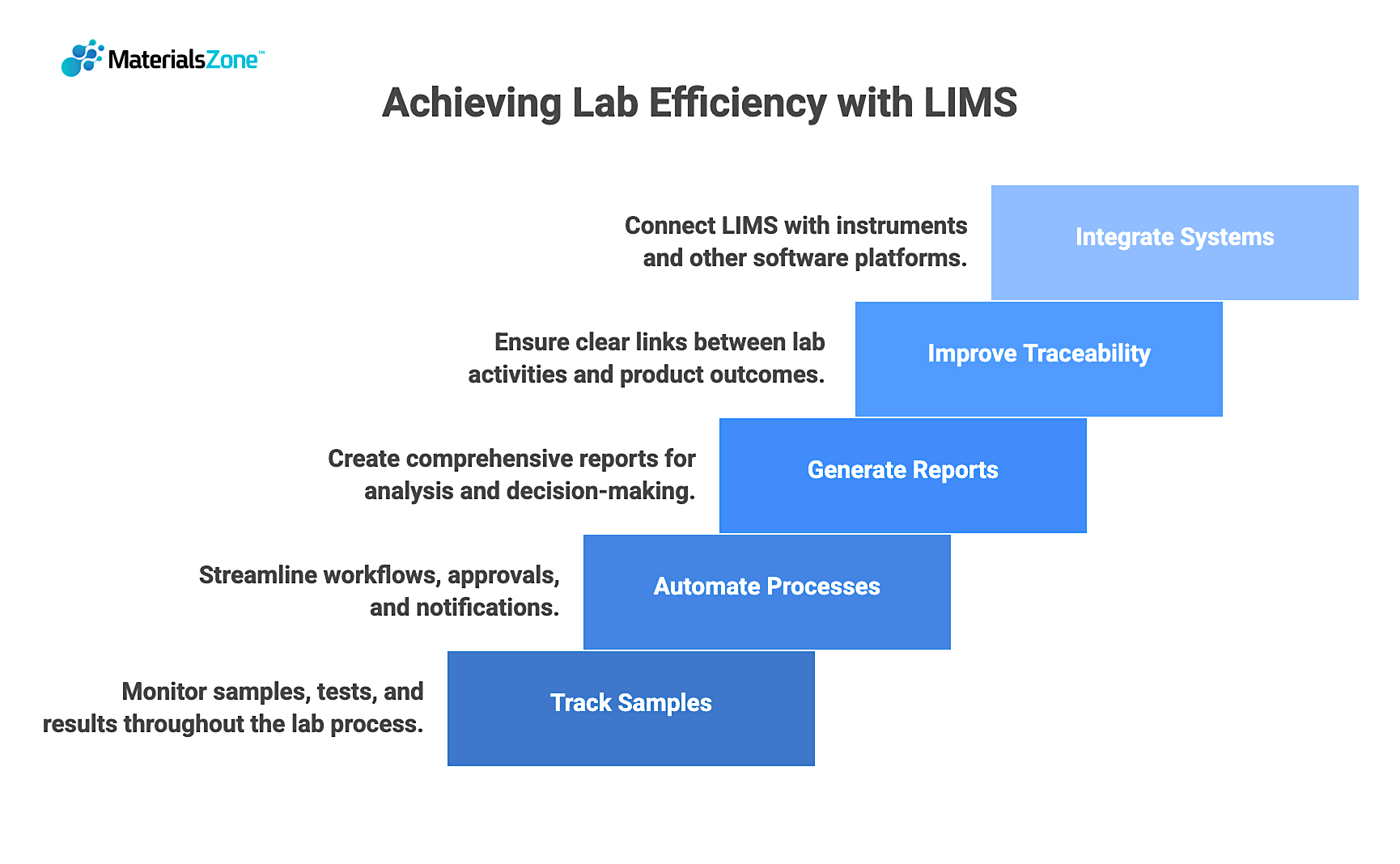
LIMS software helps R&D, QC, production, and testing labs organize lab data, manage workflows, and maintain traceability between lab activity and product outcomes. In typical research and manufacturing scenarios, LIMS can:
- Track samples, tests, results, and inventory
- Automate lab processes such as workflows, approvals, notifications, and reporting steps
- Generate reports
- Improve traceability
- Integrate with instruments and other software platforms
Some labs, including those focused on complex materials R&D, may need more specialization than a traditional LIMS offers. For teams working in labs like these, the greater advantage can be in connecting LIMS and ELN (Electronic Lab Notebook) functionality with current and historical data related to formulation, raw materials, experimentation, analytics, collaboration, and AI-guided decision-making, so lab data becomes more than a record of what happened. It becomes a foundation for AI-Guided R&D: predicting outcomes, reducing trial-and-error, identifying better next experiments, and connecting lab activity to business results.
LIMS vs. ELN vs. LIS: When Each System Makes Sense
Does every lab need a LIMS? It depends. A lab may not need a full LIMS if it has low sample volume, simple workflows, limited compliance requirements, or primarily needs flexible experiment documentation rather than structured sample and test management.
There are other solution categories similar to LIMS that are geared toward the needs of particular industries and processes. Here’s how they compare:
- LIMS (Lab Information Management System) is best for structured management of samples, workflows, testing, reporting, compliance, and traceability.
- ELN (Electronic Lab Notebook) is best for documenting experiments, protocols, observations, calculations, and research context.
- LIS (Laboratory Information System) usually refers to clinical or medical software systems used for patient-linked diagnostic workflows.
In practice, the best fit depends on whether your lab needs structured operational control, flexible research documentation, or, in clinical settings, a patient-linked diagnostic system.
5 Types of LIMS Software
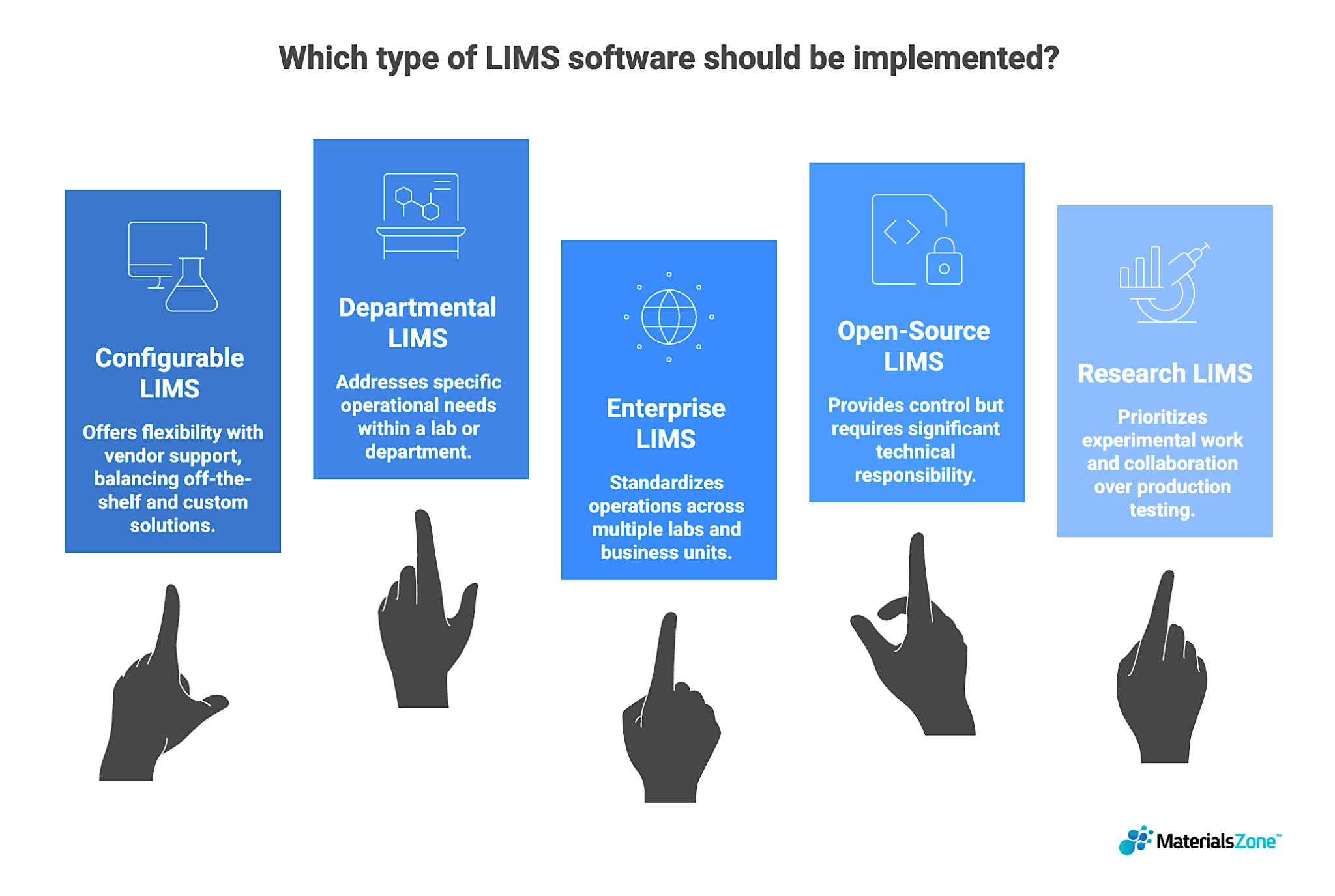
LIMS software can be sorted into five categories that reflect the primary buyer needs each platform is most likely to support. These categories are not mutually exclusive, and many LIMS will fit into more than one.
1. Configurable LIMS
- A commercial LIMS designed to support different lab workflows through built-in configuration options rather than custom code.
- Sits between off-the-shelf systems and fully custom builds
- Gives labs flexibility while keeping implementation and maintenance under vendor support.
2. Departmental LIMS
- A LIMS used by a specific lab, team, department, or function rather than across the entire organization.
- Usually narrower in scope than an enterprise LIMS
- Often selected to address a defined operational need, such as organizing samples, tests, inventory, QC records, or R&D data.
3. Enterprise LIMS
- An enterprise LIMS is a large-scale LIMS used across multiple labs, sites, departments, or business units.
- Designed to standardize lab operations, data governance, compliance, and reporting across complex organizations.
4. Open-Source LIMS
- A LIMS with source code that can be inspected, modified, and extended by users or technical teams.
- Gives organizations more control over the software environment but usually requires them to take on extra responsibility for setup, hosting, security, customization, and maintenance.
5. Research LIMS
- A LIMS designed for labs where experimental work, sample context, collaboration, and data management take a higher priority than high-volume production testing.
- Helps teams connect samples, protocols, results, metadata, and project records without forcing research workflows into rigid QC models.
Top Picks at a Glance
Configurable LIMS
- Recommended for all-in-one, AI-guided materials informatics with LIMS/ELN functionality: MaterialsZone
Departmental LIMS
- Recommended for individual R&D teams: Labguru
Enterprise LIMS
- Recommended for multi-site manufacturing: LabWare LIMS
Open-Source LIMS
- Recommended for open-source analytical workflows: SENAITE
Research LIMS
- Recommended for life sciences research data management: LabKey LIMS
Comparison Table: Best LIMS Software Compared
This table compares LIMS software by category, deployment model, integration capabilities, setup complexity, and regulatory compliance support, so you can quickly identify which tools fit your lab’s operational and technical requirements.
For materials-focused buyers, it is also a starting point for evaluating whether a platform can connect LIMS data to formulation context, analytics, and AI-guided product decisions.
Top 17 LIMS (Lab Information Management System) Software by Category
Configurable LIMS
Buyers in this category should look at how much the platform can adapt through standard configuration, how easily workflows can change over time, and when paid customization becomes necessary.
1. MaterialsZone – Recommended for all-in-one, AI-guided materials informatics with LIMS/ELN functionality

MaterialsZone is an AI-guided materials informatics platform with integrated LIMS and ELN functionality for materials R&D teams.
Conventional LIMS tools are strong for sample tracking, workflow control, and traceability, but materials teams often also need formulation context, raw material data, experimental history, analytics, collaboration, and predictive modeling.
This is where an AI-guided LIMS approach becomes valuable: it helps teams move beyond recording what happened so they can analyze relationships, predict likely outcomes, reduce trial-and-error, decide what to test next, and connect R&D work to measurable business results.
MaterialsZone brings these capabilities together through its Materials Knowledge Center, Collaboration Hub, Visual Analyzer, Predictive Co-Pilot, and LIMS/ELN functionality to create a more complete AI-Guided R&D environment.
Key Features:
- Materials Knowledge Center: Centralizes internal and external materials data in a structured, searchable environment.
- Collaboration Hub: Helps R&D, QC, production, and other teams work from shared data and project context.
- Visual Analyzer: Supports multi-dimensional analysis so teams can identify patterns across materials, formulations, and results.
- Predictive Co-Pilot: Uses AI-guided modeling to help predict outcomes and guide the next R&D decision.
Review: “Using the AI feature enabled prediction and optimization of printing conditions and resin composition, relying on a minimal number of experimental iterations.”
2. Sapio Sciences LIMS – Recommended for chemistry and formulation-focused R&D labs

Sapio Sciences LIMS emphasizes “science-aware” design that prioritizes access, frictionless workflows, and scientist-led data analytics. The platform integrates ELN and SDMS (Scientific Data Management System) in one unified platform.
Key Features:
- Sample and Materials Management
- AI Chat Assistant
- No-Code LIMS Templates
Review: “The feature of having multiple environments like validation, development, and production is beneficial.”
3. QBench – Recommended for rapidly changing lab workflows
QBench is a cloud-hosted LIMS that features a no-code workflow automation engine along with support for detailed reporting and compliance monitoring. Its no-code configuration tools can help labs adapt workflows without heavy custom development.
Key Features:
- Integrated QMS
- Visual Report Template Editor
- Automations Engine
Review: “The UI looks modern and is appealing to the eye. It has many highly flexible tools that can simplify processes.”
4. Autoscribe Matrix Gemini LIMS – Recommended for low-code LIMS configuration
Autoscribe Matrix Gemini LIMS uses codeless, graphical configuration to support workflows across a wide range of industries. The platform is built for long-term lab data management, workflow control, and error reduction.
Key Features:
- Secure Web Interface
- Visual Configuration Tools
- Additional Modules
Review: “The flexibility of the solution is totally unique but it can be daunting to a new user.”
Departmental LIMS
Buyers should confirm that a departmental LIMS is scalable and able to integrate with wider business systems. It should not become a separate data silo.
5. Labguru – Recommended for individual R&D teams

A cloud-based solution that scales well at the team level, Labguru gives R&D labs tools for workflow automation, inventory and sample management, and instrument integration. It also supports team collaboration by keeping protocols, samples, inventory, and results connected within the same workspace.
Key Features:
- Integrated ELN
- Labguru Mobile App
- BI Dashboards
Review: “Labguru especially made a difference in terms of collaboration among lab members working on different projects.”
6. LabWorks LIMS – Recommended for food and beverage testing labs

LabWorks LIMS supports lab data management across multiple industry sectors, including testing, environmental, water, and food and beverage labs. The platform helps labs manage samples, workflows, compliance records, reporting, and operational data.
Key Features:
- Laboratory Sample Management
- Laboratory Inventory Management
- Automated Compliance
- Analytics and Operation Dashboard
Review: “The system is highly configurable, allowing us to tailor it to our specific needs without extensive customization.”
7. Lockbox LIMS – Recommended for QC manufacturing labs
Lockbox LIMS is built on the Salesforce platform and is designed for life sciences, R&D, NGS, and QC manufacturing labs. Its modular structure supports sample tracking, inventory management, protocol execution, and quality workflows.
Key Features:
- Lab Sample Tracking
- Lab Inventory Management
- LIMS Customer Portal
- QMS Document Control
Review: “The sample and storage management modules are feature-rich, flexible, and easy to use.”
8. Genemod – Recommended for lab inventory-centered R&D teams

Genemod combines LIMS, ELN, and inventory management functionality in a platform built for R&D teams. Its AI-enabled tools support lab workflow management, protocol documentation, and access to structured research data.
Key Features:
- Context-Aware AI Chatbot
- Integrated ELN
- Equipment Management
Review: “Its structure is well-designed, allowing us to tailor it to our lab environment and scale as we grow.”
Enterprise LIMS
Enterprise LIMS buyers should assess implementation complexity, integration needs, validation support, vendor stability, security, and the ability to standardize workflows without blocking local lab requirements across sites.
9. LabWare LIMS – Recommended for multi-site manufacturing
Serving laboratories cross a wide range of industries, LabWare LIMS is an enterprise platform for managing lab workflows, data, reporting, and compliance requirements. It can be configured to support different laboratory processes across sites and business units.
Key Features:
- ELN Add-On
- Lot Management
- Environmental Monitoring
Review: “The latest generations of the LabWare LIMS platform offer pre-designed templates so the LIMS System can be deployed out of the box with only minimal configuration needed to get up and running.”
10. LabVantage LIMS – Recommended for global pharma

LabVantage offers a technologically advanced system based on end-to-end efficiency, a flexible HTML5 environment, and AI analytics capabilities. Industry-specific packages and rigorous support for the latest security and compliance standards make this a solid choice for large-scale operations.
Key Features:
- Sample and Consumables Management
- Environmental Monitoring
- Integrated SDMS
- Dynamic Scheduling
Review: “Results are easy for groups to see and they're always accessible. If I need to find a sample owned by more regular users, it is very quick.”
11. Thermo Scientific SampleManager LIMS – Recommended for regulated QC

This LIMS software provides deep integration with the entire ecosystem of Thermo Fisher instruments and equipment. It’s a complete informatics solution that supports error-free processes and streamlined workflows across complex and regulated lab environments.
Key Features:
- Integrated SDMS, ELN, and LES
- Data Analytics Solution
- Sample Management
- Inventory Management
Review: “I have used LIMS for over 20 years now and I like the interface and flexibility for use with our commercial needs.”
12. STARLIMS – Recommended for broad enterprise lab informatics

STARLIMS helps labs manage samples, workflows, data, reporting, and traceability across regulated environments. Its suite can include SDMS, LES, ELN, and analytics capabilities, supporting industry-specific workflows beyond core LIMS functions.
Key Features:
- Integrated Labstep ELN
- Hundreds of Out-of-the-Box Reports
- 15+ Premade Out-of-the-Box Workflows
Review: “After the launch of the STARLIMS system, our laboratory management is more convenient and simple, and the probability of errors is relatively low.”
13. Agilent SLIMS – Recommended for laboratory execution workflows

Agilent SLIMS combines LIMS and ELN functionality within a Laboratory Execution System for managing and executing lab workflows. It can be tailored to an organization’s needs with premade configurations from the SLIMS Store.
Key Features:
- Built-In LES (Laboratory Execution System)
- Sample Management
- Advanced Data Integrity Standards
Review: “It’s easy to put orders in your notes and search for specific information.”
Open-Source LIMS
Open-Source LIMS buyers will want to evaluate internal IT capacity, documentation quality, community activity, security practices, hosting requirements, and access to professional support.
14. SENAITE – Recommended for open-source analytical workflows
SENAITE’s open-source LIMS covers the analytical workflow from sample intake to report publication. Built on Plone, it supports sample management, worksheets, calculations, audit logs, client access, reporting, and integrations through its REST API.
Key Features:
- Built-In Dashboard
- Sample Management
- Instrument Management
- Client Portal
Review: “I would recommend hiring the support of a professional service provider since these systems are complex to use and maintain. The project has a vibrant community that helps you with anything.”
15. Bika LIMS – Recommended for open-source quality management workflows

Bika LIMS provides sample tracking, analytical workflows, instrument integration, quality control, and reporting. It can be extended with add-ons for bulk sample importing, Certificates of Analysis, instrument interfaces, billing, queue management, and other lab-specific needs.
Key Features:
- Sample Importer
- Certificate of Analysis Templates
- Management Reports
Review: “Better than any boxed product.”
Research LIMS
For research LIMS, buyers need to consider how well the system supports experiment context, collaboration, metadata structure, and downstream analysis.
16. LabKey LIMS – Recommended for life sciences research data management
LabKey LIMS supports sample management, inventory management, and lab data management for scientific research teams, with a focus on life sciences and biologics. It helps teams manage sample lifecycles, storage, workflows, and related research data.
Key Features:
- Integrated ELN
- Inventory Management
- Sample Management
- Storage Management
Review: “It’s like Google Drive but for lab experiments. It helps us organize lab data quite well and share it among peers.”
17. LabCollector LIMS – Recommended for research lab sample and inventory management
LabCollector LIMS supports sample tracking, test management, inventory, and lab workflow management through a modular platform. It can be tailored with add-ons and integration options for different research lab needs.
Key Features:
- Client/Patient Portal
- One-Click Barcoding
- I-Collector Instrument Integration Hub
Review: “Once the layout design and migration concerns were addressed, I found the system very intuitive, easy to use, and the team is wonderful to work with.”
How We Compared These Tools
Solutions were compared using common criteria to help readers quickly identify relevant options. We based our research on publicly available information as of 22 June 2026.
What we reviewed:
- Vendor websites, product pages, feature pages, and available documentation
- Pricing and plan details
- Available security, compliance, and deployment information
- Third-party reviews and credible independent comparisons
Evaluations focused on core functionality, setup complexity, deployment model, integrations, automation, reporting, compliance support, and category fit. We did not conduct hands-on testing for each tool. When a capability was not clearly documented, we avoided treating it as a confirmed strength.
How we compared tools:
Categorizations were based on key structural differences in how LIMS products are built, deployed, and adopted. Because many LIMS products can fit more than one category, we grouped each tool by the primary buying need it is most likely to support:
- Configurable LIMS covers commercial platforms that adapt to different lab workflows through built-in configuration rather than custom code.
- Departmental LIMS covers tools built for specific labs, teams, or functions.
- Enterprise LIMS covers platforms built for multi-site, complex organizations with high governance requirements.
- Open-Source LIMS covers software with source code that can be inspected, modified, and extended by users or technical teams.
- Research LIMS covers systems designed around experimental context, samples, metadata, and collaboration rather than routine production or QC testing.
The categories reflect how flexible the software is, who owns and maintains it, how broadly it is deployed, and what type of lab workflows it supports.
Choose a LIMS That Fits Your Lab’s Data and R&D Needs
A LIMS can help labs bring structure and traceability to samples, workflows, results, and records. For materials R&D teams, the stronger fit is often a next-generation, AI-guided approach. These advanced platforms include LIMS/ELN functionality and help interpret lab data in the context of formulations, process variables, quality outcomes, and future product decisions.
MaterialsZone applies that AI-guided approach through a materials informatics platform designed for complex materials data. It helps teams leverage their LIMS investment into AI-Guided Business Results by organizing experimental information, analyzing relationships across formulations and results, and using predictive insights to connect lab activity with measurable R&D and product outcomes.
Book a MaterialsZone demo to see how your team can turn materials data into faster, more confident product decisions.

.jpeg)