


Cosmetic Stability Testing: An Essential Guide
Cosmetic stability testing is a structured, product-specific process for determining whether defined quality attributes remain acceptable over time under relevant conditions. Effective programs connect credible failure modes with justified stress conditions, measurements, acceptance criteria, and decisions rather than relying on universal protocols or assuming accelerated testing directly predicts real-time shelf life. Clear, traceable data across formulations, batches, methods, specifications, packaging, and time points also supports investigations, change decisions, knowledge reuse, and more efficient AI-guided R&D.
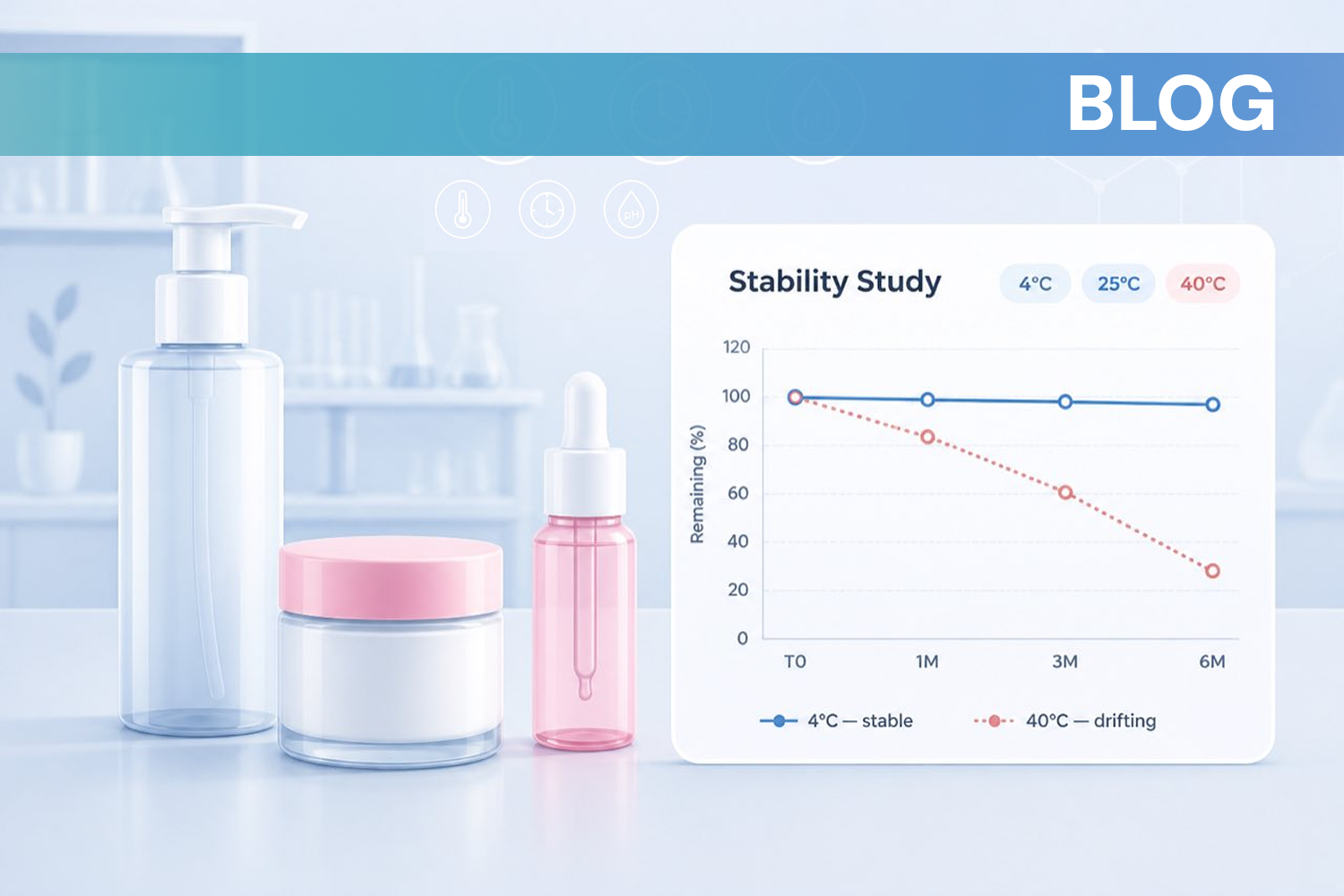

A cosmetic formula can perform acceptably during development and still drift once exposed to its final package, distribution environment, or normal conditions of use. Product quality and safety remain under close scrutiny: in 2025, cosmetics were the most frequently notified dangerous-product category in the EU’s Safety Gate system, accounting for 36% of validated alerts. These notifications cover a range of product safety and regulatory issues and should not be interpreted as evidence of stability failures specifically.
Formulation and R&D teams need to define which risks they are evaluating through cosmetic stability testing, the conditions that represent those risks, the measurements that can detect change, and the decision each result will support.
What Does Cosmetic Stability Testing Measure?
Cosmetic stability testing is an evidence-based program used to assess whether defined product attributes remain acceptable over a specified period and under relevant conditions.
Depending on the product, those attributes may include physical appearance, color, odor, texture, homogeneity, pH, viscosity or rheology, key constituent levels, microbiological quality, package performance, and dispensing behavior.
The evidence is necessarily bounded by the study design. Results apply to the batches, formula versions, packaging configurations, conditions, methods, time points, and acceptance criteria that were actually evaluated.
What Does Cosmetic Stability Testing Measure?
Accelerated studies can help teams examine how a product behaves under selected conditions, but they should not be treated as providing a universal conversion to a guaranteed real-time shelf life. ISO/TR 18811 deliberately does not prescribe universal conditions, parameters, or criteria, and shelf life varies with factors such as product type, use, and storage.
Link each study decision through the same chain:
This example is illustrative rather than prescriptive. The condition, method, time points, and criterion should be justified for the specific product.
Stability Testing vs. Packaging, Preservation, and Microbial Testing
Related cosmetic tests often sit within the same development program, but they answer different questions.
ISO 11930:2019, as amended by ISO 11930:2019/Amd 1:2022, addresses the antimicrobial protection of cosmetic products and remains the current published edition. ISO/CD 11930 is under development and is intended to replace it.

Regulatory Expectations for Cosmetic Stability Testing
Stability evidence has a regulatory role, but the exact obligation depends on the market and product category.
- European Union: The Cosmetic Product Safety Report must include the product’s physical and chemical characteristics and stability, including stability under reasonably foreseeable storage conditions. EU labeling requirements also distinguish between products with a minimum durability of 30 months or less and products with a durability of more than 30 months, for which a period-after-opening indication generally applies when relevant.
- Great Britain: The Product Information File includes a Cosmetic Product Safety Report. UK guidance states that Part A addresses product stability alongside physical and chemical properties, microbiological information, preservation, packaging, and likely use.
- United States: FDA considers determining a cosmetic product’s shelf life to be the manufacturer’s responsibility. Products regulated as drugs, or as both drugs and cosmetics, are subject to drug-specific stability testing and expiration-date requirements.
This overview does not replace market-specific regulatory review. Great Britain and Northern Ireland should also be treated separately where their requirements differ.
How to Conduct Cosmetic Stability Testing: 5 Key Steps
Step 1: Decide When to Run, Repeat, or Bridge a Stability Study
Teams may need new or updated stability evidence when changes affect the formula, materials, process, packaging, storage conditions, intended use, or claims.
Relevant changes can include the formula, ingredient grade, supplier, preservative system, manufacturing process, scale, production site, package, storage conditions, intended use, or claims.
Not every change automatically requires a complete repeat study. Teams should assess whether existing evidence still applies, whether targeted bridging can answer the new question, or whether a broader repeat study is justified. You can document the scientific rationale for either approach.
A simple check is to return to the study-design matrix: has the change introduced a new failure mode, altered a relevant stress condition, changed the measurement needed, or undermined a previous acceptance criterion?
Step 2: Build a Product-Specific Stability Testing Protocol
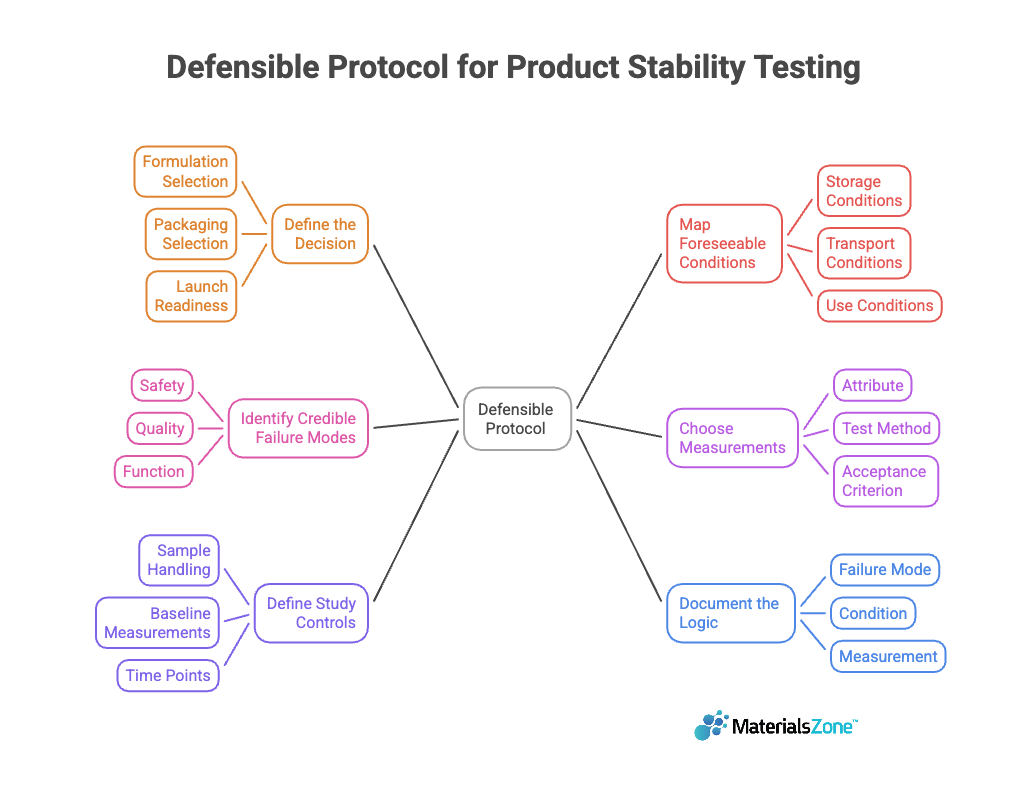
A defensible protocol begins with the decision the study needs to support rather than a generic list of tests.
- Define the decision. Be clear about whether the study supports formulation selection, packaging selection, launch readiness, a change-control decision, shelf-life justification, or another defined purpose.
- Map foreseeable conditions. Consider expected storage, transport, packaging, and use conditions for the intended markets. The objective is to make the test conditions relevant to the product rather than simply copying those used for a previous formulation.
- Identify credible failure modes. Ask what could change in a way that affects safety, quality, function, appearance, or user experience.
- Choose measurements that can detect those failures. Link each failure mode to a relevant attribute, test method, and product-specific acceptance criterion.
- Define study controls. Specify sample handling, baseline measurements, controls, time points, responsibilities, deviations, investigations, and decision rules.
- Document the logic. Preserve the link from failure mode → condition → measurement → acceptance criterion → decision so the result remains interpretable later.
ISO/TR 18811 supports a product-specific approach and does not prescribe one stability-testing method for every cosmetic product.
Step 3: Choose the Attributes and Acceptance Criteria to Monitor
Attribute selection should begin with the failure mode rather than a generic testing panel. Choose the measurement capable of detecting the relevant change, then complete the corresponding method, acceptance criterion and decision fields in the study-design matrix.
The method matters as much as the attribute. Record sample preparation, equipment, orientation, replicates, units, and environmental conditions so later time points and batches can be compared properly. Avoid importing universal acceptance limits from unrelated products. Additionally, criteria should be predefined and scientifically justified for the product under study.
Formulation and packaging decisions can also interact. This becomes particularly important when changing materials for environmental reasons, as discussed in MaterialsZone’s guide to sustainable cosmetics.
Step 4: Run the Study With Traceable, Comparable Data
A stability result is only useful if the team can reconstruct exactly what was tested and how.
Connect every result to the formula version, raw material or ingredient lots, manufacturing batch, packaging configuration and sample ID. Also retain the storage condition, orientation, pull point, method version, instrument, operator and specification in force at the time.
Preserve specification history as well as the specification in force at each time point. Where results are compared across studies or batches, confirm that methods, units and sample-preparation procedures are equivalent, and retain the link between each result and its corresponding study-design matrix row.
As teams centralize stability records, data governance also matters, particularly when sensitive R&D data must remain accessible to the right users while preserving accountability.
Step 5: Interpret Cosmetic Stability Testing Results
Interpretation should return to the predefined matrix. For each measured attribute, determine whether the result meets, approaches, or exceeds the acceptance criterion, then assess the direction, rate, and consistency of any change.
A trend can remain acceptable while results stay within the predefined criterion. Likewise, an isolated out-of-pattern result should not automatically be attributed to the formulation. Compare data across time points, conditions, batches, packages, and controls, and investigate analytical variation, sample handling, the method, instrument performance, and packaging before assigning a cause.
A practical decision path is:
Observation → method and sample check → investigation → product decision → documented rationale
That final rationale matters whether the decision is to pass, fail, extend the study, reformulate, bridge to existing evidence, or perform additional testing.
Cosmetic Stability Testing for Shelf Life and Period After Opening
Shelf-life evidence generally concerns whether the product remains suitable before opening under defined storage conditions. Where the period after opening is relevant, the assessment must also account for risks introduced during normal use, including repeated opening, dispensing, handling, exposure to contamination, and in-use storage.
Requirements for communicating shelf life and period after opening vary by jurisdiction. In the EU, cosmetics with a minimum durability of 30 months or less generally carry a date of minimum durability. Where minimum durability exceeds 30 months, a period-after-opening indication generally applies unless the concept is not relevant to the product.
Which Types of Stability Evidence Should Be Considered Together?
Shelf-life and period-after-opening decisions may draw on:
- real-time stability studies;
- accelerated stability studies;
- packaging-compatibility assessments;
- microbiological and preservation evidence; and
- relevant in-use studies.
You can interpret these sources together because each provides a different type of evidence. Accelerated testing can indicate product behavior under selected stress conditions, but it should not be converted into shelf life using a universal formula or treated as a substitute for appropriate real-time evidence where real-time evidence is needed to support the decision.
The final decision should reflect the formulation, package, tested configurations, intended storage and use conditions, and target market. Labeling terminology and requirements should also be confirmed for the relevant jurisdiction and product category.
Document the assumptions, evidence, acceptance criteria, tested configurations, and scientific rationale supporting the assigned shelf life or period after opening. Recording that rationale gives teams a clear basis for review when the formulation, package, process, or intended use changes.
How to Turn Stability Testing Data Into Reusable R&D Knowledge
Stability programs create a dense network of connected information: formula versions, raw materials, batches, packaging configurations, conditions, methods, specifications, time points, observations, and decisions.
When those records are scattered across spreadsheets, reports, instrument files, and shared drives, it becomes harder to compare studies, investigate unexpected results, or understand why a previous formulation succeeded or failed.
MaterialsZone helps R&D teams keep that context connected and turn stability data into reusable knowledge for AI-Guided R&D. Its Materials Knowledge Center keeps stability results connected to the formulation, experimental, and testing context behind them. The Visual Analyzer helps teams compare linked data across studies and identify patterns or trends that may warrant further investigation. The Collaboration Hub helps formulation, analytical, quality, and other teams work from the same connected data and insights, supporting collaboration and knowledge sharing across departments.
MaterialsZone’s Predictive Co-Pilot uses structured experimental data to model R&D outcomes, forecast stability-related properties, and help teams identify promising experiments to run next. These predictive insights can support earlier, more focused decision-making, but should be validated against appropriate empirical testing and should not replace product- or market-specific stability evidence.
For stability teams, connected records make it easier to retrieve prior evidence when assessing formulation changes or investigating deviations. Keeping each result with its experimental and data context also helps scientists build on previous work, reducing unnecessary repeat testing and supporting more efficient, AI-Guided R&D.
Build Stability Evidence Your Team Can Defend and Reuse
Effective cosmetic stability testing depends on a clear evidence trail from the failure mode and test conditions through measurement, acceptance criteria, and product decisions. Teams also need enough experimental context to understand how that evidence applies when a formulation, process, package, or intended use changes.
Keeping stability results connected to the wider R&D record makes previous work easier to retrieve and evaluate. MaterialsZone gives R&D teams a structured environment for managing that knowledge, helping scientists compare studies and make better-informed development decisions, and supporting AI-guided, Lean R&D while retaining responsibility for testing, interpretation, and validation.
If fragmented stability and development data are making it harder to compare results or reuse previous work, book a MaterialsZone demo to see how connected R&D data can help your team build reusable knowledge, reduce unnecessary repeat work, and make better-informed stability decisions.



-min.jpeg)
