Production Chemistry: Definition and Best Practices
Production chemistry is the discipline of controlling chemical systems so manufacturing remains safe, stable, consistent, and economical at scale. Reliable programs integrate formulation, raw materials, processes, QC, and batch data so teams can trace production outcomes to their underlying causes. Best practices help teams monitor risk indicators, validate compatibility, standardize testing and documentation, and coordinate decisions across R&D, QA/QC, operations, and HSE. Long-term performance tracking and analytics turn production history into reusable knowledge, enabling faster troubleshooting, continuous improvement, and more reliable manufacturing decisions.
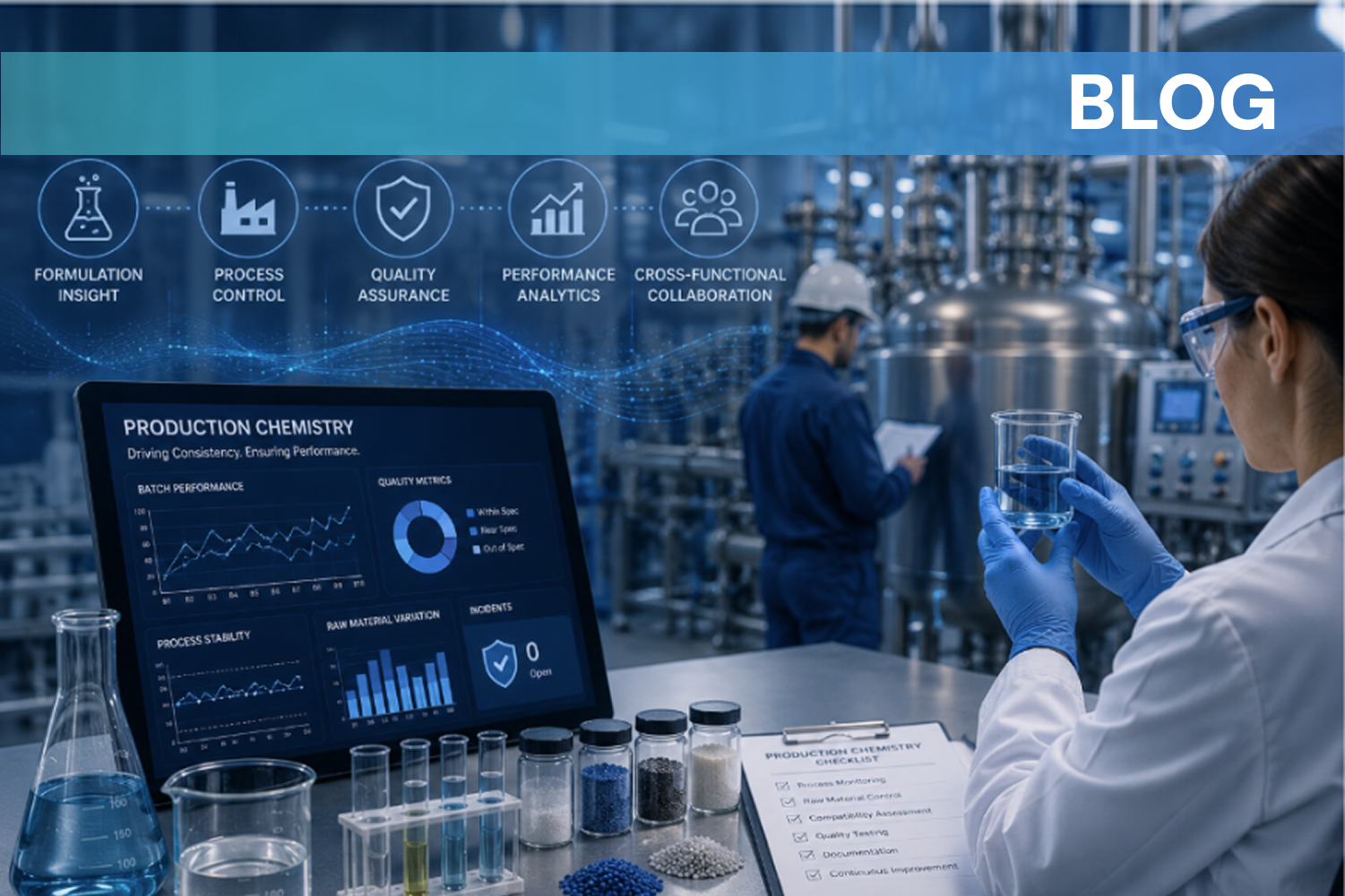

It's an exciting day when a formulation clears R&D and moves into production. Sometimes, it's followed by another exciting day (for all the wrong reasons) when the first commercial batch drifts out of spec because a raw material behaves differently at scale. More R&D is not the answer this late in the game: you need a production chemistry team to save the day.
R&D’s chemistry doesn’t “fail” in these scenarios, but the production environment introduced variables that the lab couldn’t fully account for. R&D’s chemistry doesn’t “fail” in these scenarios, but the production environment introduced variables that the lab couldn’t fully account for. Even a 5–10% drop in process performance during scale-up can significantly reduce financial returns and delay commercialization by 3–12 months.
Production chemistry enables understanding of how chemical processes behave outside controlled development conditions and their integration into day-to-day manufacturing cycles.
What is Production Chemistry?
Production chemistry is the discipline of controlling the behavior of chemical systems during production and manufacturing operations. The term is usually encountered in the oil and gas industries, where production chemists manage corrosion, scaling, emulsions, and other problems that impede flow. However, the principles of production chemistry are applicable wherever chemistry affects product quality, process stability, equipment performance, regulatory compliance, or workers' safety.
Organizations that need product, material, or chemical processes to perform consistently outside the lab need a production chemistry team. Production chemists test and select production chemicals and monitor their performance. When issues arise, they investigate them and work with operations, QA/QC, and HSE teams to make production decisions.
Their core value is in translation: production chemistry turns R&D intent into processes that run reliably at scale. Their success depends not only on chemical expertise but also on access to structured production knowledge that helps them understand how formulation decisions affect manufacturing performance over time.
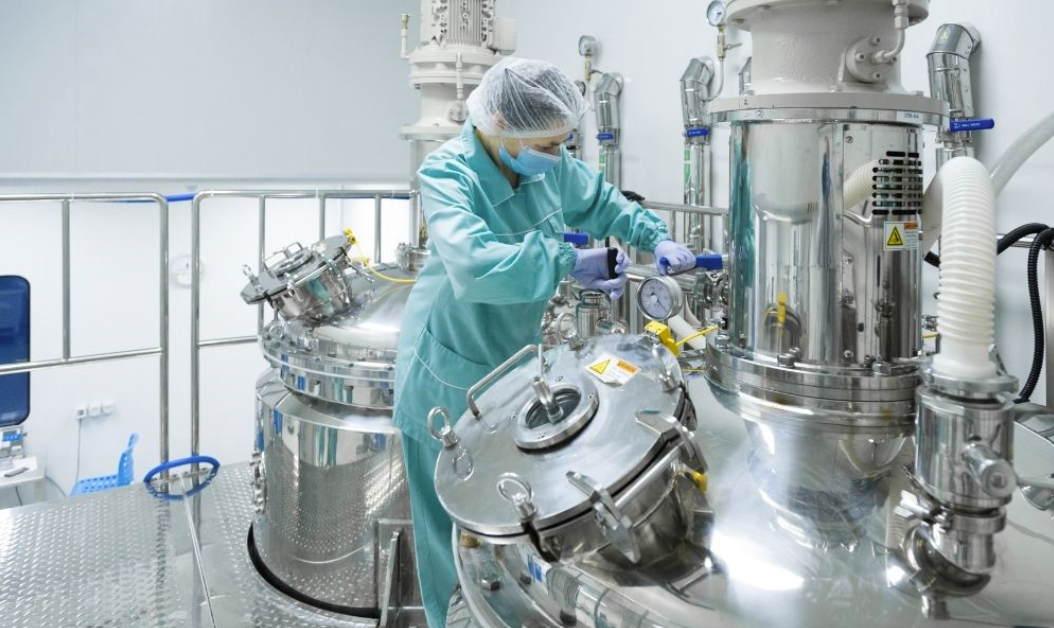
Production Chemistry vs R&D Chemistry
Despite the clear differences, R&D and production chemistry are closely connected processes. R&D defines what the chemistry is supposed to do, while production chemistry tests whether it can maintain that performance under real manufacturing conditions.
During production, feedback should flow back into R&D so they can adjust formulations, materials, methods, or process windows before repeating past errors. Materials informatics platforms like MaterialsZone can be valuable supports for this crucial hand-off, connecting formulation data with lab results, raw materials data, process conditions, QC records, and production outcomes. These platforms empower teams to track changes accurately and feed what they’ve learned back into future R&D and scaling decisions.
Why Production Chemistry Matters in Modern Manufacturing
Production chemistry teams step in to address problems that arise when processes migrate from controlled lab environments to real-world production conditions, where chemical behavior can change unpredictably.
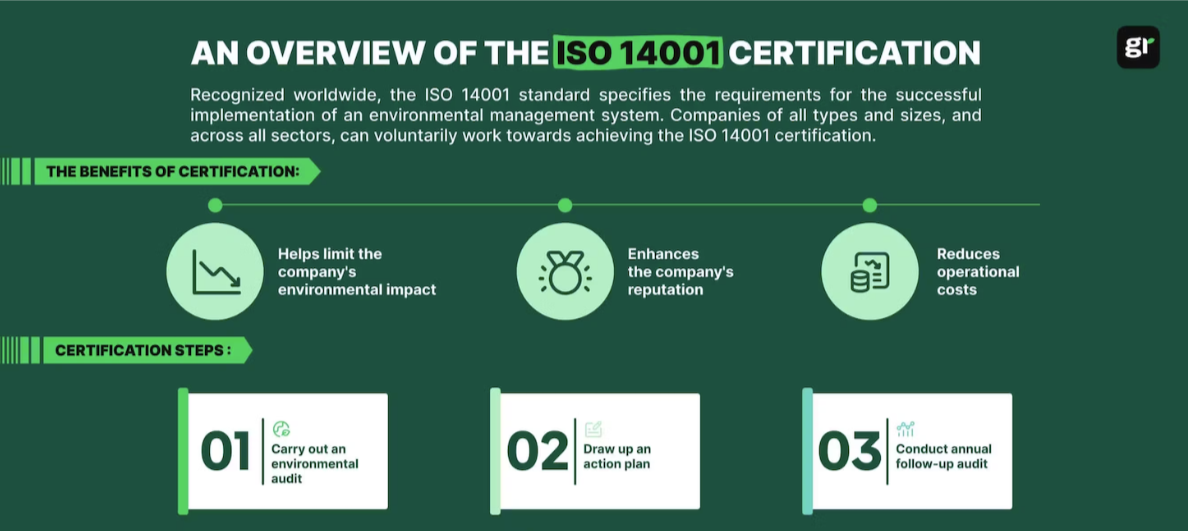
As operations scale up, even the subtlest changes in raw materials, temperature, mixing, contamination, equipment surfaces, or process timing can affect whether a product stays within specifications. Besides off-spec products, inadequate chemical control can lead to equipment damage, risks to health and the environment, material waste, downtime, and lots of costly troubleshooting. Better process control also helps manufacturers meet broader environmental objectives, including those supported by ISO 14001 EMS.
The emphasis on production chemistry in oil and gas is essential for managing issues that frequently affect wells and pipelines, such as corrosion, scaling, emulsions, wax deposits, hydrates, and gas souring. More broadly, the same discipline helps manufacturing teams mitigate problems like instability, separation, viscosity drift, poor curing, residue, contamination, and batch-to-batch variation.
Business value is shifting from reactive damage control to controlled production, leading to fewer surprises and faster root cause analysis. Decision-makers can leverage these insights to make higher-quality decisions and develop reliable strategies for scaling.
7 Best Practices for Production Chemistry
1. Start by Connecting Lab Data to Production Reality
Isolated lab results can’t provide the context you need to make smart product and process decisions in a live operational environment. The full story isn’t told by formulations and test results alone, but also by QC and deviation records, batch outcomes, and data on raw materials and process parameters.
With the right materials and informatics platforms to support data standardization and the integration of complex production data, teams can trace outcomes back to the technical context that explains them. This way, you can quickly identify whether production issues stem from the formula, materials, timing, equipment, or other variables, and deploy effective solutions.
2. Define the Parameters that Actually Signal Production Risk
Keep your monitoring focused and relevant by identifying the chemical and process measurements that indicate whether production is stable or beginning to drift outside acceptable limits. Key parameters will vary depending on the process, but may include:
- pH
- Viscosity
- Concentration
- Dosing levels
- Impurities
- Temperature
- Corrosion indicators
- Microbial activity
- Particle size distribution (where relevant)
The goal is to identify the variables that consistently predict process drift, allowing teams to detect problems early and intervene before product quality is affected.
3. Validate Compatibility Before Scale-up
All kinds of trusted factors can turn into wild cards as you scale up. Ingredients, additives, production chemicals, raw materials, equipment surfaces, process conditions, and even packaging can interact in unexpected ways, making compatibility testing essential when evaluating new materials or implementing green chemistry principles in production.
An equally lengthy list of potential problems with manufacturers who let compatibility issues get out of hand at scale: instability, separation, fouling, precipitation, corrosion, poor performance, and toxic hazards. Pilot runs and other compatibility tests can help you get ahead of these issues, along with production readiness reviews to reduce the risk of unforeseen failures and supplier-change checks once production kicks off.
4. Standardize Testing and Documentation
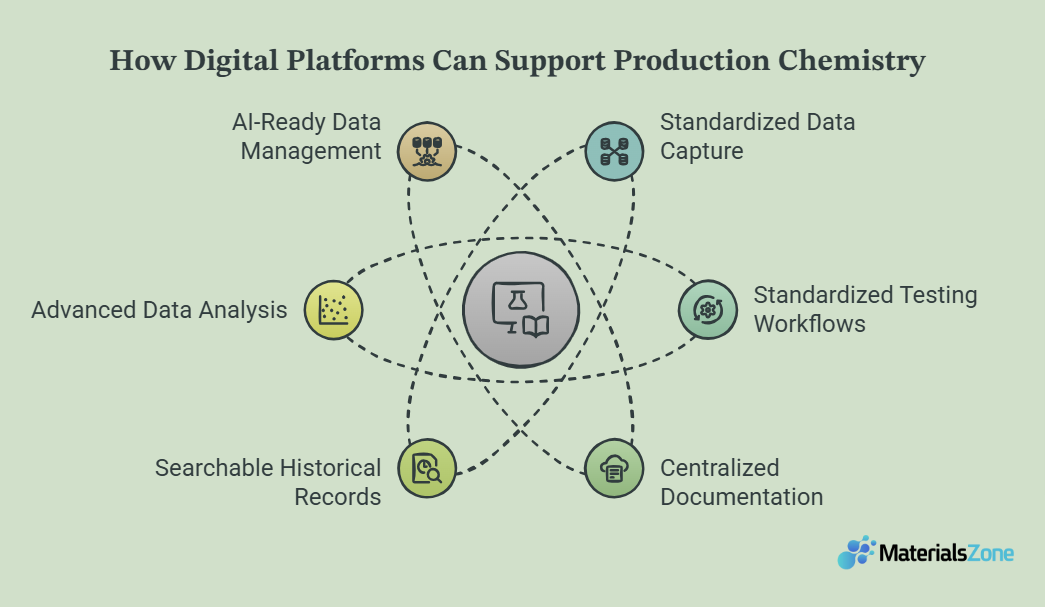
Centralized documentation and structured, standardized data make formulation context and batch history accessible across projects. Without standardization, teams often struggle to compare batches and understand why one production run behaved differently from the next.
Production chemistry teams can deliver their best work when they are supported by platforms that provide consistent naming conventions, data fields, and reporting formats, as well as consistent methods and procedures. Structured data also makes it easier to identify patterns, trends, and process variations across batches, projects, and production sites, while supporting advanced analytics and AI-guided decision-making.
5. Build Cross-functional Review Points
Chemical issues in production frequently affect more than one team. Production chemistry sits at the intersection of R&D, QA/QC, operations, productions, and HSE; decision-making can never hinge entirely on one person’s scattered emails or memory.
Agree ahead of time on who the decision owners are, share review points, and establish clear escalation paths. When production issues arise, cross-functional groundwork will help teams move faster and make better decisions. Shared production knowledge is usually more valuable than additional meetings because it reduces dependence on tribal knowledge and individual memory.
6. Track Chemical Performance Over Time
Chemical solutions that work perfectly in one batch may behave very differently after a supplier change, an equipment adjustment, a site transfer, or a scale-up. Tracking performance over time helps teams identify risks associated with supplier changes and supports more effective vendor risk management.
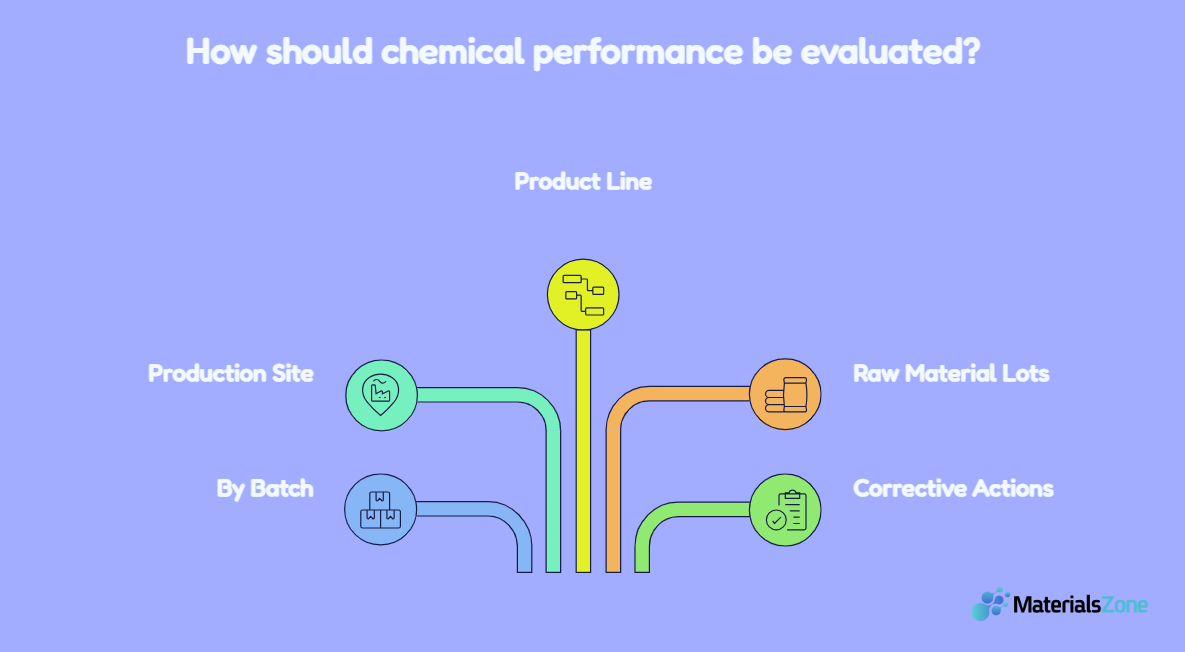
Chemical performance should be evaluated across all relevant categories, such as by batch, production site, product line, raw material lots, or corrective actions taken. Instead of treating every production issue as a new investigation, historical performance serves as a searchable knowledge base that helps teams recognize patterns, troubleshoot more quickly, and make better production decisions.
7. Use Analytics to Move From Reaction to Prevention
It’s not always the case that there’s a single, obvious root cause for production chemistry issues. Multiple interacting variables are often jointly responsible. Teams should compare historical formulations, raw material lots, process conditions, QC measurements, and production outcomes to identify the combinations of variables that consistently lead to successful (or failed)production runs.
Platforms like MaterialsZone can support this step in two significant ways: first, by providing teams with visualization tools and predictive capabilities that give insights into formulation, process timing, and other prevention factors. In addition, they can turn your historical test and production data into reusable knowledge to inform AI-guided R&D and production chemistry decisions.
Strong Informatics Helps Production Chemistry Teams Solve Problems Faster
Production chemistry bridges the gap between lab success and reliable finished output. Its principles keep chemical processes safe, stable, efficient, and scalable under unforgiving real-world manufacturing conditions.
The strongest production chemistry programs don't just resolve production issues—they capture why those issues happened and make that knowledge available for every future formulation, scale-up, and manufacturing decision. That's how organizations move from reactive troubleshooting to continuous improvement in both production and R&D.
To get your R&D, QA/QC, or production teams working with shared production chemistry data rather than scattered records, you need a materials informatics layer. MaterialsZone supports collaboration, visual analysis, and predictive AI, allowing teams to connect fragmented production and R&D data, uncover relationships across formulations and manufacturing processes, and turn historical production knowledge into AI-guided decisions.
Sign up for a demo today to see how MaterialsZone can move your production chemistry teams from rushing to fix things after the fact to a proactive, AI-guided approach to correcting and optimizing key manufacturing processes.