How AI Is Used for Cosmetics Formulation
AI for cosmetics formulation uses machine learning to predict product properties and help scientists make better-informed experimental decisions. Predictive models can help identify promising ingredient combinations, prioritize experiments, and assess reformulation options against performance and cost constraints. Reliable predictions depend on relevant experimental data, including ingredient grades, processing conditions, test results, and previous failures. Laboratory validation is essential to confirm formulation performance, particularly when models encounter unfamiliar ingredients or conditions. Successful adoption means demonstrating measurable improvements over existing R&D processes while keeping scientists in control of experimental decisions.

There are endless ways to formulate a shampoo, but only so many can be successful. That’s why cosmetics formulation is all about selecting experiments that provide useful evidence. Each experiment consumes ingredients, equipment time, and lab resources, and the results may raise new questions about stability or ingredient compatibility.
In a 2025 study published in Computers & Chemical Engineering, researchers used machine learning to guide shampoo experiments toward ingredient combinations more likely to produce phase-stable formulations. This illustrates how AI can help teams prioritize what to test, while its value still depends on relevant data and laboratory validation.
How AI for Cosmetics Formulation Works
AI for cosmetics formulation uses both experimental and external data sources to identify relationships between ingredients, processing conditions, and product properties. These relationships help formulators interpret past results, predict how changes might affect performance, and decide which experiments to run next.
This approach is part of the materials informatics field, which combines experimental data, computational modeling, and scientific expertise to guide materials development. In practice, the workflow follows four steps:
1. Bring formulation and testing data together
The starting point is a clear record of what has already been tried and what the results showed. MaterialsZone’s Materials Knowledge Center brings historical formulation and testing data together, giving teams a foundation for analysis and predictive modeling.
2. Explore the results and identify patterns
Scientists can analyze this data to investigate relationships between formulation inputs, processing conditions, and measured properties. AI assistants can help them explore and interpret the results. MaterialsZone’s built-in assistant, Maven, lets users ask questions about data in their current table view and generate charts to investigate patterns. Its answers to formulation-data questions are scoped to the active table, applied filters, and selected columns.
3. Predict properties and recommend experiments
Predictive machine learning models learn from past experiments to estimate how changes in composition or processing might affect a defined property. MaterialsZone’s Predictive Co-Pilot uses this data alongside project targets and constraints to predict formulation properties and recommend experiments worth exploring.
4. Test formulations and feed back the results
Formulators decide which recommendations to test in the lab, then add the results to the platform. Those results expand the available data and can inform subsequent analysis and model updates, helping teams build on what they learn as development progresses.
By connecting these steps, MaterialsZone extends cosmetic formulation software beyond data management to support prediction and experiment planning, with scientists guiding the process and validating results.

3 Applications of AI in Cosmetics Formulation
We’ve mentioned a few ways AI can support several formulation decisions, but how does it actually work?
Consider an illustrative shampoo development project. The R&D team wants to achieve a specified viscosity range while maintaining short-term phase stability. It has historical formulation and testing records, but limited evidence for one proposed surfactant supplier grade. Here’s how AI could help the team work through that decision:
1. Predict Phase Stability and Selected Sensory Attributes
Achieving the desired viscosity and consistency is an important part of cosmetic formulation, but maintaining those properties over time can be challenging. Changes in ingredient concentrations or processing conditions can affect a product's physical stability, potentially causing separation or texture changes.
AI can help formulators identify patterns in historical test results and predict which ingredient combinations are more likely to meet specific stability requirements. R&D teams can focus experiments on promising candidates, though laboratory testing remains essential to confirm performance.
Beyond stability, AI can also help predict how a cosmetic product will feel during application by assessing certain texture characteristics earlier in development. In a 2024 study published in Applied Rheology, researchers used ML to predict sensory properties across 117 cosmetic samples, with stronger results for thickness and spreadability than for stickiness.
2. Prioritize the Next Experiments
Cosmetic formulation often involves testing multiple ingredient combinations before finding one that meets the required performance targets. AI can reduce this trial and error by analyzing previous results and identifying which experiments to prioritize.
Returning to the shampoo example, suppose the formulation needs to meet specific viscosity and short-term stability requirements. A predictive model might recommend a promising ingredient combination, but what if it contains a surfactant grade that the team has rarely tested before?
Instead of relying on the prediction alone, formulators can use the available data to decide whether to test the recommended formula or first investigate how the unfamiliar ingredient behaves.
With this AI capability, R&D teams focus resources on experiments most likely to yield useful information and make more informed choices about where to direct their efforts.
3. Evaluate Reformulation Options
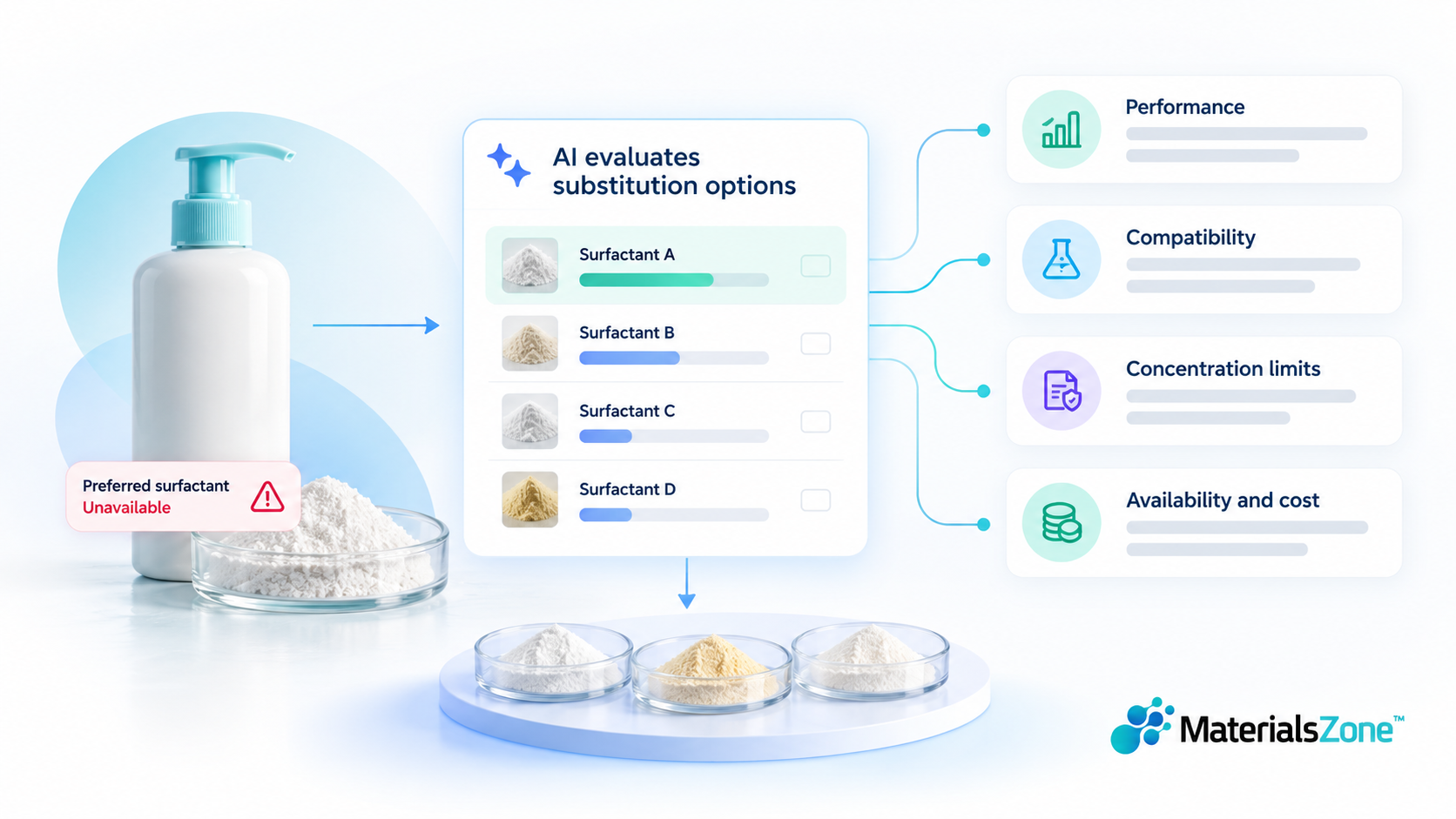
Cosmetics R&D teams frequently reformulate products to accommodate ingredient availability, cost targets, new performance requirements, or even changing supplier risk. AI can help researchers assess potential substitutions against multiple constraints before selecting candidates for experimental testing.
For example, if the shampoo's preferred surfactant becomes unavailable, a formulator could investigate alternatives while considering:
- Performance: Whether the replacement is likely to maintain the required viscosity and physical stability.
- Compatibility: How the substitute may interact with other surfactants, polymers, thickeners, and processing conditions.
- Concentration limits: Whether the proposed use level fits applicable formulation and regulatory constraints.
- Availability and cost: Whether the ingredient is obtainable in the required grade and quantity, and how the substitution affects calculated formulation cost.
Predictive guidance can help narrow the experimental choices. However, ingredient substitutions still require laboratory verification, especially when available data don't cover the proposed supplier grade or formulation conditions.
What Data Does AI Need for Cosmetic Formulation?
A large volume of data isn't always enough. The information needs to be accurate and consistent enough for scientists to compare results across experiments. For cosmetic formulation, this means having access to:
- Ingredient data: Raw material identities, supplier grades, and concentrations.
- Processing information: Mixing conditions, manufacturing parameters, and batch history.
- Testing results: Measured properties, test methods, and experimental conditions.
- Previous failures: Unsuccessful formulations and unexpected results that help identify what hasn't worked.
The details behind these records matter just as much as the results themselves. For example, when predicting shampoo viscosity, a model needs to distinguish between different surfactant grades and account for differences in testing conditions. Without data context, it may identify relationships that don't hold up in the lab.
Well-organized formulation records and experimental results provide the foundation for AI materials discovery, allowing R&D teams to identify patterns in previous research and make better-informed decisions about what to test next. There’s no miracle number or one-dataset-fits-all - it’s more important that the available data are reliable and sufficiently representative of the formulations you want to develop.
Why AI-Predicted Cosmetic Formulations Need Lab Validation
To err is human, but so is AI. AI models learn from historical formulation data, so their predictions may be inaccurate when working with unfamiliar ingredients or processing conditions. Therefore, you need laboratory testing to establish whether recommended formulations actually perform as expected.
For example, an AI model might predict that a shampoo will meet its viscosity and short-term stability targets. Scientists still need to verify those properties using predefined testing methods and acceptance criteria. Even if the formulation passes, scientists still need further cosmetic stability testing and other assessments to establish shelf life, preservative effectiveness, safety, efficacy, packaging compatibility, and readiness for commercial production.
In the US, the FDA's cosmetic testing guidance outlines manufacturers' responsibilities for substantiating product safety. The model itself also needs validation against independent experiments. Testing it on formulations that closely resemble its training data can give a misleading impression of accuracy, particularly when the model encounters new ingredients.
If laboratory results fail to meet the agreed criteria, or the available data don't adequately represent a particular ingredient grade, your team should stop to investigate the gap before relying on further recommendations.
How to Evaluate an AI Cosmetics Formulation Pilot
The shampoo example highlights an important consideration for R&D managers: the most useful AI recommendation is not necessarily the formulation with the highest predicted performance. A recommendation that helps scientists resolve a meaningful uncertainty may also have value.
- Establish a Baseline
Before introducing AI, establish how your team currently selects experiments and how much time and laboratory work it takes to meet formulation targets. For example, if achieving the required viscosity and stability typically takes 12 experiments over three weeks, that's your baseline. Document the criteria for a successful formulation and agree on how you'll compare results, so you can actually measure whether AI improves the process.
- Compare Predictions With Experimental Results
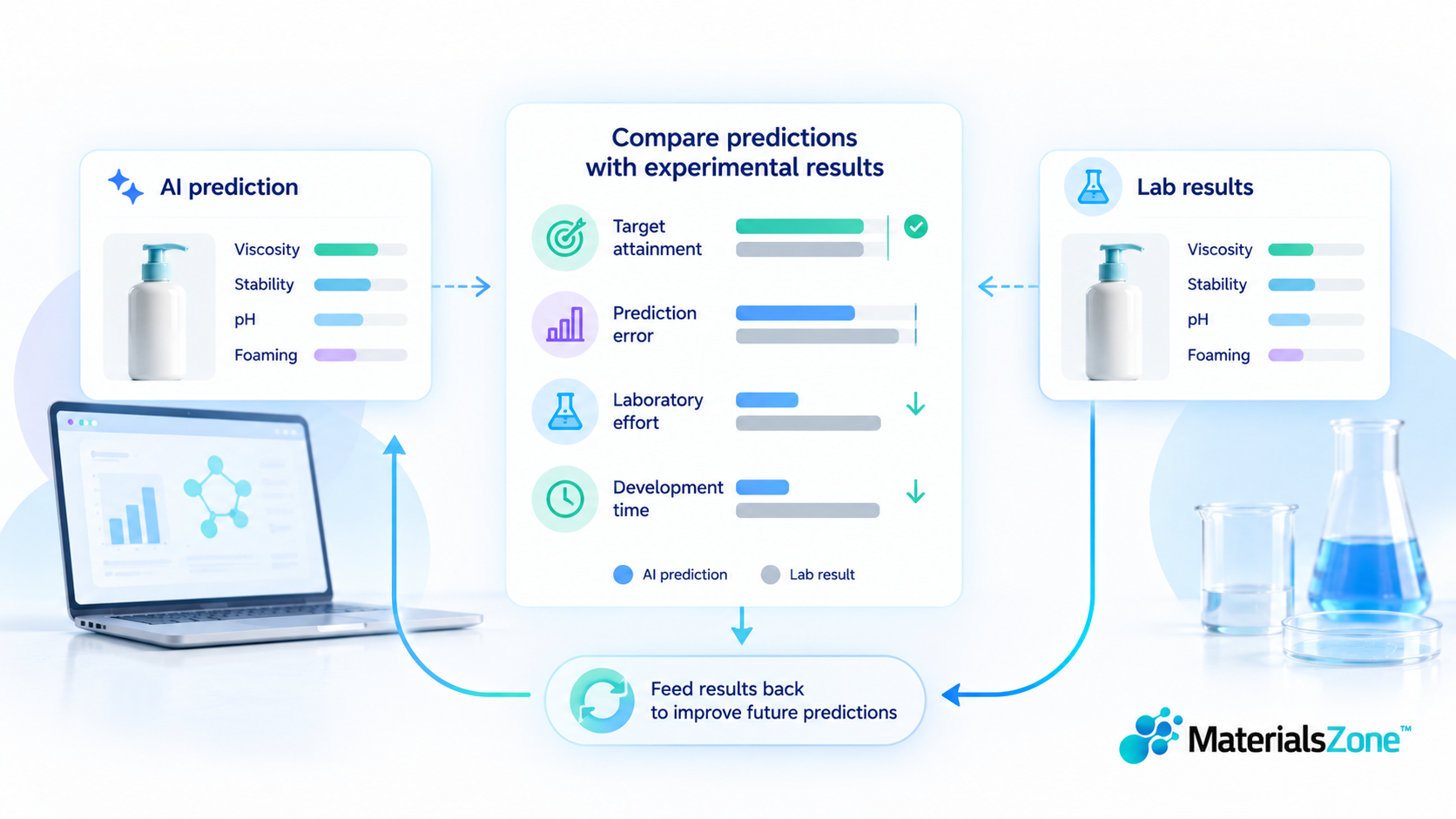
Evaluate your new AI-assisted approach against the established baseline using prospective experiments. Some useful measures include:
- Target attainment: How often tested candidates meet the predefined formulation criteria.
- Prediction error: How closely predicted properties match laboratory measurements.
- Laboratory effort: The number and type of experiments and resources required to reach a decision.
- Development time: The elapsed time needed to complete the defined experimental task.
Crucially, record unexpected results and assess whether the model provided useful guidance when initial recommendations failed. Feed these findings back into the next round of experiments to improve future recommendations. Remember, one successful formulation doesn't mean the model will perform reliably across different ingredients or product categories.
3. Decide Whether to Proceed, Pause or Refine
If the pilot meets your targets and improves on your existing process, you can expand it to similar formulations within the tested domain. But if predictions repeatedly miss the mark or AI offers little improvement, investigate the gaps and consider narrowing the application before investing further.
Consider the practical side, too. Can your team of scientists trace the data behind predictions? Are proprietary formulations protected by appropriate enterprise access controls? Will the technology fit into existing lab workflows while leaving scientists in control of the final decisions?
By bringing experimental data, predictive recommendations, and test results into one platform, MaterialsZone helps teams build on what they've already learned and make more informed decisions about what to test next. The pilot can then show whether those capabilities translate into fewer unnecessary experiments and faster formulation development.
Smarter Cosmetic Formulation, Fewer Experiments
The real value of AI in cosmetic formulation comes from making better decisions with the data your team already has. MaterialsZone helps R&D teams put that knowledge to work, moving beyond manual data analysis and lengthy trial-and-error processes.
With MaterialsZone's Predictive Co-Pilot, formulators can set specific performance targets and formulation constraints, then use machine learning to explore promising ingredient combinations and identify experiments worth prioritizing. Its interactive predictive capabilities give scientists more control over their research direction, helping them focus laboratory resources where they are most likely to deliver useful results.
Discover how Predictive Co-Pilot can help you reduce trial and error and accelerate formulation development.