Accelerated Shelf Life Testing Explained
Accelerated shelf life testing (ASLT) estimates product stability by measuring deterioration under controlled conditions designed to speed up relevant changes. Reliable predictions depend on: Study design: Selecting meaningful quality endpoints and stress conditions that preserve the relevant deterioration mechanisms. Predictive modelling: Using conventional kinetic models or machine learning to analyse degradation patterns, depending on data complexity and model suitability. Validation: Testing predictions against independent evidence and real-time observations while assessing uncertainty and applicability. Data management: Connecting experimental results, formulations and packaging information to support future R&D decisions and AI-guided experimentation.
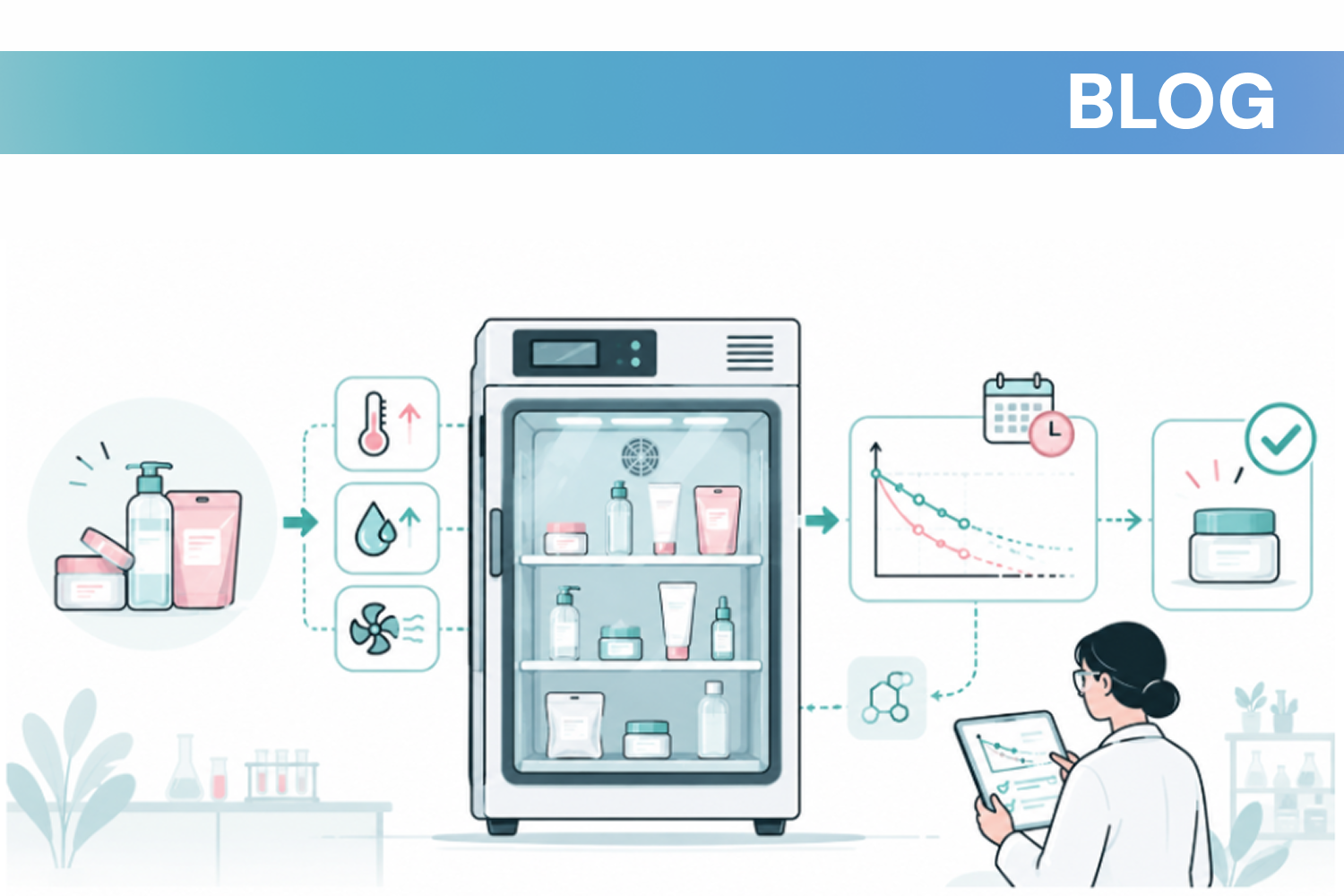

A model can fit an accelerated chamber study well and still perform poorly on a new formulation, package or storage condition. The experiment or model may rely on assumptions that do not hold under those conditions.
Design accelerated shelf life testing around the decision you need to make, then validate the prediction under intended storage conditions.
For experienced R&D teams, improving accelerated shelf life testing means designing the study around the decision it needs to support, then validating whether the resulting prediction transfers to intended storage conditions. CFIA guidance similarly recommends validating indirect shelf-life studies and notes that running a parallel real-time study can help test the predicted shelf life.
What Makes Accelerated Shelf Life Testing Useful?
Accelerated shelf life testing uses controlled stress factors, commonly elevated temperature, to increase the rate of relevant deterioration and model how long a product is expected to remain acceptable under normal storage conditions.
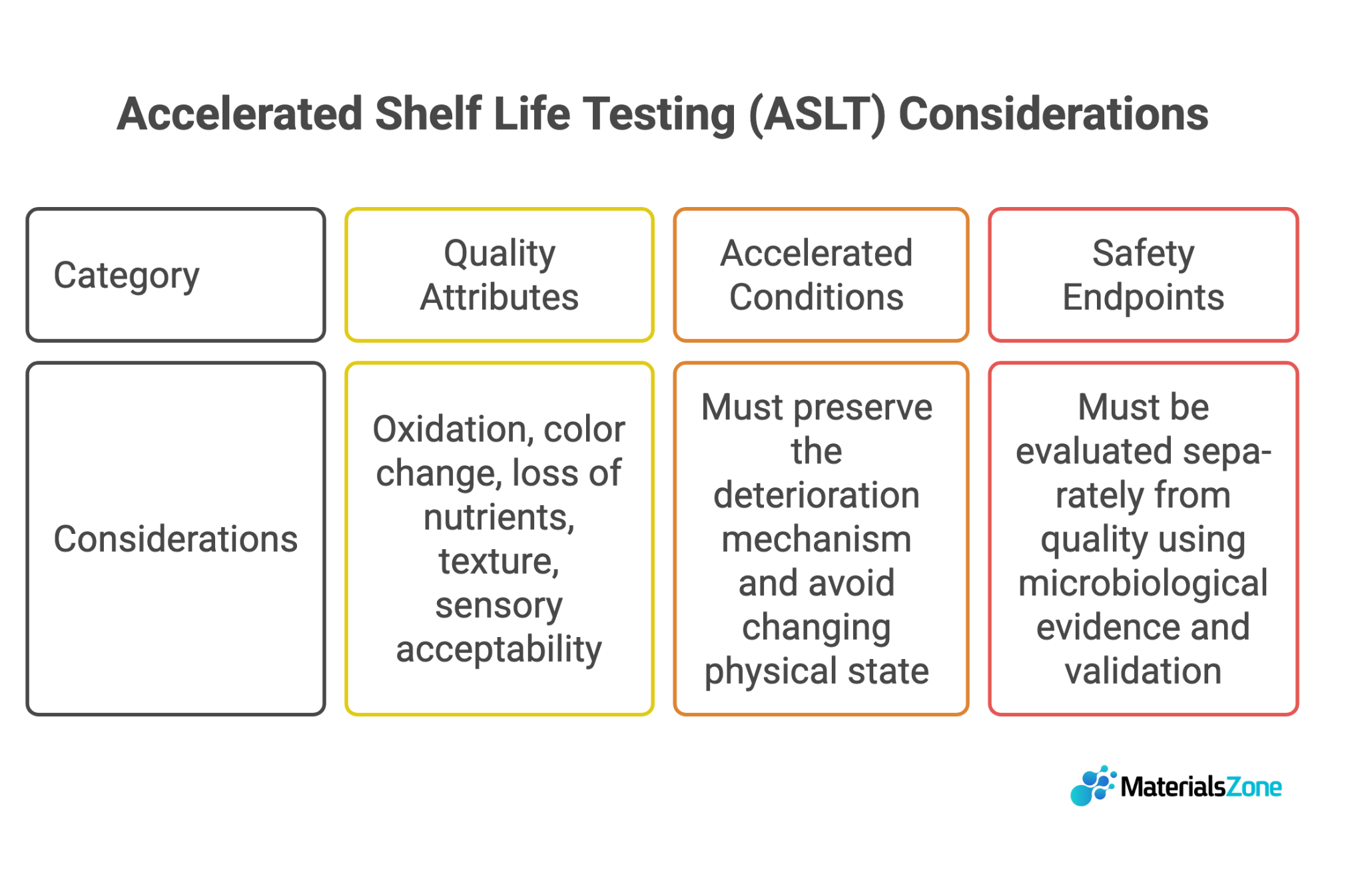
Define an endpoint that captures the relevant deterioration and supports the formulation or packaging decision. Depending on the food, that may involve oxidation, color change, loss of nutrients, texture, sensory acceptability, or another measurable quality attribute.
The accelerated condition must also preserve the deterioration mechanism being modeled. A model based on behavior at elevated temperature becomes less useful if the stress changes the product’s physical state, alters its packaging interaction, or activates a different degradation pathway.
Evaluate quality and safety endpoints separately. ASLT can investigate chemical, sensory, physical, and, where scientifically appropriate, microbiological changes. However, a model developed to predict oxidation or sensory deterioration cannot independently establish microbiological safety. Safety-related predictions require relevant microbiological evidence, appropriate predictive methods, and product-specific validation .CFIA guidance likewise distinguishes sensory, chemical, physical, and microbiological evidence when determining food shelf life.
The same principle applies outside food. In cosmetic stability testing, teams need product-specific evidence rather than a universal conversion from accelerated results to real-time shelf life. Likewise, ASTM F1980 addresses accelerated aging of sterile barrier systems for medical devices and should not be treated as a general food ASLT protocol.
Where Machine Learning Can Improve Accelerated Shelf Life Testing
Conventional ASLT often uses kinetic models to describe how a selected quality attribute changes over time and how its deterioration rate responds to temperature. Arrhenius and Q10 approaches are common examples.
The Q10 factor expresses the ratio of deterioration rates at temperatures 10°C apart. Its value depends on the product, deterioration mechanism, and temperature range, so assuming a universal Q10 of 2 can lead to unreliable shelf-life estimates. Arrhenius-based predictions likewise depend on the suitability of the assumed temperature-rate relationship and whether the relevant deterioration mechanism remains consistent across the tested conditions.
Machine learning can extend this approach when deterioration cannot be represented adequately by one attribute or a simple kinetic relationship. Instead of modeling a single measurement, an ML-assisted approach may combine several measured quality attributes or high-dimensional sensor data to identify patterns associated with deterioration.
A 2026 Food Chemistry study compared conventional ASLT with two data-driven approaches for dried shrimp: PCA-based machine-learning-assisted ASLT and hyperspectral imaging integrated with machine learning. Both approaches produced shelf-life estimates closer to the observed values than conventional ASLT under the conditions examined.
The researchers evaluated dried shrimp under specific test conditions, so the comparison does not establish that ML outperforms conventional kinetic models in other applications.
Machine learning also does not physically accelerate aging. Faster measurement or data analysis may make an ASLT workflow more efficient, but the underlying evidence still comes from product behavior over time.
Design Accelerated Studies for Better Predictions
Adding a more sophisticated algorithm cannot compensate for an accelerated study that measures the wrong endpoint or applies an irrelevant stress condition.
Before starting the study:
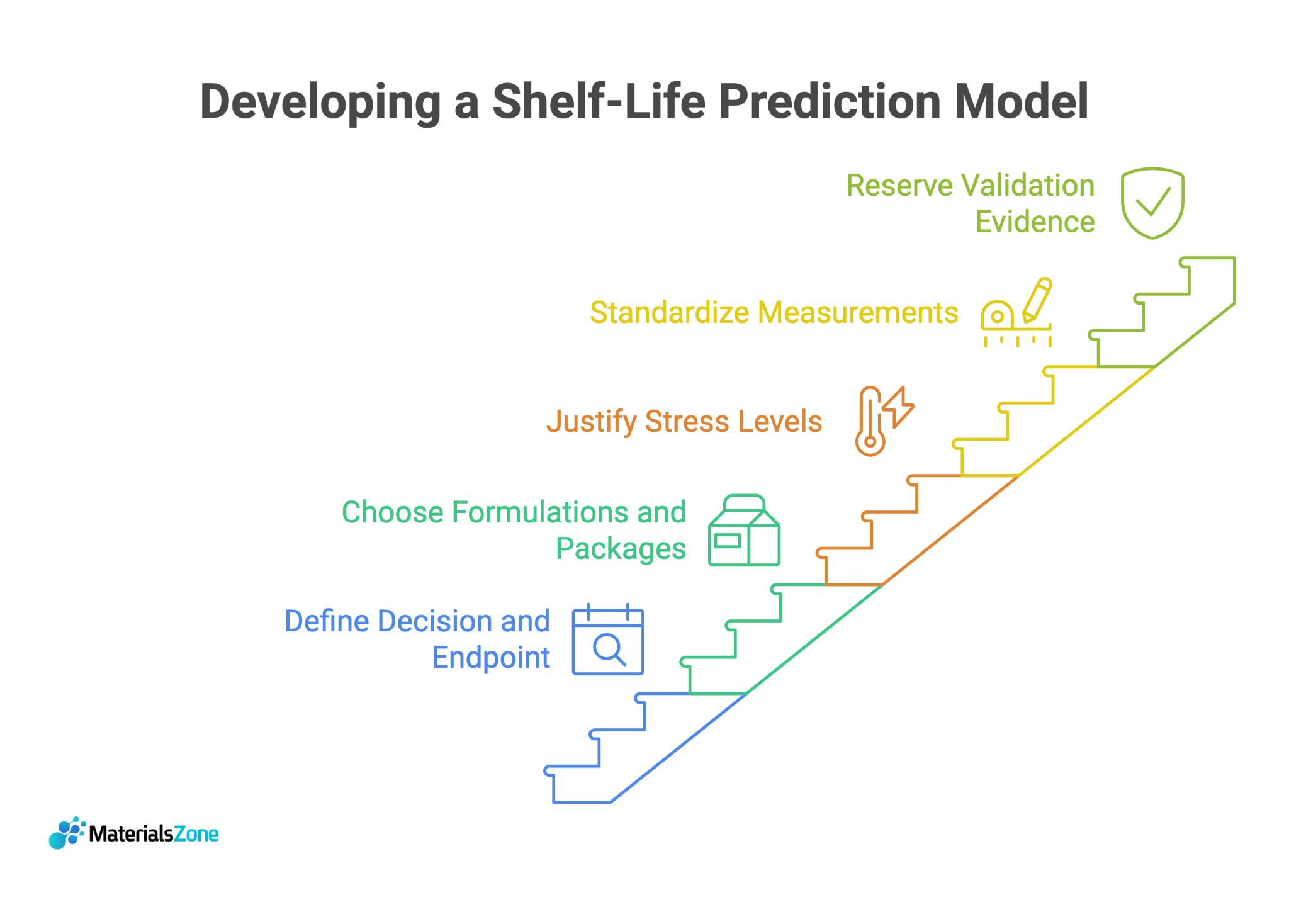
- Define the decision and endpoint first. Establish what the prediction will be used for and which measured change represents the relevant end of acceptable shelf life.
- Choose representative formulations and packages. Packaging, ingredient changes, and processing conditions can alter deterioration rates and mechanisms.
- Justify the stress levels. Conditions need to accelerate the relevant process without creating deterioration that would not occur under intended storage.
- Standardize measurements and sampling. Methods, replicates, time points, sample handling, and units need to remain comparable.
- Reserve independent evidence for validation. Reserve independent batches and real-time observations for validation.
Consider an oil-containing snack where oxidation eventually causes unacceptable flavor. Measuring an oxidation marker may provide a useful model input, but the endpoint still needs to connect meaningfully to product acceptability. Package oxygen barrier properties could also change the observed deterioration rate, meaning the formulation and final package cannot always be modeled independently.
For ML-assisted studies, check that each model input will be available when you need to make the prediction. Inputs collected after the shelf-life outcome is known can produce a strong retrospective fit without supporting prospective predictions.
Validate Predictions Before Applying Them
For conventional ASLT, validation should test whether the assumed degradation mechanism and temperature dependence remain relevant at intended storage conditions. Changes in packaging behavior, physical state, or the rate-limiting deterioration mechanism can undermine extrapolation even when the accelerated data fit the chosen equation well.
Teams should separate model development from evaluation and, where practical, hold out independent batches, formulations, or product groups rather than randomly distributing closely related time-point measurements between training and test data. Otherwise, the evaluation dataset may be too similar to the data the model has already seen.
Useful checks include comparing the ML model with a simpler conventional baseline, examining prediction errors at intended storage conditions, and identifying where predictions require extrapolation beyond the model’s supported product or temperature range.
Compare predictions with observed results. CFIA explicitly recommends validating indirect shelf-life approaches and notes that concurrent real-time studies can help assess predicted shelf life.
For every model, record the uncertainty, validation result, and boundaries of application. A model that performs well for one formulation, package, and temperature range is not automatically validated for the next.
Use Shelf Life Data to Improve Formulation Decisions
Use shelf-life study results to inform formulation changes, package selection, new product development and future predictive models. Keep each result linked to its experimental context.
Connecting results from multiple experiments requires consistent data definitions and access to the relevant experimental context. Formula version, package configuration, storage condition, method, time point, observed result, predicted result, and final decision should remain connected.
MaterialsZone’s AI-guided materials informatics platform helps R&D teams connect experimental data with formulation and development decisions. Teams can use the Materials Knowledge Center to organise formulation, materials, and test data, then use the Visual Analyzer to compare results and investigate relationships across experiments.
With Predictive Co-Pilot, teams can use experimental data to model outcomes and receive suggestions for further experiments based on project targets and constraints. Researchers test those suggestions and feed the results back into the workflow to refine subsequent recommendations.
For an accelerated shelf life testing programe, teams should assess where these capabilities can support candidate selection and further testing. Any shelf-life prediction still needs evidence that it applies to the relevant product, packaging, and storage conditions. Running a parallel real-time study can help validate the estimate.
Build a Shelf Life Estimate You Can Validate
For accelerated shelf life testing, choose the model and next experiment according to the product decision, available data and validation evidence. Use kinetic models when their assumptions fit the deterioration mechanism.
Consider ML when richer datasets capture relationships that simpler models miss. Validate its predictions for the intended product and storage conditions before using them to guide development decisions.
With MaterialsZone’s Predictive Co-Pilot, your team can use experimental data to model outcomes and receive recommendations for further experiments based on project targets and constraints.
Book a MaterialsZone demo to explore how your team can connect shelf-life study data with formulation analysis, predictive modelling, and decisions about which experiments to run next.