R&D Guide to Food Product Development: Step-by-Step with Examples
Food product development is an evidence-driven process for turning a product concept into a validated, manufacturable, and commercially viable food. Effective development is iterative, with formulation, sensory performance, safety, packaging, cost, and processing decisions continually informing one another. Clear product briefs, controlled experiments, and defined validation criteria help teams identify weak options and make evidence-based decisions. Pilot production, scale-up, and post-launch monitoring extend R&D beyond the bench, while connected records help teams preserve learning and improve future development cycles.
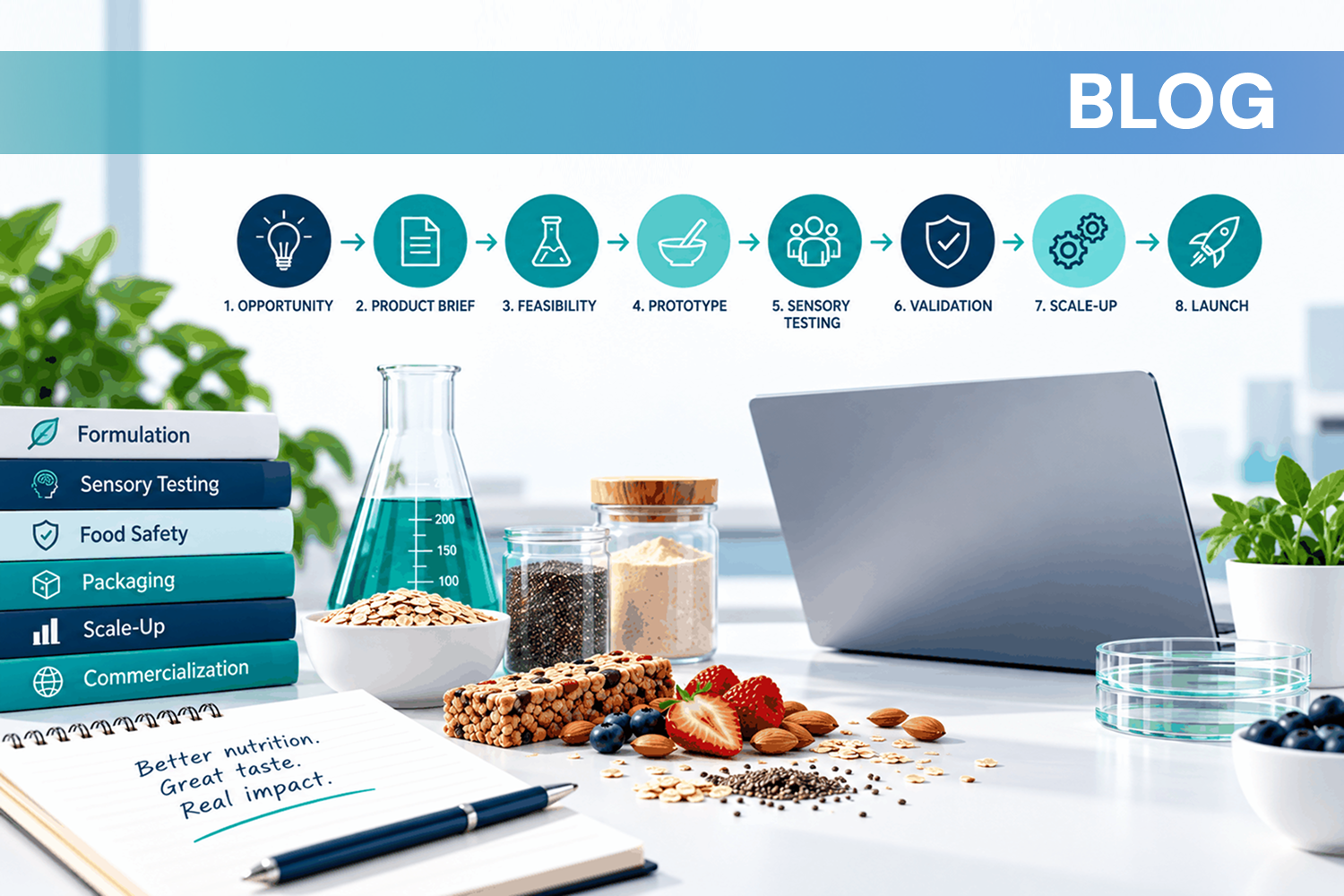

A promising food concept rarely moves in a straight line from idea to recipe to supermarket shelf. Instead, food product development eliminates weak options and builds progressively stronger evidence.
In one educational Stage-Gate example from Iowa State University, 12–15 initial ideas may ultimately be narrowed to just one or two products. The figures demonstrate an important principle: good development processes are designed to learn and filter, not simply progress.
R&D teams need to understand how formulation, sensory performance, food safety, packaging, cost, and manufacturing decisions affect one another throughout food product development.
What Is Food Product Development, and Why Isn’t It Linear?
Food product development is the coordinated process of creating, formulating, processing, validating, and commercializing a new or improved food product.
It typically brings together R&D and food scientists with quality, regulatory, operations, sourcing, packaging, marketing, and commercial teams. For R&D teams, these checkpoints work best as evidence-based decision points rather than rigid handoffs.
A prototype might meet its sensory target but fail shelf-life testing. Or, a new ingredient might improve nutrition but change allergen requirements.
Development therefore involves feedback loops and new evidence can mean revisiting the product brief, formulation, process, package, or even the original consumer proposition.
The 8 Steps of Food Product Development
Define the Opportunity, Product Brief, and Feasibility
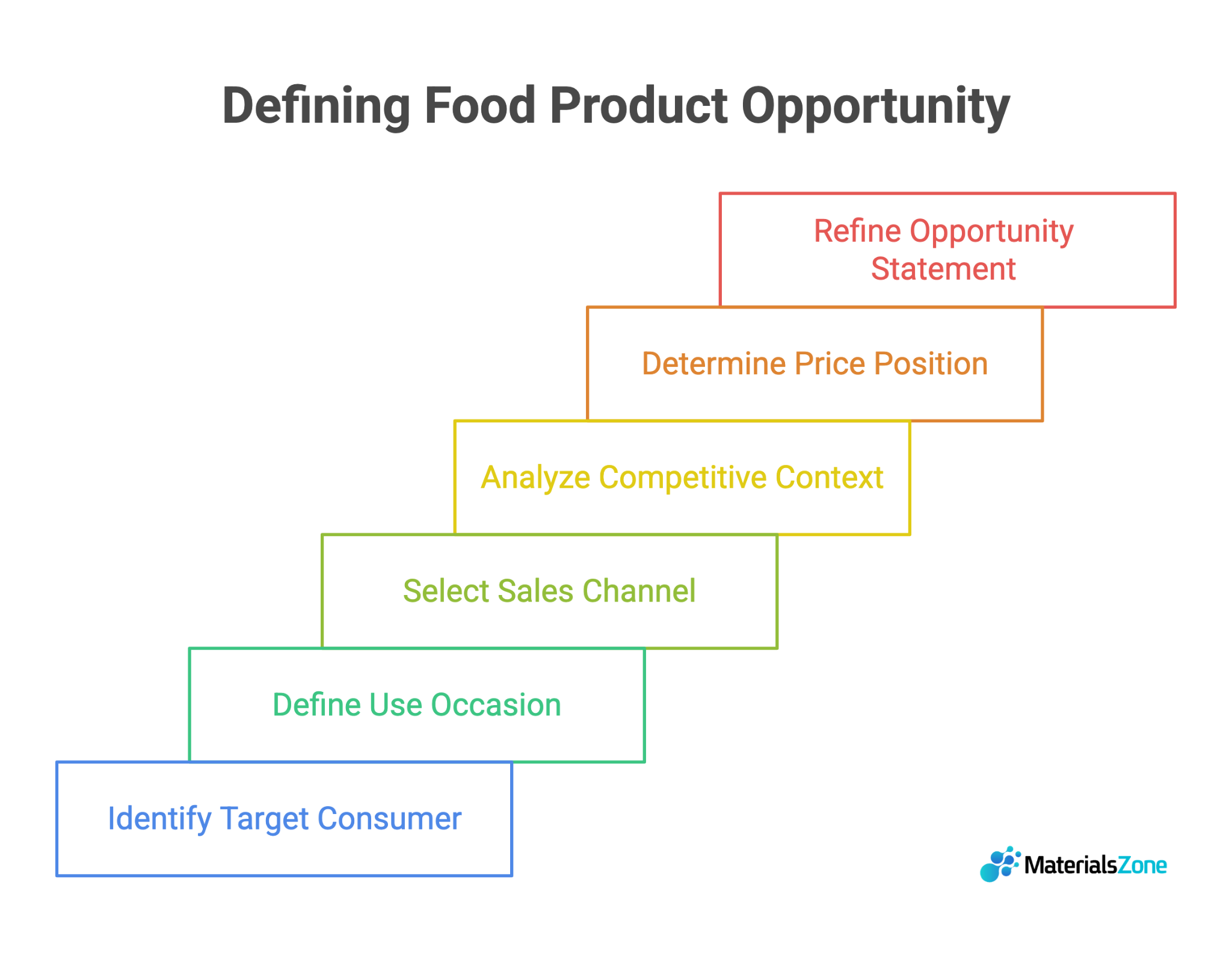
Step 1: Define the Opportunity and Target Consumer
Before food product formulation begins, establish what problem the product needs to solve.
That means identifying the target consumer, use occasion, sales channel, competitive context, and likely price position. Consumer research and market evidence should result in a focused opportunity statement.
Let’s consider a hypothetical reduced-sugar, high-protein oat snack bar. Its opportunity might initially sound simple: develop a convenient snack for consumers who want more protein and less sugar.
R&D still needs greater precision. The team must define the protein target and establish what ‘reduced sugar’ means for the intended market and claim. It also needs to understand the expected texture and flavor profile.
For example, in the US, a ‘reduced sugar’ claim has specific FDA conditions, so the formulation target must be defined against the appropriate reference food rather than treated as a general aspiration.
At this stage, the team decides whether the opportunity is relevant and strategically worthwhile enough to justify development resources.
Step 2: Build the Product Brief and Success Criteria
The next step translates the opportunity into measurable requirements. A food product brief may include:
- sensory targets
- nutrition and claim ambitions
- ingredient restrictions
- allergen considerations
- shelf-life requirements
- target cost
- intended packaging
- processing or manufacturing constraints
For the oat bar, increasing protein while reducing sugar creates interacting requirements. Sugar can contribute more than sweetness, while protein ingredients can affect flavor, hardness, moisture behavior, and processing.
As such, success criteria should be defined before extensive formulation work begins. The relevant team needs a clear way to determine whether a prototype meets the brief.
Step 3: Assess Technical, Commercial, Supply, and Regulatory Feasibility
Not every requirement carries the same weight. It is a best practice to separate true constraints from preferences and identify the assumptions that require validation:
- Can suitable protein ingredients be sourced at the required volume and cost?
- Are there allergen implications?
- Can the target manufacturing process handle the proposed formulation?
- Will the product require particular packaging properties?
- Are the proposed nutrition or labeling claims supportable in the intended market?
Food safety and labeling also start here, and they should not appear for the first time immediately before launch.
The output is a feasibility assessment containing known constraints and the validation work required before the project progresses.
Food Product Development Steps: Formulate, Test, and Iterate
Step 4: Formulate and Develop Bench Prototypes
Once your team understands the target and constraints, they can begin formulation development.
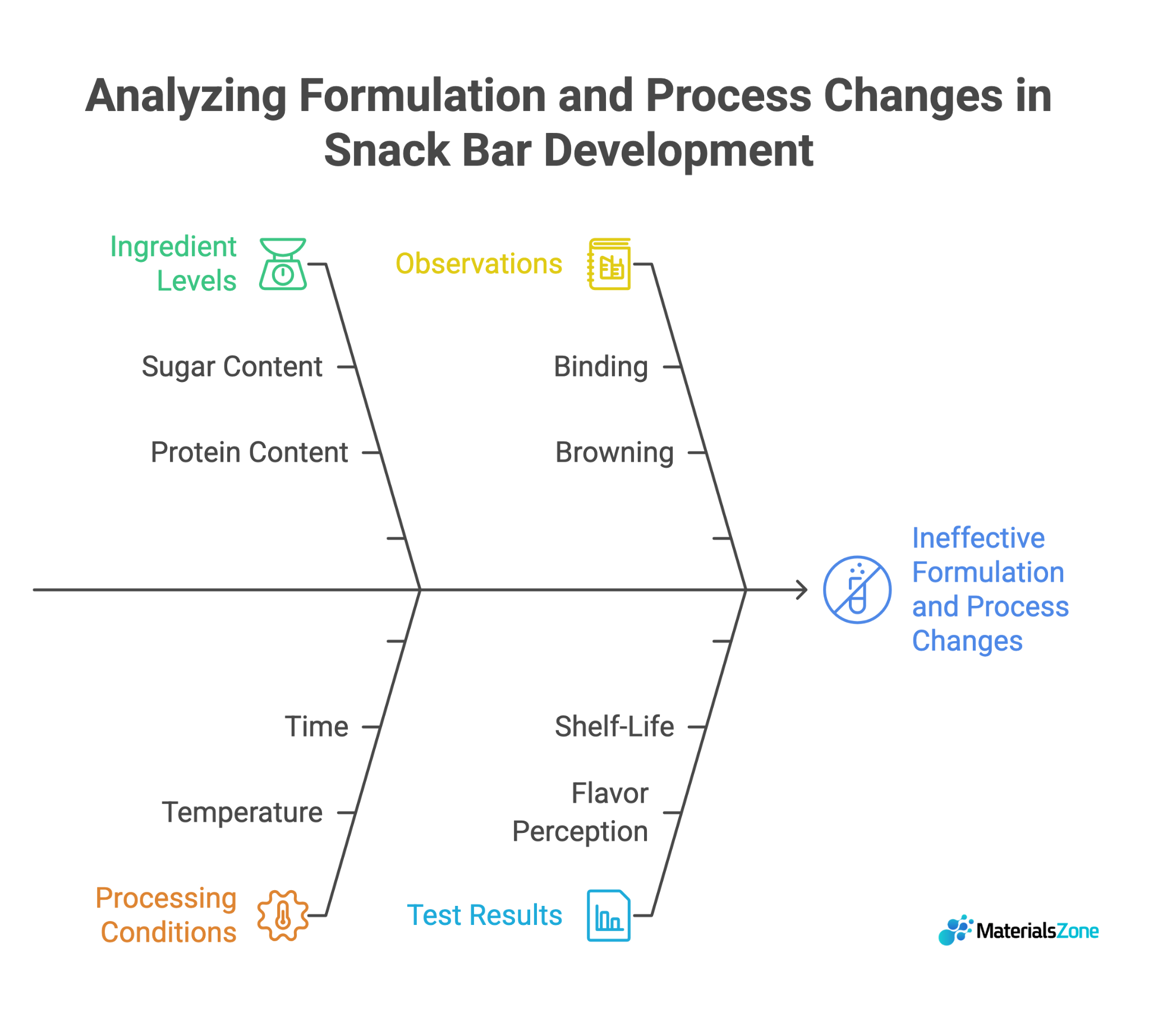
Start with a defined baseline. Change variables deliberately and capture enough context to understand the result, including ingredient levels and lots, processing conditions, observations, test results, and formulation version.
For the snack bar we discussed, reducing sugar could influence binding, browning, flavor perception, moisture migration, and shelf-life behavior. Raising protein content may alter hardness, aftertaste, water binding, or processing.
Changing several variables simultaneously without recording them properly makes it difficult to determine what caused an improvement or failure. A useful prototype generates interpretable evidence about which formulation or process changes produced the result.
Standardizing and connecting experimental records makes comparisons between iterations more reliable and helps teams understand how formulation, processing, and test results relate to one another. In this example, MaterialsZone’s AI-Guided R&D environment can help teams connect formulation and process information and analyze multiple variables across experiments.
Step 5: Run Sensory and Consumer Testing
A technically successful formulation still has to deliver the intended consumer experience.
Sensory testing should therefore match the decision being made. Internal or trained sensory evaluation can help diagnose attributes such as hardness, sweetness, aroma, aftertaste, or texture. Target-consumer research can answer whether the intended audience actually accepts or prefers the product.
For the hypothetical snack bar, one prototype may meet its nutrition target but introduce an unwanted protein aftertaste. Another may achieve better flavor but become too hard during storage.
The best way forward is to capture both preference and diagnostic feedback and compare the findings with the product brief. Based on the sensory and consumer evidence, your team can advance and reformulate a candidate, or revisit the original product target.
Validate Safety, Shelf Life, Labeling, Packaging, and Scale-up
Step 6: Validate Food Safety, Shelf Life, Nutrition, Claims, and Labeling
Before commercialization, teams still need to validate the candidate formulation for food safety, shelf life, nutrition, claims, and labeling.
Food safety assessment should consider the hazards relevant to the specific formulation and process, which may include biological, chemical, physical, and allergen hazards.
In the US, 21 CFR Part 117 establishes CGMP requirements and, for many FDA-registered human food facilities, hazard-analysis and risk-based preventive-control requirements unless an exemption applies. Separate HACCP regulations apply to seafood processors under 21 CFR Part 123 and juice processors under 21 CFR Part 120.
Shelf-life testing should likewise reflect the product and the ways it could fail. Depending on the food, relevant endpoints can include:
- microbiological safety
- sensory quality
- texture
- oxidation
- moisture migration
- color
- package integrity
Safety and quality should remain distinct. A change in texture may make a product unacceptable without making it unsafe, while a food safety failure requires a different response.
Nutrition, claims, and labeling also require market-specific review. For US products, FDA maintains current resources covering Nutrition Facts requirements and food-allergen labeling. Always confirm requirements for the intended jurisdiction rather than assuming they transfer between markets.
Step 7: Pilot, Scale Up, and Validate Packaging and Supply
Scale-up can change mixing, heat transfer, cooling, forming, filling, and drying behavior even when a formulation performs well at bench scale. Pilot and scale-up work therefore needs to establish whether the intended process repeatedly delivers the required product specifications.
Teams should also assess ingredient specifications, quality controls, packaging compatibility, distribution conditions, supply chain variability, and production economics.
Returning to the oat bar example, a texture that works well immediately after bench production might become harder at production scale. Packaging barrier performance may also become important if moisture gain, loss, or migration affects texture or water activity.
The question is whether the formulation, process, supply chain, and package consistently produce the validated product. If not, the correct next step may be back to formulation rather than forward to launch.
Step 8: Launch, Monitor, and Feed Learning Back Into R&D
Launch readiness requires more than final recipe approval.
Teams should have approved product and process specifications, manufacturing controls, packaging and labeling, appropriate supply continuity, and clear ownership of decisions and deviations.
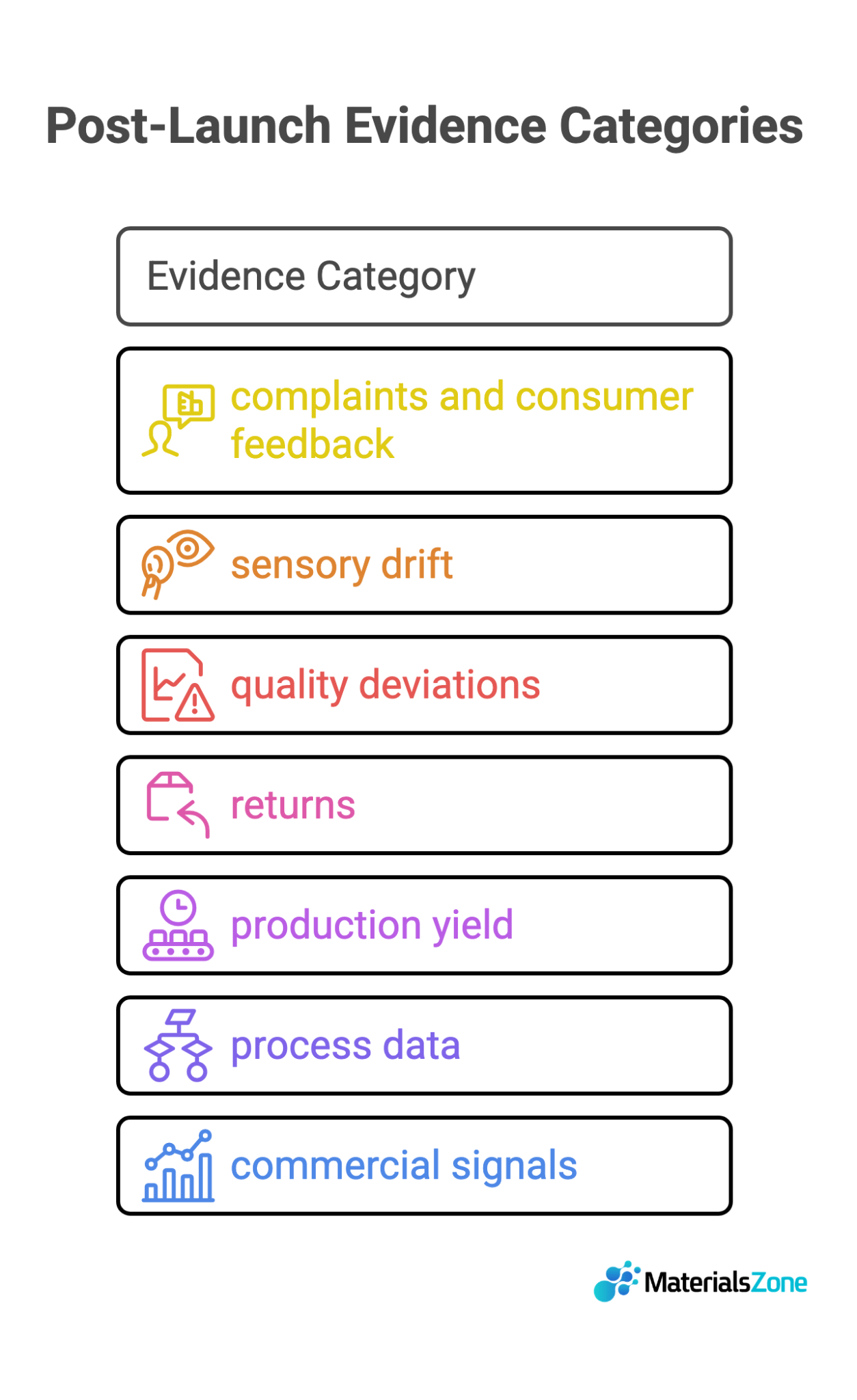
Once the product reaches market, new evidence becomes available. This may include customer feedback or process data.
At this point, your team should distinguish consumer-preference issues from quality deviations, food safety concerns, and process-performance problems because each requires a different investigation and response.
Post-launch evidence also closes the R&D loop. Verified learning from production and the market should feed into the product record, future reformulations, and related development projects rather than remaining in disconnected spreadsheets, reports, or individual memory. A connected R&D environment can make that accumulated knowledge easier to reuse.
Build a Repeatable Food Development Learning Loop
A reliable food product development process defines the evidence teams need at each stage and gives them a structured way to revisit decisions as new results emerge. Formulation affects sensory performance and ingredients influence safety and processing. Plus, packaging interacts with shelf life, and scale-up can introduce effects that were not visible at bench scale.
MaterialsZone helps R&D teams preserve and reuse formulation, process, experimental, and testing evidence so that findings from one development cycle can inform the next. The Materials Knowledge Center brings scattered R&D data into a connected environment, while the Collaboration Hub helps your teams work from the same information across functions. The Visual Analyzer supports multi-dimensional analysis across experiments, and the Predictive Co-Pilot helps scientists model outcomes and identify promising directions for further testing.
By connecting historical knowledge with current experimental data, MaterialsZone gives your food R&D teams a stronger basis for comparing formulations, understanding variable interactions, and reducing avoidable trial-and-error as products move from bench development toward commercialization.
Explore MaterialsZone’s AI-Guided R&D solutions to see how connected experimental data, multi-dimensional analysis, and AI-guided modeling can help food R&D teams make faster, evidence-based development decisions.