Explore our latest events and insightful content to stay ahead in the world of materials science.
The importance of chemical safety has never been more pressing. Industries that rely on advanced materials face a unique set of challenges, balancing operational efficiency with the ever-growing landscape of regulatory requirements. With environmental and health risks coming under greater scrutiny, ensuring transparency in chemical handling practices has become essential.
Innovation is the lifeblood of a company's success in R&D-intensive industries. Chemicals, pharmaceuticals, and advanced materials rely heavily on developing new, high-performing materials and formulations. Materials Informatics (MI) is transforming R&D, enabling organizations to speed up discovery and optimize development processes.
Understanding the mechanical properties of solids is more critical than ever in today's rapidly evolving technological landscape. Whether you're developing new pharmaceuticals, formulating innovative food products, or engineering cutting-edge materials, these properties hold the key to unlocking superior performance and pushing the boundaries of what's possible.
A laboratory information management systems (LIMS) have been an essential data management platform for carrying out research and development across a wide range of industries for a very long time. However, more advanced solutions can provide the core features of a LIMS system while also introducing the benefits of AI and ML to accelerate research and development. The Materials Informatics Platform does just that, providing features far beyond what the best LIMS software has to offer.
Additive Manufacturing (AM) companies are frequently challenged to satisfy new materials/product requirements. Time-to-market velocity dictates their growth potential in an ever-competitive market.
Materials science is a broad and diverse field that seeks to understand and manipulate the properties of materials to create new products and technologies. With the advent of modern computational methods and big data analytics, a new subfield of materials science has emerged: materials informatics.
Are you towards finalizing R&D plans and activities for 2023?🤔 As a R&D Manager, it's important to constantly reevaluate and optimize your R&D strategy to ensure your company is staying ahead of the curve and maximizing its potential for innovation.
The predictive accuracy and efficiency of materials informatics is governed by the amount of relevant data available. Relevance means that the selected variables and data ranges collected therein are in fact significant predictors of the desired outcome.
In the fast-paced world of materials development, managing and analyzing vast amounts of data is crucial for successful research and innovation. This article explores the pivotal role of lab data management software in streamlining materials development processes. By leveraging advanced technologies and intelligent data handling, lab data management software revolutionizes the way materials data is collected, organized, and utilized.
Maven is a new agentic AI capability that searches, visualizes, and analyzes internal and external data through a user-friendly interface, accelerating the way organizations act on knowledge at scale.
Discover how AI-Guided R&D accelerates food innovation.
Let's discuss how we can help you accelerate your packaging R&D.
Explore how AI is accelerating discovery in specialty chemicals – join us at Chemspec Europe
Discover how AI-Guided R&D is reshaping coatings innovation – meet us at ACS 2026.
Join us for a hands-on discussion on using AI in real cosmetics R&D processes.
Join us for a practical discussion on embedding AI into real plastics R&D workflows.
Watch the webinar on-demand.
Join Jeff and Omri to discover how AI-powered materials informatics tools are transforming Advanced Materials R&D by reducing experimental cycles and accelerating formulation discovery.
See how AI-Guided R&D is transforming plastics and advanced materials – meet us at K 2025.
We are delighted to be exhibiting at the Advanced Materials Show in Columbus, Ohio (USA) on September 30 - October 1. Visit us at Booth 428!
Discover how AI-powered materials informatics tools are transforming Advanced Materials R&D by reducing experimental cycles and accelerating formulation discovery. Learn how smart data and smarter tools are reshaping materials innovation.
The webinar is now available on demand.
The gathering of the coatings and paint industry from 25 – 27 March 2025
The annual conference for coatings formulators and manufacturers to discuss innovations in coatings technology
Materials Zone, a scientific AI/ML-based collaborative platform, harnesses data, technological tools, and years' worth of extensive know-how and experience to accelerate R&D and manufacturing processes and reduce costs across industries. Learn more about how the platform can help you achieve meaningful AI/ML insights and drive better decision-making.
Digitizing and automating the lab space
How to achieve meaningful AI/ML insights to accelerate R&D and manufacturing processes. A presentation by Assaf Anderson from Materials Zone.
This symposium invites contributions on new challenges to enhance the performance of perovskite-based photovoltaic cells, light-emitting devices, and related optoelectronic devices for energy harvesting & production and optical information processing. It will further consider theoretical modelling of new materials or analytic approach to material and device degradation. Perovskite-like materials inspired from halide perovskite crystals will also be discussed in the scope of the symposium.
Digital solutions for additive manufacturing
From Materials Data to AI Accelerated Results, Fast! Materials Informatics Platform (MIP) is an organizational platform that accelerates materials/products innovation.
From Materials Data to AI Accelerated Results Faster! AI/ML Acceleration for the Plastics Industry.
Designing the Nanomaterials of the Future - Opportunities from Artificial Intelligence. We are proud to host keynote speakers such as Prof. Edward Sargent, Prof. Marjolein Djistra, Dr. Emory Chan, and Prof. Liberato Manna. Don’t miss out! Register in the link below for free participation-
DIGITAL. AUTOMATED. CONNECTED.
Modern semiconductor and display development is constrained by complex materials challenges and lengthy experimental cycles. R&D teams face intense pressure to optimize processes and materials faster, et traditional trial-and-error approaches struggle to keep pace. Materials informatics – the application of AI/ML to materials data – offers a breakthrough. It leverages vast materials and process data to predict outcomes and guide experiments, reducing development time.
As the push for sustainability grows, semiconductor and photovoltaic (PV) industries are under increasing pressure to incorporate recycled materials into their products. Embracing recycled feedstocks (like reclaimed silicon, metals, or plastics) can reduce waste and carbon footprint. However, doing so in high-performance electronics is non-trivial – recycled materials often exhibit variability and unknown impacts on product quality. This white paper examines how an AI-driven materials informatics approach can de-risk and optimize the integration of recycled resources.
The concept of Lean, originating from Toyota's manufacturing processes, has revolutionized industries worldwide by optimizing efficiency and minimizing waste. In this white paper, we explore the journey of Lean principles from their inception to their application in materials research and development (R&D).
Materials informatics plays a critical role in accelerating materials discovery, development, and optimization. In the age of digital transformation, ensuring the security of data and information is a top priority. Our company recognizes the importance of robust security measures to protect intellectual property, sensitive research data, and client information and hereby earns the trust of our customers by making data security our top priority.
This white paper advocates for the integration of AI with active learning in materials science and chemistry research. By addressing the limitations of traditional trial-and-error methods, AI offers a transformative approach that can greatly enhance the material product development process. It accelerates the materials discovery process, leading to faster and more cost-effective innovations across various industries. As technology progresses, the fusion of AI and materials science promises a more efficient and promising future for materials research.
AI materials discovery uses artificial intelligence, machine learning, and materials data to help R&D teams discover, design, predict, and optimize materials with desired properties. It can support innovation in property prediction, formulation optimization, inverse design, next-best-experiment recommendations, and AI-guided product development.
AI in materials science applies machine learning, data science, and automation to materials R&D so teams can predict outcomes, prioritize experiments, and improve decision-making across the R&D lifecycle.
Lab automation software solutions are specialized platforms designed to automate and streamline various laboratory processes. Automation plays a vital role in managing laboratory workflows, data collection, and analysis, and is crucial for staying competitive.
Material performance issues rarely start in production, but that is often where they are discovered. A packaging film that looked stable in early testing may warp during temperature cycling, or a capsule coating that passed initial quality checks may become brittle during low-temperature transit. These failures are expensive and disruptive, and they are often avoidable.
Today’s laboratories face growing challenges navigating the complexities of materials research. Even minor missteps during the R&D process can lead to compromised results, regulatory delays, or substantial financial and reputational risks. It’s more critical than ever for laboratories to ensure precision, reliability, and operational consistency. That’s where the Good Laboratory Practice (GLP) framework comes in.
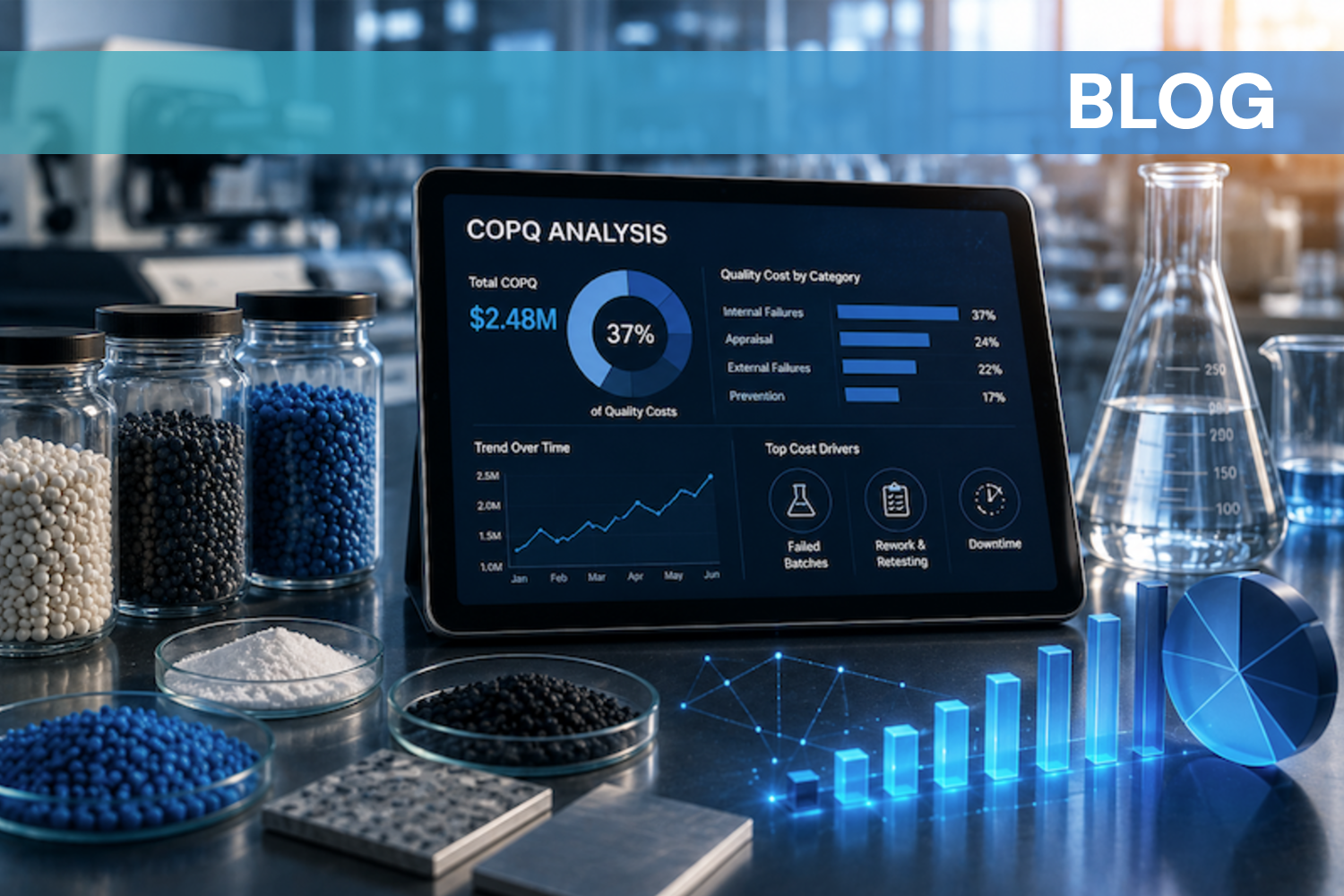
The Cost of Poor Quality (COPQ) is the total financial loss a company incurs when materials, processes, or end products fail to meet quality standards. The metric represents significant hidden costs for manufacturers in complex, data-heavy manufacturing and R&D industries such as chemicals, advanced materials, or FMCG products. AI-guided R&D platforms like MaterialsZone can effectively address the data and process issues that lead to excessive COPQ.
Beauty has a hidden cost. The products people use every day can raise difficult questions about what lies behind their performance and presentation, especially when green claims are used to reassure consumers. Conventional cosmetics can have an impact in many ways, from hard-to-recycle packaging to manufacturing choices that generate more waste and emissions.
For companies selling consumer products, making an environmental claim is common. Ensuring that those claims stand up against scrutiny, however, is not. Regulators across the European Union are clamping down on sustainability claims used in consumer marketing. A lack of transparency has weakened consumer trust and made it harder for responsible companies to differentiate genuine environmental improvements from the misleading claims known as greenwashing.
Your company is developing a commercial product that contains multiple chemicals and materials for sale in the European Union. One day, your procurement manager receives an email from a supplier explaining that a critical raw material is being discontinued. Everything seems manageable, as the replacement they offer “should be equivalent.” The R&D team swaps out the materials to keep the project moving. Two weeks later, QA flags an issue during pre-launch checks. The updated formulation now contains a restricted substance above a legal threshold, meaning your team cannot immediately demonstrate what is in the product.